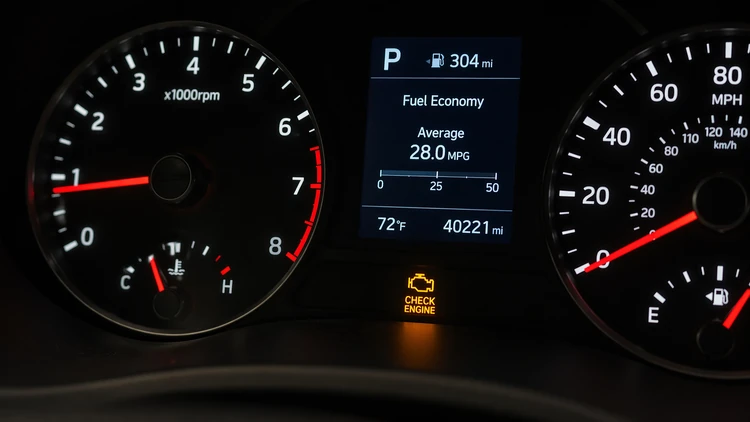

U.S. drivers are facing record-high check engine repair costs driven largely by aging vehicles.
The most common repair — replacing a catalytic converter — can cost more than $1,300.
Average vehicle age has reached a record 12.6 years, increasing the likelihood of expensive fixes.
When the check engine light comes on, do you ignore it or take your vehicle to a mechanic? The data suggest it’s mostly the former, not the latter.
Americans are paying more than ever to fix check engine light problems as the nation’s vehicle fleet continues to age, according to a new CarMD report.
The company’s latest Vehicle Health Index, based on more than 31 million diagnostic records, found that older cars are driving a rise in costly repairs, even as some overall average costs fluctuate.
America’s vehicle fleet is getting older
The average age of vehicles on U.S. roads has climbed to a record 12.6 years, a trend that is contributing to more frequent and expensive repairs. As cars get older, major components wear out, increasing the likelihood of high-ticket fixes tied to check engine warnings.
"Keeping up with routine maintenance and addressing dashboard warning lights early are two simple ways to help keep your vehicle running safely and efficiently as it ages," said David Rich, CarMD vice president of automotive technology. "Even small issues can reduce fuel economy, which is something drivers are paying close attention to as gas prices rise."
Among the most common — and costly — repairs is replacing a catalytic converter, which now averages about $1,348 including parts and labor. That repair typically affects older or poorly maintained vehicles and often stems from unresolved issues such as faulty spark plugs or oxygen sensors.
Other frequent repairs include replacing oxygen sensors (about $254), ignition coils and spark plugs (around $400), and mass air flow sensors (about $323). At the lower end, some issues — like a loose gas cap — can cost little or nothing to fix if addressed early.
Here’s a list of some average repair costs, according to CarMD:
Catalytic Converter: $1,511
Oxygen (O₂) Sensor: $287
Ignition Coil & Spark Plug(s): $480
Mass Air Flow (MAF) Sensor Replacement: $346
Ignition Coil: $256
EVAP Canister Purge Control Valve: $172
Fuel Injector(s): $572
ABS Wheel Speed Sensor: $314
Thermostat: $324
Spark Plug(s): $299
The average repair costs $415
Despite the rise in expensive individual repairs, overall average check engine-related repair costs declined slightly in the most recent data, falling about 3% to roughly $415. The drop was largely driven by a 5% decrease in parts' prices, though labor costs increased by about 1.4% due to more complex and time-consuming repairs.
CarMD analysts say the growing complexity of modern vehicles is also contributing to higher labor costs, as technicians require more time and expertise to diagnose and fix problems.
The report warns that costs could climb again if tariffs or supply chain pressures push parts' prices higher.
Automotive experts emphasize that ignoring a check engine light can lead to more severe — and more expensive — problems. Addressing issues early, they say, remains the best way for drivers to avoid escalating repair bills as vehicles continue to age.