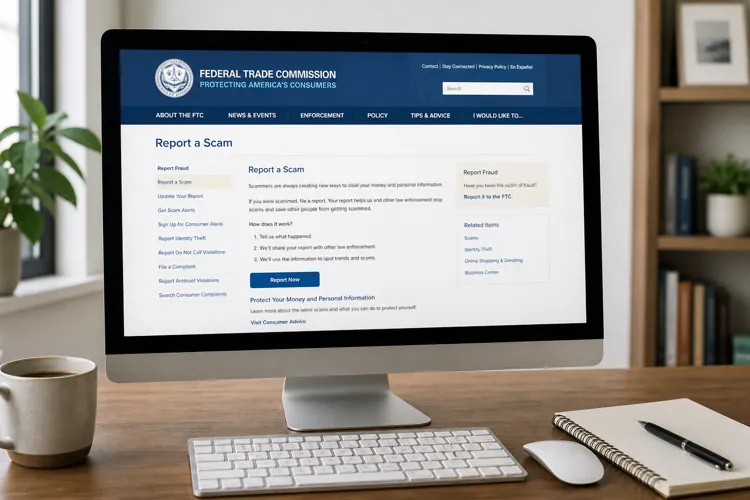

The FTC is urging consumers who encounter scams to report them rather than simply deleting the message, hanging up the phone, or moving on.
Fraud reports are added to the Consumer Sentinel Network, a national database available to federal, state, and local law enforcement agencies.
The FTC also uses consumer reports to identify new scams and warn the public about them through its Consumer Alerts.
Spotting a scam before losing money may feel like the end of the story. The Federal Trade Commission (FTC) says it shouldn't be and is asking consumers for help.
In a new consumer alert, the agency is encouraging Americans who encounter fraud to tell someone about it and report it to the government. The reason is simple: information from consumers can help authorities identify emerging fraud schemes and potentially prevent other people from becoming victims.
"Many people experience fraud but never report it," the FTC said in its Aug. 28 alert, adding that scammers benefit when people remain silent.
The agency says even consumers who recognize a scam before losing money can provide useful information.
What happens when you report a scam?
When a consumer files a fraud report with the FTC, the information goes into the Consumer Sentinel Network, a secure national database that can be accessed by federal, state, and local law enforcement agencies.
FTC investigators, attorneys, and analysts examine those reports for patterns. A large number of complaints involving similar phone calls, text messages, emails, websites, or payment methods can help investigators see that what appears to be an isolated incident is actually part of a larger operation.
Those reports can also contribute to investigations and enforcement cases. But enforcement isn't the only purpose.
The FTC says its staff studies consumer reports to identify new scams that deserve public attention. Those schemes can then become the subject of FTC Consumer Alerts explaining how the scam works and how people can avoid it.
That makes consumer reporting something of an early-warning system.
Tell someone else
The FTC is also encouraging consumers to do something that doesn't involve the government at all: tell another person about the scam.
Sharing what happened with a friend, relative, or coworker can make that person more likely to recognize the same scheme when it reaches them.
That's increasingly important because scammers frequently use the same basic tactics against thousands of potential victims. A fraudulent text claiming to be from a toll agency, for example, may be sent to huge numbers of phones. An imposter claiming to represent a bank, government agency, or utility company can make the same pitch repeatedly.
Knowing beforehand what the scam looks like can make it much easier to recognize.
The FTC's advice is straightforward: tell at least one person what the scam looked like so that person will be prepared if targeted.
Where to report fraud
Consumers can report suspected fraud through ReportFraud.ftc.gov. The FTC also offers a subscription service for its Consumer Alerts, which provide warnings about emerging scams and fraud trends.
Consumers who have actually paid a scammer may need to take additional action immediately. Depending on how the money was sent, that could include contacting a bank, credit card issuer, payment app, or other financial institution and asking whether the transaction can be reversed.
Consumers who gave away sensitive personal information may also need to take steps to protect their accounts and identity.
But the FTC's latest message goes beyond what consumers should do after losing money. The agency wants people who successfully spot scams to report those encounters as well.
The message is that avoiding a scam protects one consumer. Reporting it — and telling someone else about it — may protect many more.