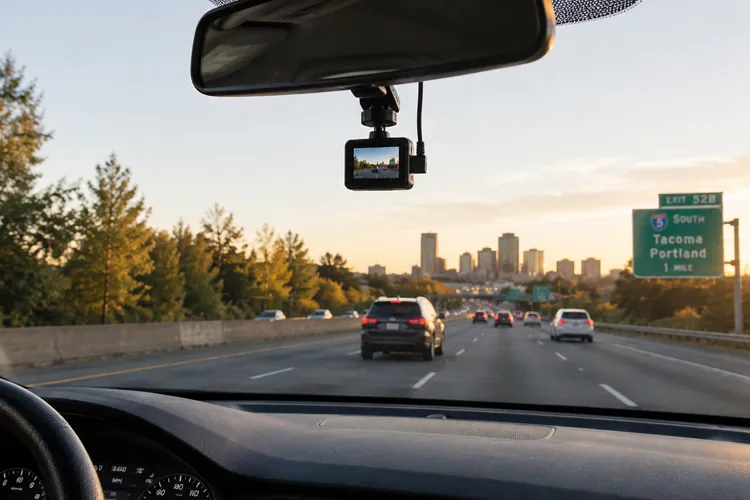

Dash cams can save you money: Video evidence can help prove fault after an accident and reduce costly insurance disputes.
Great for families: Parents use them to monitor teen drivers, while students benefit from protection against hit-and-runs and parking lot damage.
Choose features wisely: Look for front and rear cameras, night vision, GPS, and parking mode, while skipping unnecessary subscriptions.
A decade ago, dash cams were mostly associated with police cruisers, commercial trucks, and viral internet videos.
Today, they're becoming one of the most popular car accessories in America.
From documenting accidents and hit-and-runs, to helping parents keep tabs on teen drivers, dash cams offer a level of protection that many drivers find hard to ignore. But they aren't perfect. They cost money, require some maintenance, and can sometimes capture footage you'd rather not share with an insurance company.
So, are dash cams worth it? For most drivers, the answer is yes. But understanding both the benefits and drawbacks can help you decide whether one belongs in your vehicle.
The biggest advantage: Video evidence
The primary reason most drivers buy a dash cam is to have video evidence if you get in an accident.
After an accident, it’s not uncommon to be in a situation where both drivers tell a very different story. Enter the dash cam which can provide you with objective footage showing exactly what happened.
This can be especially valuable in:
Rear-end collisions
Hit-and-runs
Parking lot accidents
Road rage incidents
Insurance disputes
Fraudulent accident claims
Dash cam footage is increasingly accepted by insurance companies and can definitely help speed up claims investigations. In some cases, footage can help prove you weren't at fault, potentially saving thousands of dollars in repairs, deductibles, and future premium increases.
Can a dash cam lower your insurance?
Most major U.S. insurers do not currently offer a direct discount simply because you have a dash cam installed. Companies such as State Farm, Allstate, Progressive, and GEICO generally don't provide a specific dash-cam discount.
However, that doesn't mean a dash cam can't save you money. If footage proves another driver was at fault, you’ll most likely avoid being assigned fault and lengthy claim disputes that tend to drag on forever.
But the biggest thing you’ll avoid is any possible premium increases due to an accident being your fault when it wasn’t. Think of a dash cam not necessarily as a discount device, but more of an insurance policy for your insurance policy.
Why parents love dash cams for teen drivers
Dash cams can be particularly valuable for families with new drivers or young drivers moving away to college.
Many parents use them to:
Review accidents
Encourage safer driving habits
Monitor distracted driving
Verify what happened during an incident
A front-facing camera is sometimes enough for families, but many parents opt for a dual or triple-camera system that records both the road, the road behind the car, and the vehicle’s interior.
For college students driving long distances or parking on campus, a dash cam can also provide evidence in the event of a hit-and-run or vandalism.
Pro tip: Strongly consider a dash cam that has a rear camera as part of the package. When my daughter was rear-ended shortly after going away to college, it was great to have the rear cam footage to easily prove fault. A front and rear camera setup provides far better protection than just a front-facing camera alone.
The downsides of owning a dash cam
Dash cams aren't all upside; here are some potential downsides worth considering.
They cost money: A quality dash cam typically costs between $80 and $300, with premium systems costing even more.
They require maintenance: Memory cards eventually wear out and need replacement, especially in hot and cold climates. Cameras also need the occasional check-up to ensure they're still recording properly.
The footage can work against you: If you're clearly at fault in an accident, the footage may support the other driver's version of events.
Parking mode can drain batteries: Some cameras continue to record while parked to protect against vandalism. If improperly installed, this can potentially drain your vehicle's battery.
Pro tip: If you're installing a dash cam yourself, be careful when hard-wiring it to your vehicle's fuse box to enable "always-on" parking mode. An improper installation can drain your battery and leave you with a car that won't start. I learned this lesson the hard way. Unless you're comfortable working with automotive electrical systems, I found that professional installation is often worth the extra cost.
The features worth paying for
Not every feature is necessary given your situation. Here’s a handy guide to help you figure out what what’s worth the money and what's just hype.
Look for:
2K or 4K video resolution
Night vision capability
GPS location tracking
Loop recording
Impact detection (G-sensor)
Parking mode
Front and rear camera coverage
Skip these:
Excessive app subscriptions
Features you know you’ll never use
Overly complicated cloud-storage plans
Pro tip: Test your footage every month. Take the 30 seconds required to review recent recordings and verify that the camera is still functioning properly, especially during the hot summer months.
The best choices in terms of value and features
Based on recent expert testing and reviews from CNET, these models consistently rank among the best choices for most drivers:
Vantrue E1 Pro (Best overall): For around $120, this compact camera delivers impressive 4K video quality, strong nighttime performance, GPS, and excellent license-plate capture at a price that's hard to beat.
Garmin Dash Cam Mini 3 (Best compact camera): For around $100, this tiny dash cam virtually disappears behind your rearview mirror while still capturing reliable 1080p footage and offering easy smartphone connectivity.
70mai M310 (Best budget cam): For less than $40, you get 1296p QHD resolution, decent night vision, and a small and unobtrusive camera shell with no screen on it.
VIOFO A329S (Best premium cam): For around $400, you get outstanding 4K front video, a high-quality rear camera, excellent night vision, GPS tracking, parking mode, and enough storage support to record long road trips without constantly overwriting footage.
Pro tip: Buy the largest memory card the camera supports. Many drivers discover their footage has already been overwritten when they need it most. More storage means more recorded driving history and microSD cards are very inexpensive these days.