

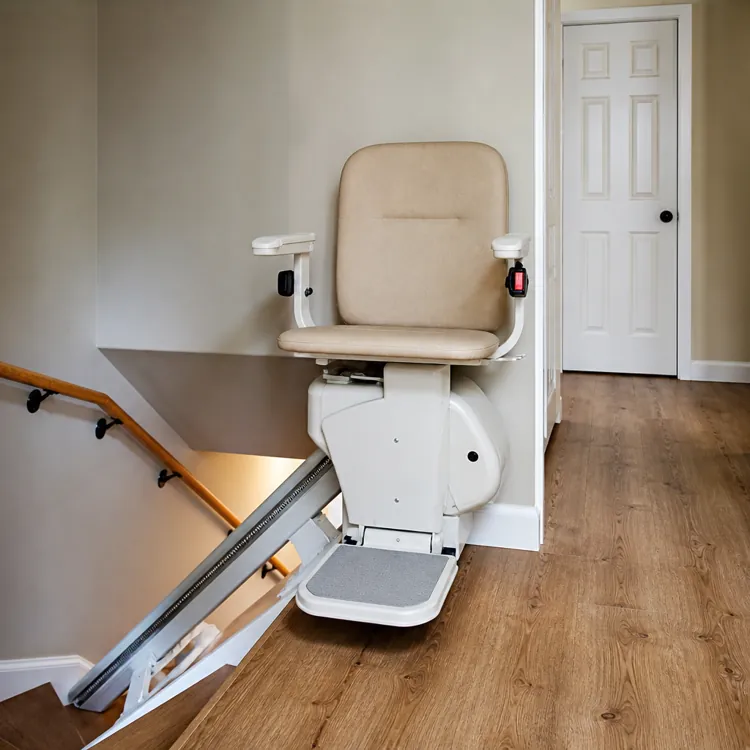
Compare standing stair lift companies
| Company | Customer rating | Weight capacity | Warranty length | Availability | |
|---|---|---|---|---|---|
 Acorn Stairlifts | Learn More | 4.8 | 350 pounds | 12 months | Most U.S. states |
 Stannah Stairlifts | Get a Quote | 4.8 | 352 pounds | Lifetime motor gearbox coverage; 1-year parts and labor | Over 42 states across the U.S. |
- Weight capacity
- 350 pounds
- Warranty length
- 12 months
- Financing offered?
- No
- Free consultation
- Yes

- Weight capacity
- 352 pounds
- Warranty length
- Lifetime motor gearbox coverage; 1-year parts and labor
- Financing offered?
- Yes
- Free consultation
- Yes
Standing stair lifts buyers guide
When choosing a standing stair lift, prioritize comfort, ease of use, safety features and its fit with your staircase. You also want a lift that fits your budget and complements your home design.
Key insights
Stair lifts can cost from $2,500 to $10,000, depending on custom features and staircase configuration.
Jump to insightSafety features and fit within your home are the most important factors to consider.
Jump to insightStanding lifts are a space-efficient option for those with good balance and standing ability.
Jump to insightStanding stair lift cost
A standing stair lift can cost anywhere from $2,500 to $10,000, depending on factors like your model, its features, the installation company you choose, and your home and staircase configuration. This estimate includes the initial consultation, measurements and installation.
Factors affecting cost:
- Curved vs. straight stairs: Curved staircases require more customization, materials and a longer setup, increasing the cost compared to straight stairs.
- Model and features: Lift models with advanced features—like swiveling seats, high weight capacity or smart seatbelts—tend to cost more, compared to more basic models.
- Customization: The more customization your stair lift requires, the more it will cost. Features like a folding rail, swiveling seat and folding powered footrest will lead to a costlier stair lift but can be worth it.
- Installer location: Generally, it’s cheaper to buy a stair lift from a local installer, rather than ordering online and looking for someone local to help with installation. Local stair lift vendors have experienced, certified staff and usually include the installation in their estimated costs.
- Upkeep and warranty: Some providers offer short warranties that only cover a year or so, while others—like Stannah—include a lifetime warranty on parts, which could end up saving you thousands of dollars in the long run.
- Used vs. new: Some providers give the option to install a used stair lift, rather than new, which can decrease the cost by up to half. However, your choices of models and features may be more limited, with poorer warranty options.
- Renting: If you only plan to use a stair lift for a short time, renting may be an option. However, the monthly cost of renting a stair lift often exceeds the monthly cost of financing plans to buy a stair lift.
Unfortunately, Medicare and private insurance plans generally do not cover stair lifts, although some Medicare Advantage Part C plans may offer partial coverage. This means that in most cases, you’ll likely be paying out of pocket for your stair lift.
What to look for in a standing stair lift
Look for a standing stair lift with safety and convenience features that will make it easy to integrate your lift into your daily life. It’s also critical to ensure that your stair lift fits your stairway setup and hallway configuration.
Features and specifications
Make sure your stair lift’s specifications fit your height and weight, with safety features that allow you to use your lift with peace of mind.
Prioritize the following features in a standing stair lift:
- Seat height and angle: With a standing chair lift, the seat angle becomes especially important, because it needs to provide sufficient weight support while also allowing you to easily enter and exit the unit. Many standing lifts allow you to adjust the angle and height as needed, so you have a perfect fit.
- Weight capacity: It’s critical that your stair lift can easily support your body weight. Most stair lifts can support between 300 and 350 pounds, though some models support up to 400.
- Safety features: The most important safety features for standing lifts are seatbelts, especially those that delay operation until you’re secure. Handles and footrests are critical as well, ensuring you properly enter and exit the lift, and remain secure while riding. Obstruction sensors detect if an object is in the way, halting your ride when it might be dangerous.
- Convenience features: Certain features enhance ease of use. For example, look for a user-friendly hand control that doesn’t strain your wrist, lights to help you get on and off your lift in the dark and footrests that fold up automatically without requiring you to bend over.
Stair and home configuration
When you install a stair lift in your home, make sure it fits your stairs and home design, leaving enough room for others to still use the stairs normally, and leaving enough space in hallways and doorways when the lift is parked.
Standing stair lifts can often fit staircases as narrow as 25 to 28 inches, making a more space-efficient option than regular seated stair lifts. However, if your home has a curved staircase, you’ll likely need to customize the rail track to your home. It’s also important to make sure that your hallways and doorways leave ample runoff room when you park your lift.
Most installers provide upfront cost estimates that include not only installation but consulting and measuring to make sure the job is a good fit for your home.
When to choose seated vs. standing stair lifts
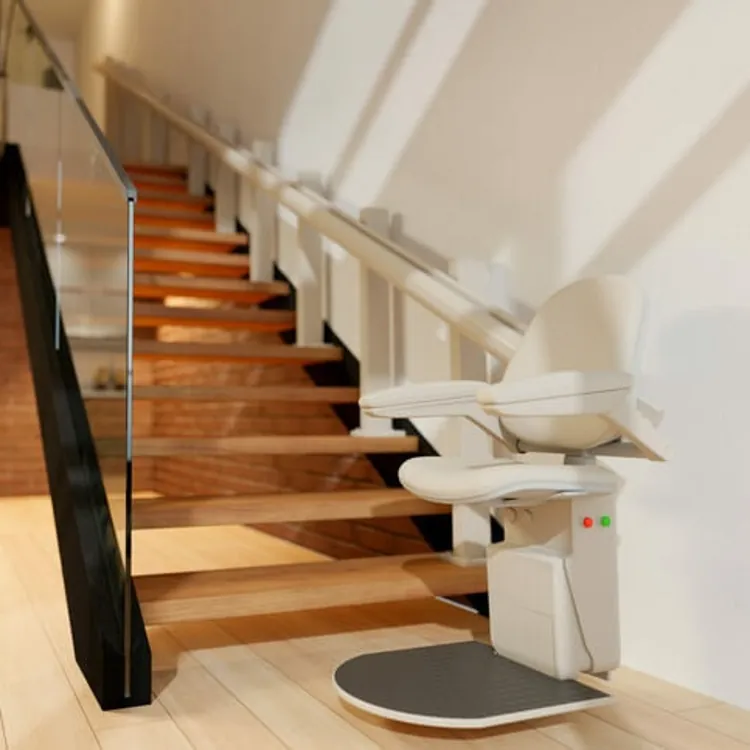
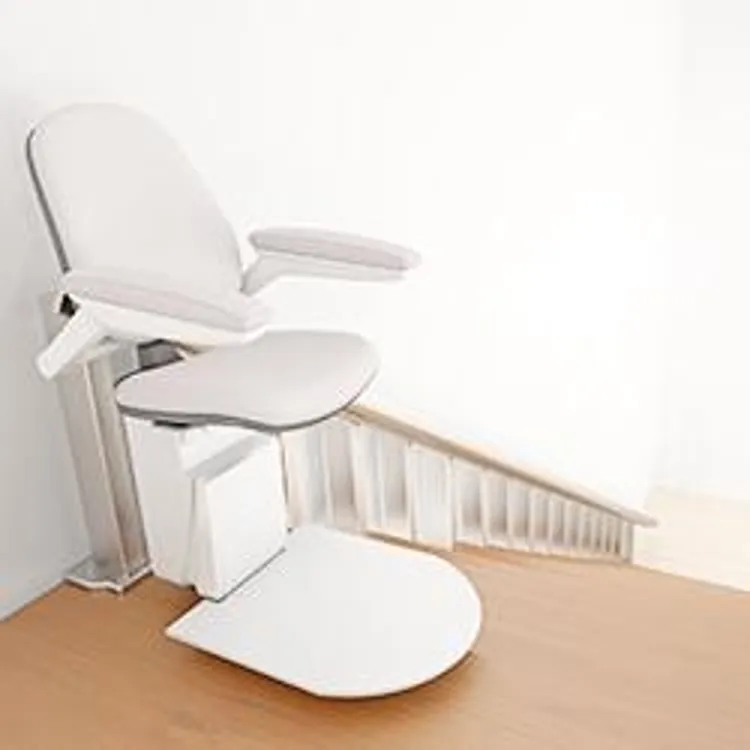
Compared with the more common seated stair lifts, standing stair lifts place the seat higher and angled so that you lean against the seat in a more semi-seated position. This saves you from having to bend your knees as deeply, making it a good option for those with poor joint mobility.
Also called “perch” stair lifts, standing stair lifts can be easier to enter and exit, because you don’t have to go from sitting to standing. Standing lifts also sit closer to the wall, requiring less stair space. However, standing stair lifts have some risks: if the user has poor balance or weak legs, a seated stair lift provides more stability and support, preventing falls.
“One point I always encourage families to consider is whether a standing stair lift is actually the right fit for the person using it. Because the user remains standing throughout the ride, they need sufficient balance, leg strength and stability. For some older adults, a seated stair lift may ultimately be the safer choice,” said Daniel Preston, founder of LiveInCare USA, a marketplace that connects families with independent caregivers and home care agencies across the United States.
Pros and cons of standing stair lifts
Standing stair lifts are more space-efficient than seated lifts, and they also tend to be easier to enter and exit. However, they require more vertical space and may pose a higher risk of falling for users with poor balance.
Here’s a closer look at the pros and cons of standing stair lifts:
Pros
- Requires less knee bending than seated
- Easy to enter and exit
- Space efficient
- Quick setup
- Improved access to your house
Cons
- Can be costly
- Not covered by most Medicare plans
- May pose a risk for users with poor balance
- Less comfortable than seated stair lifts
- Makes it harder to carry items up and down the stairs
FAQ
Is there a stair lift that you can stand on?
Yes, standing stair lifts, also called perch stair lifts, have a higher seat with an angle that allows you to lean against it in a semi-seated and semi-standing position.
How much does a standing stair lift cost?
A standing stair lift typically costs between $2,500 and $10,000, with the potential to land even closer to $20,000 for feature-rich models and staircases that require a lot of customization. This price includes consultation and installation. Note that curved staircases generally cost more than straight staircases.
Are standing stair lifts covered by Medicare for seniors?
No, standing stair lifts are not typically covered by Medicare for seniors. However, some Medicare Advantage Part C plans or private plans might offer partial coverage.
Are standing stair lifts able to be installed on any staircase?
Stair lifts can be installed on most staircases, but not all. A staircase needs to be at least 24 to 30 inches wide, with sufficient room at the top and bottom of the staircase to support the chair’s runoff area. The stairs also need to be strong enough. Most installers will measure your home before the project begins to ensure it’s safe for a stair lift.
What is the typical weight capacity for a standing stair lift?
Most standing stair lifts have a weight capacity between 300 and 400 pounds.
Article sources
ConsumerAffairs writers primarily rely on government data, industry experts and original research from other reputable publications to inform their work. Specific sources for this guide include:
- Acorn Stairlifts Inc., "The Acorn Sit/Stand Stairlift." Accessed July 22, 2026.
- Lifeway Mobility, "How Much Does a Stair Lift Cost in 2026?" Accessed July 22, 2026.
- National Council on Aging, "Medicare and Stair Lifts: A Coverage Guide for Older Adults." Accessed July 22, 2026.
- Options HME, "Stair Lift Price Guide." Accessed July 22, 2026.
- Stair Lift Experts, "Standing Stairlifts." Accessed July 22, 2026.
- Stairlift Costs, "Standing / Perch Stairlifts vs Traditional Seated Stairlifts: What’s the Difference?" Accessed July 22, 2026.
- Stannah, "Sadler Chair." Accessed July 22, 2026.
- Stannah, "Stairlift Weight Limits: Capacity, Safety, and Heavy-Duty Options Explained." Accessed July 22, 2026.