

How door sensors work
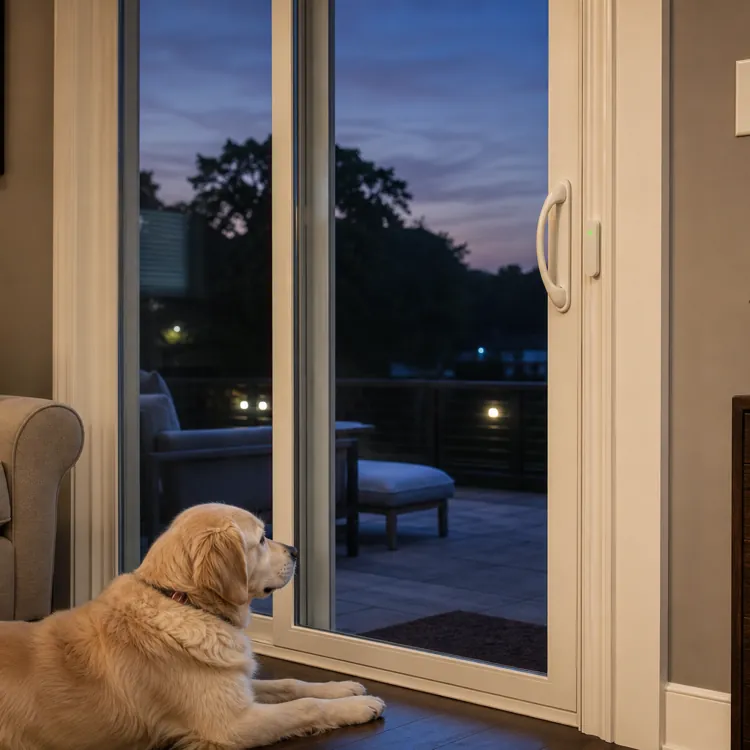
Door sensors consist of two primary components — a magnet and a reed switch — that trigger an alarm when separated. When the door is shut, a precisely aligned magnet causes two reeds housed within a tiny glass tube (the reed switch) to make contact, completing the circuit. When someone opens the door, the magnet moves away from the reed switch, causing the reeds to disconnect and triggering the alarm.
Door sensors can initiate one or more actions when triggered:
- An audible alarm to notify those in the immediate area
- An alert to your smartphone via text or push notification
- An alert to your home monitoring service provider
Most door sensors are either standalone (wireless) or integrated into your home’s existing electrical and security systems (wired). Wireless door sensors require batteries, and installing one or two is an easy DIY project. If you plan on hard-wiring several door sensors, professional installation can help ensure a strong, reliable connection, albeit at a higher cost.
When connected to a Wi-Fi network, both wired and wireless door sensors can send alerts. Advanced door sensors can also connect to security cameras and start recording when triggered.
Door contact sensors and circuits
Door sensors detect door position (i.e., open or closed) based on the precise gap between the magnet and the reed switch. Accurate positioning of both components also ensures a closed circuit when the door remains shut and an open circuit when the door opens.
The magnet and the reed switch are typically located near the center and leading edges of the door sensor’s halves. For example, the small magnet that creates a tiny magnetic field may be located on the left edge of the larger half, and the reed switch on the right edge of the smaller half. Proximity and alignment are critical to proper function.
Most manufacturers specify a minimum or maximum distance between the two sides of the door switch to prevent malfunctions and false alarms. Acceptable gaps can range from the width of a credit card to a few inches.
Changes in the door sensor’s magnetic field intensity can also cause an open circuit and trigger an alarm. For example, prying the sensor away from the door or frame would cause more or less magnetic force. If an intruder tried to disarm or remove the door sensor, their attempts would only get them noticed — and potentially caught — sooner.
Types of door sensors
Contact sensors represent the most common door sensor type available. You can choose from several variants of contact door sensors based on application, location, advantages and disadvantages.
| Sensor type | How it detects | Best locations | Pros | Cons |
|---|---|---|---|---|
| Surface mount | Door opens and breaks a magnetic circuit | Standard interior and exterior doors | Low cost, no hard-wiring required, easy installation and replacement | Extremely visible, easy to tamper with, prone to adhesive failure over time |
| Recessed | Door opens and breaks a magnetic circuit | Aesthetic installations | Hidden, cleaner look, harder for intruders to tamper with | Harder to service and replace, requires permanent modification and precise alignment |
| Rollerball | Door moves off a spring-loaded contact | Door frames | Less visible, ideal for high-traffic areas, less affected by door warping | Less common, improper alignment can cause the sensor to jam or fail |
| Garage tilt | Door angle changes from closed to open | Overhead garage doors | Application-specific design with simple installation, even on older doors | Tends to be less precise, fewer options available |
| Outdoor weatherproof | Door opens and breaks a magnetic circuit | Harsh environments | Highly durable, mounts securely, sealed for fewer false alarms | Bulky, expensive, may require more frequent maintenance |
| Pull-apart | Door opens and physically separates the two connected parts | High-security applications | Strong physical trigger that’s hard to bypass | Doesn’t auto-reset easily, inconvenient and clunky operation limits everyday use |
Most contact door sensors are surface-mount, meaning they attach to the surface of a door and the corresponding door frame. One drawback of this design is that they’re easily visible to potential burglars and detract from a home’s aesthetic. For these reasons, many homeowners choose recessed door sensors to achieve the same level of security with less visibility.
Door sensor installation and troubleshooting
While door sensors offer a cost-effective way to enhance your home’s security, they must be installed properly to function correctly. Here are the basic steps involved in installing a common surface-mounted door sensor:
- Choose the best location: Place the sensor on the latch side of the door (the side with the handle and lock), ideally in the top corner above the handle. Find a corresponding flat spot on the nearest door frame (typically on the right or left side, depending on the door's orientation).
- Clean the surface: Scrub the door and frame free of dirt, then wipe it with rubbing alcohol and allow it to dry fully.
- Mock up the door sensor’s position: Hold up the door sensor’s two halves to determine the best position. The magnet half of the sensor typically mounts on the door, while the sensor sits on the frame directly in line with the other half.
- Measure the gap: With the door sensor held in place, determine the gap between them and verify that it’s within the recommended range. Make small pencil marks so you can place both parts in your desired spot when ready.
- Attach the door sensor: Use the provided adhesive strips or screws to secure it to the door and frame. Ensure a tight fit, especially when using adhesive.
- Test and adjust as needed: Open and close the door to test the sensor’s response. If you experience triggering delays or inconsistencies, you may need to reposition, realign and retest the sensor until it triggers reliably.
When deciding where in your home to install door sensors, start with the primary entrances, such as the front and back doors, as well as the garage and basement doors. If you opt for a comprehensive home security system that includes door sensor installation, a company representative can assess your home’s layout and recommend optimal placement.
Common door sensor issues and fixes
Most door sensor problems stem from improper alignment, lack of power or signal issues. Effective troubleshooting requires identifying the cause before determining the best solution:
- Misalignment: When the sensor and magnet aren’t properly aligned, realign them so they sit parallel and at the correct distance apart.
- Low or dead battery: If the sensor loses power or doesn’t function reliably, replace the battery to restore normal operation.
- Weak or shifting magnet: Replacing or re-securing the magnet should fix this issue.
- Adhesive failure: Consider replacing the failed adhesive with a new strip or using screws for a more permanent solution.
- Radio frequency signal issues: Common with wireless sensors, these can be resolved by reducing distance or interference to restore the signal.
- Physical damage: If internal components or the sensor’s external housing are damaged, replace the sensor entirely.
- Door/frame warping: A shifting door frame can cause misalignment, which is easily fixed by repositioning the sensor.
- False alarms from vibration: Reduce false alerts by securing the sensor to a more stable surface unaffected by external movement.
- Debris blocking contact: Clean the sensor routinely to prevent dirt from interfering with the connection or contact points.
If your door sensor came with a DIY security system (such as Ring or Frontpoint), contact customer support directly to report the issue or request a replacement. For professionally-installed systems through providers such as Brinks or Vivint, request a service appointment for further assistance.
FAQ
What triggers door sensors?
Door sensors are triggered when a door opens, breaking the alignment between the reed switch and the magnet. Misalignment between these two components due to poor installation can also trigger the door sensor, causing a false alarm.
Do door sensors work without Wi-Fi?
Door sensors can work without Wi-Fi, but they’re only capable of alerting with a local alarm. Door and window sensors must be connected to a Wi-Fi network to enable smartphone notifications and remote monitoring.
What is the difference between a door sensor and a window sensor?
In most cases, there’s little to no difference between a door sensor and a window sensor. You can use them interchangeably, though you may need slimmer or low-profile sensors for some windows.
How long do door sensor batteries last?
Door sensor batteries tend to last between one and five years, depending on use. Check your home’s door sensor batteries every six months to a year to ensure they’re functioning properly.
Can door sensors be installed on any type of door?
Door sensors can be installed on almost any type of door. Some doors, such as pocket doors, metal doors or doors with large gaps, may require specialized sensors or alternative placement to function properly.
Article sources
ConsumerAffairs writers primarily rely on government data, industry experts and original research from other reputable publications to inform their work. Specific sources for this article include:
- Vivint, "Door Sensors: How They Work and Why You Need Them for Home Security." Accessed May 5, 2026.
- Kisi Inc., "Door Contact Sensors in Access Control." Accessed May 5, 2026.