

Key insights
An in-line heater maintains the water temperature in your bathtub for 30 minutes to an hour.
Jump to insightIn-line heaters only work when whirlpool jets are activated.
Jump to insightThese heaters can offset the capacity limits of smaller water heaters since you won’t have to refill your tub to bring the temperature back up.
Jump to insightWhat are in-line heaters?
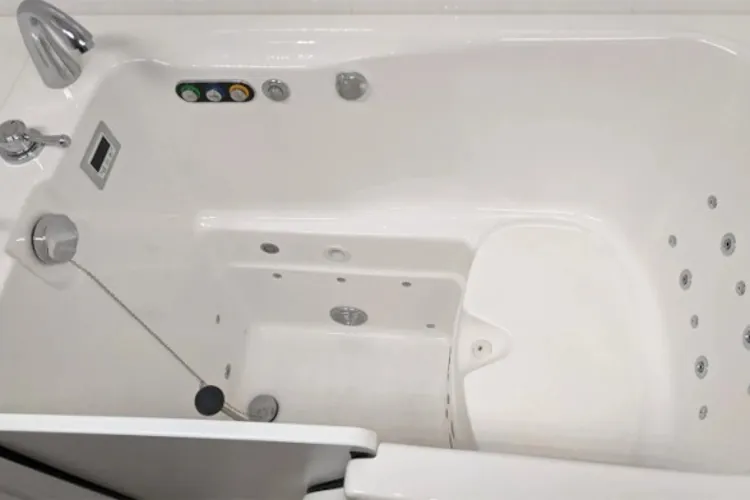
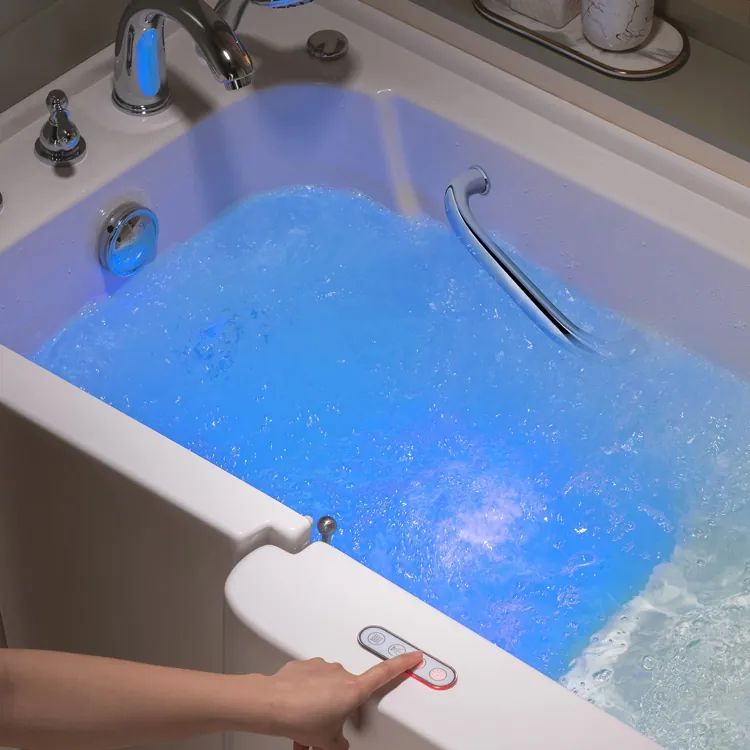
An in-line heater is an electric pump attached under your tub that automatically switches on when the whirlpool jets are activated. It suctions water from the bottom of the tub, pulls it through the pump’s heating element and then returns the water on a continuous cycle as long as the jets are on. These heaters are not designed to heat up cold water, but they will maintain the temperature of hot water for 30 minutes to an hour.
In-line heaters vs. heated surfaces
In-line heaters in walk-in tubs maintain the water temperature during soaking. On the other hand, heated surfaces are electric heating pads built into the seat, backrest or sidewalls of the tub. They warm the seat and backrest to provide immediate comfort before and during the bath, helping you avoid the shock of cold surfaces. Many walk-in tubs offer both to maximize comfort.
Walk-in tubs with in-line heaters
Because an in-line heater relies on the continuous circulation of the jets, soaking-only models can’t make use of one, so the real decision is whether you opt for a basic soaking tub or one with jets.
Most walk-in tubs equipped with whirlpool features incorporate in-line heaters as a standard feature. However, in some cases the in-line heater may be an optional upgrade as part of a hydrotherapy package, so be sure to verify that the heater is included in the price you’re quoted.
“My favorite feature are the jets,” a walk-in tub customer, Margaret in Nevada, told us. “The only part I don't like about it is I have to get a wall heater because it's cold in there. So, you have to sit in the cold for a little while, while the water fills. After that, it's really nice.” With an in-line heater, Margaret’s problem would be solved.
Pros and cons of in-line heaters
The biggest benefit of the in-line heater is that it maintains the water temperature for up to an hour, so you can relax and bathe longer. If you only have a soaking tub, the water will cool down faster, and the only way to bring the temperature back up is to add new hot water from the tap.
There are also therapeutic advantages. Many walk-in tub customers tell us in-line heaters help with back and leg pain. For instance, Charla in Kansas wrote in a review, “One of my favorite things is the heater for the back.”
So, if you like soaking for a long time and are worried about the water temperature getting too cold, consider opting for a jetted model to take advantage of the in-line heater.
That said, if you plan to upgrade to a larger water heater when you install your tub, you may have enough to replenish the water when it cools down. Or, if you don’t like spending a lot of time in the bath or are on a budget, you could select a basic soaking tub without a heater.
Pros
- Maintains water temperature for up to an hour
- Won’t have to refill tub halfway through if the water gets cold
- Whirlpool jets provide therapeutic benefits
Cons
- Tubs with whirlpool jets are more expensive
- In-line heaters won’t heat up cold water
The only part I don't like … you have to sit in the cold for a little while, while the water fills. After that, it's really nice."
Safety features of a heated walk-in tub
Many walk-in tubs include anti-scald protection technology to safeguard older adults and other sensitive users. For example, a thermostatic control valve (also known as a thermostatic mixing valve) may be part of your tub’s faucet assembly.
This valve acts as a temperature limiter, mixing hot and cold water in an internal mixing chamber to ensure a safe temperature before it reaches the tub. You can set the water temperature to your preference. Remember that your tub’s inline heater helps maintain water temperature, but it’s not designed to increase the water temperature.
To prevent electrical hazards, ensure that your tub’s powered components run on a dedicated 120-volt, 20-amp GFCI circuit, and that a licensed electrician performs the installation.
Cost of a walk-in tub with an in-line heater
Independent of installation charges, an entry-level soaker tub costs between $2,000 and $10,000, while tubs with whirlpool jets can cost as much as $15,000 or more, depending on the model.
Most walk-in tub manufacturers require an in-home consultation before providing a quote. These are generally free, and most companies guarantee that the quote you receive during the consultation is the exact price you’ll pay. Because in-line heaters typically come standard with jetted tubs, the real cost differential is between a standard soaking tub and one with whirlpool jets.
» HOW TO: Get financial assistance for walk-in tubs
Do I need a bigger water heater?
According to the representatives we spoke with, most homeowners won’t have to upgrade their water heater unless they’re purchasing a bariatric tub or if they live in a household with multiple people. However, one Kohler Walk-in Bath representative recommended upgrading to a higher-capacity water heater since many of their tubs can hold 95 gallons of water.
Most walk-in tubs hold 50 to 80 gallons of water, which is also the size of a standard water heater, and a single fill can deplete your hot water reserves.
A walk-in tub customer, Anne in New York, told us about a significant oversight regarding the water requirements: “The tub holds 90 gallons, but my current water heater is insufficient, causing disappointment as the tub only fills a quarter, leaving me cold.” Other ConsumerAffairs reviewers have told us this costs around $4,000 or more.
When choosing whether to keep your existing water heater or upgrade to a higher-capacity model, consider the first-hour rating. This tells you how much hot water a traditional storage-tank water heater or heat pump water heater can supply within one hour.
For example, say that a 50-gallon water heater can supply 40 gallons of hot water before incoming cold water lowers the tank temperature, but it can reheat the tank quickly enough to supply another 30 gallons of hot water within an hour. This heater’s first-hour rating would be 70 gallons. This may be enough for some walk-in tubs, but you might want a bigger water heater for a two-seater or bariatric tub.
A tankless water heater or continuous draw heater is also an option. While tankless water heaters are not recommended by some installers, others say that they can be an efficient choice. If you chose a tankless water heater, look for one with a flow rate of at least nine to 11 gallons per minute (GPM) to keep up with the demands of filling a large tub.
Pro tip
Whenever you take on a home renovation like a walk-in tub, you should carefully weigh your costs and benefits. This is especially true when it comes to including deluxe features like whirlpool jets.
FAQ
How do in-line heaters work?
In-line heaters suction water from the bottom of your tub, filter it through an external heating element, then redistribute the water back into the tub through a return.
Are there certain types of bathers that benefit more from in-line heaters than others?
All bathers can benefit from in-line heaters since they allow you to soak longer and enjoy the therapeutic benefits of massaging jets without worrying about the water cooling down.
Are certain in-line heaters more high-quality than others?
Although in-line heaters are made in different wattages, all the companies we spoke with reported their heaters were designed to maintain the water temperature within a couple of degrees for 30 minutes to an hour.
The only company we spoke with using a different model was Boca, which uses a friction heater to perform the same job. The company claims its friction heater is more efficient and can maintain the water temperature for over an hour, though it still requires the jets to be on.
Bottom line
Walk-in tubs offer more than just a safer bathing experience. If you’re interested in learning more, read about our picks for the best walk-in tubs to find one that fits your needs and your budget. Many of the best-reviewed models feature whirlpool jets with in-line heaters that can give you the spa-like benefits you’re looking for.
Article sources
ConsumerAffairs writers primarily rely on government data, industry experts and original research from other reputable publications to inform their work. Specific sources for this article include:
- Building Safety Journal, “Water Heater Sizing and Location: Code vs. Practicality.” Accessed Aug. 28, 2026.
- Kohler, “Water Heater Buying Guide: Choose the Right One for Your Walk-In Tub.” Accessed Aug. 28, 2026.
- TubToday, “Thermostatic Control Valve.” Accessed Aug. 28, 2026.