

Best carpet tiles for each space
Carpet tiles are a type of flooring most popular in commercial spaces and residential basements. It’s important to choose a product with specifications that suit your space.
For high-traffic commercial spaces, consider the following:
- Short pile: Most carpet tiles have a shorter pile than traditional carpeting, but pile heights still vary. For commercial spaces, choose one of the shorter options because it will be easier to clean and maintain, making it a better fit for high-traffic areas.
- Nylon fibers: Carpet tile fibers consist of nylon or polyester, in most cases. Nylon is one of the more expensive carpet materials, but it stands up better to physical wear than olefin and polyester, making it best for commercial floors that see heavy wear and tear.
- Glue-down installation: Glue-down carpet tiles tend to remain in place better than peel-and-stick tiles, so glue-down is the way to go for commercial spaces.
- High TARR: Texture appearance retention rating (TARR) is a system developed by the Carpet and Rug Institute to evaluate how well a carpet maintains its appearance after heavy use. Not all carpet products are rated, but it’s a good idea to look for a high TARR score when choosing carpet for a commercial space.
When choosing flooring for a residential basement, most homeowners will prioritize different features:
- Long pile: A longer pile is more comfortable underfoot, so most people prefer a long pile in their living areas. Carpet tiles are limited in their pile length in most cases, but choosing a longer pile can make your basement more comfortable. If you’re installing in a basement that is prone to moisture issues, a shorter pile might be better since it’s easier to dry out.
- Olefin or polyester fibers: These fiber materials aren’t as durable as nylon, but they’re more affordable and sustainable, making them better options for residential carpet tiles, where extreme durability usually isn’t a requirement. For outdoor carpet tiles, consider olefin, which resists fading from exposure to the elements. It’s also widely available, making individual tiles easier to replace as outdoor conditions wear them down.
Peel-and-stick carpet tiles are the easiest for DIY installation but are also more likely to loosen or lift over time than glue-down tiles.
- Peel-and-stick installation: Homeowners looking to install carpet tiles will often want to do the work themselves to save on labor costs. Peel-and-stick carpet tiles are significantly easier to install and are better suited for DIY installation.
- High TARR: You can still prioritize a high TARR score for residential use, especially if you’re installing in a rental property. However, it’s generally less important than it would be in a high-traffic commercial space.
| Commercial spaces | Residential spaces (indoor) | Residential spaces (outdoor) | |
|---|---|---|---|
| Ideal pile height | Short | Long in most areas; short in moisture-prone areas | Short |
| Ideal fiber material | Nylon | Olefin or polyester | Olefin |
| Ideal installation type | Glue-down | Peel and stick | Peel and stick |
| Ideal TARR rating | High | High | High |
Best carpet tiles by type
There are a few different types of carpet tiles you can choose from. Understanding the differences in installation method, fiber content and backing materials can help you choose the best one for your specific project.
Peel-and-stick carpet tiles
Peel-and-stick carpet tiles are sometimes called residential carpet tiles because the installation method is simpler, making them more suitable for DIY installation in homes. Because they’re designed for residential spaces, they’re likely to give you more pile length options. Most peel-and-stick tiles consist of olefin or polyester fibers.
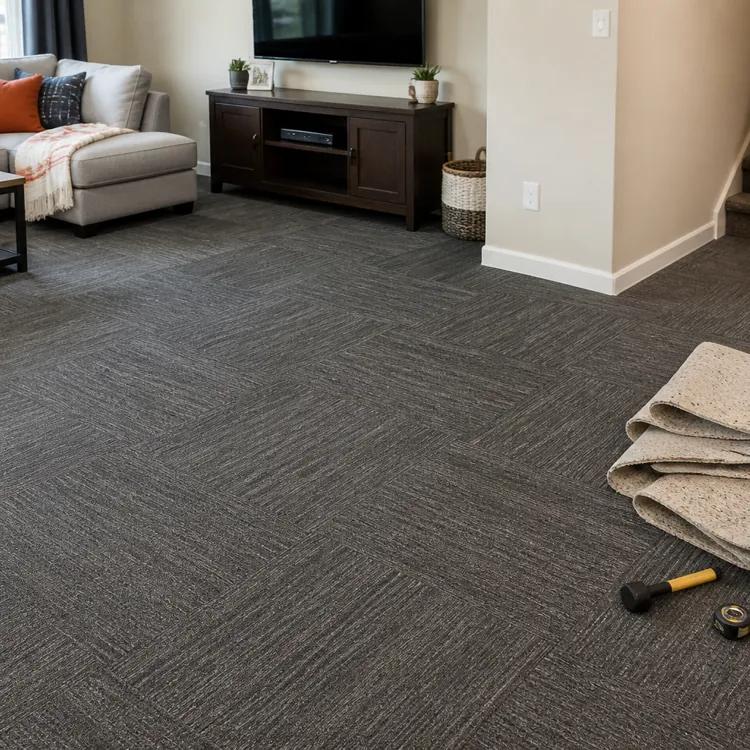
These peel-and-stick tiles have adhesive on the underside that secures them directly to your subfloor. You simply peel off the protective backing, position the tile and stick it to the plywood or concrete subfloor. After installation, use a weighted roller to make sure each tile is secure.
Peel-and-stick carpet tiles are most common in residential basements where foot traffic tends to be limited. They’re also a good choice for homeowners planning a DIY installation. These tiles are more likely to lift at the edges than glue-down tiles, but reattaching or replacing individual tiles is very simple.
Commercial carpet tiles
Commercial carpet tiles are specifically for commercial spaces. They usually require glue-down installation, which is more challenging and labor-intensive, but greatly reduces the risk of tiles lifting at the edges in high-traffic areas. You’ll need professionals to install these tiles, which means a higher carpet installation cost.
Commercial carpet tiles more often consist of nylon fibers, which are the most resilient but also the most expensive. They also typically have a short pile, which is easier to clean and maintain in high-traffic commercial buildings, and many have a high fiber density, which helps maintain the carpet’s appearance even with heavy use.
Finally, commercial carpet tiles often have a reinforced backing that includes multiple rigid and padded layers for comfort and long-term performance.
Cushioned carpet tiles
Cushioned carpet tiles come with a preattached sheet of cushioning, similar to the padding you’d put under more traditional carpeting. This delivers more comfort underfoot and can reduce strain on joints, but the added material does make them more expensive. It also reduces stress on the carpet fibers themselves, making them more durable than standard carpet tiles.
Cushioned carpet tiles are most common in residential bedrooms. They’re not as viable for basement installation because the padding is even more absorbent than the carpet itself, so moisture and water leaks can more quickly lead to mold growth.
Outdoor carpet tiles
Outdoor carpet tiles are similar to peel-and-stick or standard residential carpet tiles. They usually have a very short pile, though, which helps reduce the risk of mold growth from moisture and the elements. Outdoor carpet tiles usually have olefin fibers, which hold onto color better than other options. They can also stand up to UV light a bit longer before they fade.
Best carpet tile brands and collections
Some of the best carpet tile brands include Mohawk, Shaw, TrafficMaster and FLOR. Mohawk and Shaw make carpet tiles for residential and commercial spaces, while TrafficMaster specializes in residential options. FLOR offers design-focused tiles with customizable patterns.
- Mohawk: Mohawk manufactures some of the most durable carpet tiles for commercial spaces. Its products come with a limited lifetime warranty that covers wear, static discharge, edge unraveling, delamination (separation of the carpet’s layers) and dimensional stability (changes to the tile’s size or shape). Mohawk also manufactures high-end residential carpet tiles.
- Shaw: Shaw provides a similar commercial carpet tile warranty that also covers staining, so its commercial products are also extremely durable and trustworthy. Shaw also makes residential carpet tiles that come with a separate manufacturer’s warranty.
- TrafficMaster: TrafficMaster is one of the most popular residential carpet tile brands, largely because it’s affiliated with Home Depot, which has locations nationwide. TrafficMaster carpet products come with a five-year limited stain and limited wear warranty, plus a five-year limited texture retention warranty.
- FLOR: FLOR manufactures residential carpet tiles that are widely regarded for their design and customizations. Its products come in a wide range of patterns, making them a good option for homeowners who want something a little more unique. FLOR’s carpet tiles are durable, but they only come with a one-year warranty guaranteeing that the product will be free from manufacturing defects.
» COMPARE: Top-rated flooring companies
Checklist for buying the best carpet tiles
Since there are a lot of factors that go into choosing the best carpet tiles for your space, it’s a good idea to start your search with the most important considerations to narrow down your options.
- Fiber type: Nylon fibers work well for high-traffic areas, especially commercial spaces. Though not as durable, polyester and olefin fibers are more eco-friendly and affordable, making them a good fit for residential spaces.
- Pile height: A shorter pile is best for commercial spaces and any floor prone to moisture. A longer pile will offer more comfort, making it better for dry residential applications.
- Backing material: A cushioned backing can improve comfort and is best for dry residential spaces. For commercial spaces, consider fiberglass or vinyl backing, which helps tiles maintain their shape and may extend their lifespan.
- Installation method: Choose peel-and-stick carpet tiles for most DIY installations in residential spaces. They’re easier to install and replace when stained or damaged, but they’re also more likely to loosen over time. Glue-down tiles are better suited to high-traffic commercial spaces.
- Stain resistance: Prioritize stain-resistant carpet tiles for commercial spaces and for areas in a home that children or pets might frequent. For homes, TrafficMaster’s five-year stain warranty makes its products a great option.
- VOC ratings: Some manufactured flooring can release volatile organic compounds (VOCs) during production and even after it's installed in your space. Choose a low-VOC product to improve indoor air quality and reduce your environmental impact.
- Warranty coverage: Carpet is the least durable flooring material, so it’s always worthwhile to look into the warranty coverage you get with a product. Review both the length of the warranty and what it covers. Look for protection against problems such as premature wear, stains, edge unraveling and separation of the carpet’s layers.
- Matching dye lot: Carpet tiles can vary slightly in color from lot to lot. Purchase tiles from a single lot for consistency, and buy extras so you have matching tiles available for future repairs.
FAQ
Are carpet tiles as durable as traditional carpet?
Carpet tiles are, for the most part, more durable than traditional carpet, although the durability of both products varies based on the specific brand. Carpet tiles tend to be more durable than traditional carpet. If an area becomes damaged, you can replace individual tiles rather than the entire floor, which can lower long-term maintenance and replacement costs.
What are the best carpet tiles for high-traffic areas?
The best carpet tiles for high-traffic areas are commercial-grade products made with short-pile nylon fibers. Look for a high TARR score, sturdy backing that helps the tiles retain their shape and glue-down installation to prevent the edges from lifting.
Also consider the warranty length and coverage. A longer warranty can provide greater protection against premature wear and other product defects.
How do you install peel-and-stick carpet tiles?
Installing peel-and-stick carpet tiles is relatively simple. Just pull off the protective backing and stick the individual tiles to your subfloor. You should make sure the tiles are square with the room. You’ll also need to run a weighted roller over the floor when you’re done to ensure good adhesion.
How long do carpet tiles last?
Carpet tiles can last up to 15 years with proper maintenance, especially if they see low to moderate amounts of foot traffic. A short pile and a cushioned backing make maintenance easier and improve the carpet tile's longevity.
Article sources
ConsumerAffairs writers primarily rely on government data, industry experts and original research from other reputable publications to inform their work. Specific sources for this article include:
- Green Seal, "Choose Green Report: Carpet." Accessed July 23, 2026.
- Shaw Technical Support, "Texture Appearance Retention Rating (TARR) - Hexapod Information." Accessed July 23, 2026.
- Mohawk Group, "Commercial Carpet Tile Limited Lifetime Warranty." Accessed July 23, 2026.
- The Home Depot, "TRAFFICMASTER WARRANTY." Accessed July 23, 2026.
- FLOR, "FLOR Pre-Labeled FLOR Recycle Bag: Responsible by FLOR." Accessed July 23, 2026.
- FLOR, "Product Warranty for Carpet Tiles & Area Rugs." Accessed July 23, 2026.
- Milliken, "WELLBAC Cushion Backing." Accessed July 23, 2026.
- Milliken, "Commercial Carpet Tile Solutions." Accessed July 23, 2026.
- J+J Flooring, "Nexus Modular Backing." Accessed July 23, 2026.
- A-xet Floorcoverings Pte. Ltd., "Carpet Tiles vs. Traditional Carpets: Which is Better for Your Home?" Accessed July 23, 2026.
- All Flooring Now, "How Long Do Carpet Tiles Last? Here's Your Answer." Accessed July 23, 2026.
- Milliken, "The Hidden Role Of Cushion Backing In Office Carpet Tiles." Accessed July 23, 2026.