

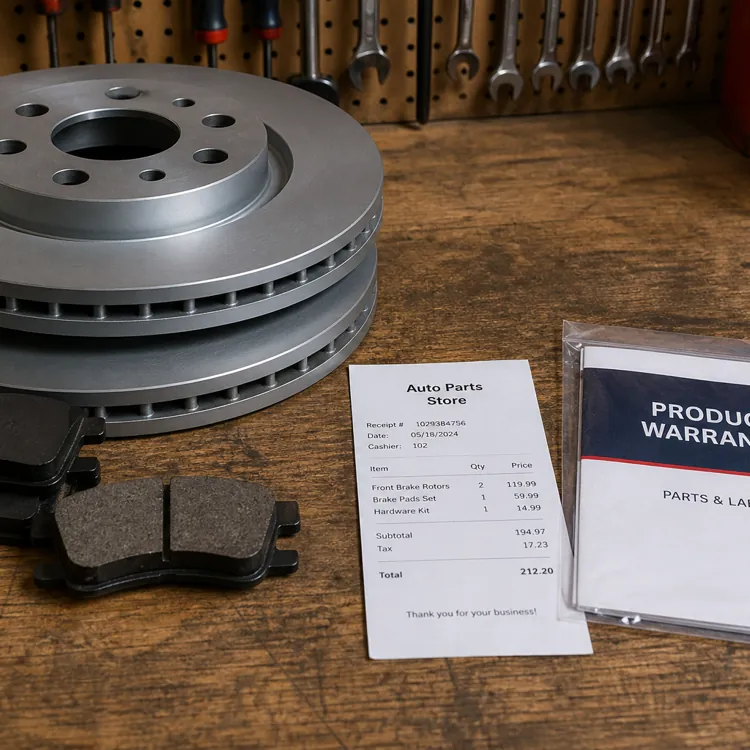
Brake rotors are an integral part of a vehicle’s braking system. When you press the brake pedal in a vehicle that has disc brakes, your brake pads and calipers squeeze your spinning rotors to a halt. This generates heat and friction, which wears the pads and rotors over time.
Unfortunately, most warranties exclude rotors from their standard coverage because of this. They aren’t meant to last, so car makers and warranty providers don’t want to cover them the same way they cover permanent, non-degrading parts. However, there are exceptions, and some warranties offer supplemental coverage for rotors as an add-on option.
Key insights
Brake rotors are considered wear-and-tear components, which means they’re not covered under most factory or extended warranties.
Jump to insightSome extended warranties offer supplemental coverage for brake parts.
Jump to insightIf you have to pay for new brake pads and rotors out of pocket, expect to spend between $450 and $900 per axle unless you have a luxury or performance vehicle.
Jump to insightBrake rotor warranty coverage
Factory and extended warranties generally don’t cover brake pads and rotors because they are designed to wear down over time. For this reason, warranty providers classify them as "wear-and-tear" items.
Wear-and-tear parts, like windshield wipers and tires, usually require multiple replacements over the life of your vehicle as a result of normal use. Warranties are meant to cover vehicle components that fail due to defects.
Basically, your brake rotors wearing down over time isn’t covered under warranty because that’s what they’re designed to do.
Warranty providers don’t cover wear-and-tear parts because they’re simply not designed to last forever.
The only real exception is if your rotors are involved in a recall, have a manufacturing defect or are damaged by another part of your car that has a manufacturing defect. In that case, your factory limited bumper-to-bumper warranty or a specialized manufacturer’s parts warranty may cover the cost of replacement brake rotors.
» MORE: Car warranty coverage
Manufacturer part-specific brake warranties
While brake rotors are generally considered wear items, certain manufacturers provide limited warranties on these components when they're replaced at authorized dealerships. These part-specific warranties are independent of your vehicle's factory warranty and only apply when genuine OEM rotors are installed by authorized service centers.
Honda, for instance, often covers replacement rotors for 12 months with no mileage restriction when installed during authorized service, protecting against defects in materials or workmanship. Similarly, Toyota may warranty dealer-installed rotors for 12 months/12,000 miles from the date of installation.
Additionally, some independent, third-party manufacturers who produce vehicle components may offer warranties on their brake rotors. Coverage and terms will vary greatly by manufacturer. Keep in mind that using parts from third-party manufacturers could lead to a claim denial if the warranty provider believes the issue occurred because you used aftermarket parts.
It's important to understand that these limited warranties only protect against premature failure due to defects — not normal wear from everyday driving. Warping, cracking or degradation caused by overheating, contamination, poor driving habits or improper brake pad material are excluded from coverage.
Check with your specific dealership or parts manufacturer for exact terms and conditions.
Brake rotor coverage under defect vs. wear scenarios
Your factory warranty may cover brake rotor replacements if premature failure results from a manufacturing defect or the malfunction of a related covered component.
Example scenarios where brake rotors might be covered:
Manufacturing defect: If rotors crack, warp or develop excessive runout within the first few thousand miles due to defects or improper manufacturing, the warranty may cover replacement.
Caliper failure: If a seized or dragging caliper causes one rotor to overheat and warp prematurely, the warranty might cover both the defective caliper and the damaged rotor.
Antilock Brake System (ABS) malfunction: If your ABS system fails and causes uneven brake application that leads to warped or damaged rotors, you may have coverage for the system repair and affected rotors.
Defective brake pads: If factory-installed brake pads have incorrect friction material that causes abnormal rotor wear or damage, both components may be covered.
Example scenarios where brake rotors would not be covered:
Normal surface wear: Rotors that have worn below minimum thickness specifications after 50,000 to 70,000 miles of typical driving.
Heat-related warping: Rotors that warp from repeated hard braking, mountain driving, towing heavy loads or performance driving.
Neglected maintenance: Rotors damaged because worn-out brake pads were not replaced in time, causing metal-to-metal contact and scoring.
Corrosion and rust: Surface rust or corrosion from environmental exposure, road salt or extended periods of non-use.
If you believe your rotors failed prematurely due to a defect, document the issue immediately. Note any symptoms like pulsating brake pedals, vibration during braking or unusual noises, and have an authorized dealership inspect the brake system to determine whether a covered defect caused the damage.
Does your extended warranty cover brake rotors?
Some extended warranty companies offer add-on coverage that might cover some or all of your brake rotor replacement costs, and you may also find rotor manufacturers or retailers that offer warranties for their products.
For example, Endurance Warranty sells add-on coverage for brakes that may cover a portion of the replacement costs. Just be aware that these plans often cost extra and don’t cover the entire repair cost, so they might not be worth the expense if you’re just buying them for the rotor benefits.
We checked the offerings from a few major extended warranty providers to see who offered supplemental coverage for brake rotors and included the results below.
| Warranty provider | Plans offering brake rotor coverage |
|---|---|
| Endurance | Endurance Advantage offers up to $140 toward replacement costs |
| American Dream Auto Protect | None |
| olive | None |
| Omega Auto Care | Maintenance Program may cover up to $130 for rotor replacements, depending on your make and model |
| Toco Warranty | None |
| Concord Auto Protect | None |
How to verify warranty coverage for brake rotors
If you are unsure whether your warranty covers brake rotors, you should check your contract or warranty handbook for details. You can also find your vehicle identification number (VIN) and may be able to look up the details of your warranty plan on the provider's website using that information.
Check your warranty's covered components section first to see if it mentions brake rotors there. If not, look at the exclusions section. Most plans list common wear-and-tear items that are not covered.
If you're still not sure about whether you have coverage or not, contact the warranty provider directly to ask. In many cases, you'll need to contact the provider regardless to get preauthorization before repairs can begin, so it can't hurt to ask before taking your car to a repair shop.
What brake components are covered under warranty?
Although your brake rotors and pads aren’t covered by your warranty when they fail from normal use, there are certain parts of your braking system that are designed to last longer. These parts typically are covered by your car warranty and shouldn’t break unless there’s a defect. Here’s a breakdown:
Covered
- Brake master cylinder
- Brake booster (power brake assist)
- Brake lines and hoses (if they fail due to defects)
- Antilock Brake System (ABS) components (ABS module, wheel speed sensors)
- Electronic brake force distribution system
- Brake pedal assembly (if defective)
Not covered
- Brake pads
- Brake rotors/discs
- Brake drums
- Brake shoes (drum brakes)
- Brake fluid (routine replacement)
- Parking brake cables and adjustments
» MORE: Your guide to car warranties
Reasons warranty claims for brake rotors are denied
Understanding why brake rotor warranty claims get rejected can help you avoid unexpected repair costs. Here are the most common denial reasons:
Normal wear and tear: Rotors that have worn below minimum thickness after 50,000 to 70,000 miles of driving are considered normally worn, not defective, and won't be covered.
Heat-related damage: Warped or heat-cracked rotors from aggressive driving, frequent hard braking, mountain driving or towing heavy loads are classified as misuse rather than manufacturing defects.
Lack of maintenance documentation: If you can't prove regular brake inspections and timely pad replacements per the maintenance schedule, claims may be denied even for legitimate issues.
Delayed pad replacement: Rotors with deep grooves or scoring caused by driving with worn-out brake pads are considered damage from neglect, not a warrantable defect.
Aftermarket parts: Installing non-OEM brake pads or performance brake components typically voids rotor warranty coverage for the entire brake system.
Environmental corrosion: Rust, pitting or corrosion from road salt, coastal climates or extended vehicle storage is generally excluded from coverage.
Improper installation: Rotors damaged during installation by nonauthorized technicians or incorrect torque specifications won't be covered under factory warranties.
How much does it cost to fix your brake rotors?
You generally replace your brake rotors in tandem with your brake pads, which adds to the overall cost. Our estimates show that a pad and rotor replacement costs between $901 and $1,084 per axle on average, but your costs will depend on your vehicle.
Replacing brake pads and rotors typically costs $901 to $1,084 per axle, depending on your vehicle.
Some premium models, performance vehicles and trucks may cost much more. For example, the 2023 Toyota GR Corolla, a high-performance hatchback, takes large slotted rotors that cost more than $600 each, and that’s before you add on the price of labor or brake pads.
Resurfacing brake rotors
You might be offered the option to resurface or “turn” your rotors, which involves machining a small amount of metal from the rotor surface to create a smooth gripping area for the pads. While this is possible and might not result in damage to the component, it’s a practice many in the industry recommend against.
Rotors experience extreme heat and wear during use and are designed to be thick enough to withstand that abuse, so removing material from the surface can affect the structural integrity. Modern rotors, especially, are much thinner and lighter than their older counterparts, so most mechanics won’t resurface them.
You’re better off replacing your rotors when the time comes.
Can I replace brake rotors myself?
If you are trying to save on the cost to replace your brake rotors, you could consider doing it yourself. The process involves lifting the car, removing the old rotors and installing new ones. While it's a relatively simple job, it does come with some safety concerns. If you have experience working with vehicles and have the proper safety gear on hand, you could replace the brake rotors yourself. Otherwise, you may want to leave the work to a professional.
FAQ
How long do rotors last on average?
Most rotors can be expected to last between 30,000 and 70,000 miles on average. However, keep in mind that your driving style, type of vehicle and road conditions can impact your rotors’ longevity.
Are brake rotors covered under bumper-to-bumper warranties?
Brake rotors are considered wear-and-tear components and are not covered under bumper-to-bumper warranties. There are exceptions however, including in cases where a manufacturing defect is detected, requiring a recall or other action.
How can you make your brake rotors last longer?
Replace brake pads before they wear too thin and damage the rotors. Practice smooth, gradual braking instead of aggressive stops, and use engine braking on downhill stretches to reduce heat buildup. Have your brake system inspected regularly to catch issues like sticking calipers early. Lastly, avoid overloading your vehicle or exceeding its towing capacity, as excess weight generates excessive heat that can warp rotors and shorten their lifespan.
What are the symptoms of bad rotors?
Bad brake rotors cause a pulsating or vibrating brake pedal when you slow down, often accompanied by steering wheel vibrations. You may hear squealing, grinding or scraping noises during braking. Other signs include longer stopping distances, the vehicle pulling to one side or visible grooves and cracks on the rotor surface. If you notice these symptoms, have your brakes inspected promptly to ensure safe operation.
Why don't mechanics turn rotors anymore?
Modern rotors are designed thinner and lighter for fuel efficiency, leaving little material to safely turn (resurface). Replacement rotors have also become cheaper, often costing less than the labor to machine old ones. New rotors provide better performance and last longer than resurfaced rotors near their wear limit, making replacement the more cost-effective and safer option for most vehicles.
Article sources
ConsumerAffairs writers primarily rely on government data, industry experts and original research from other reputable publications to inform their work. Specific sources for this article include:
- AutoZone, “How Long Do Brake Rotors Last?” Accessed Oct. 22, 2025.
- Omega Auto Care, “Omega Auto Care Maintenance Program.” Accessed Oct. 22, 2025.
- Endurance Warranty, “How Often Should Brakes Be Replaced?” Accessed Oct. 22, 2025.