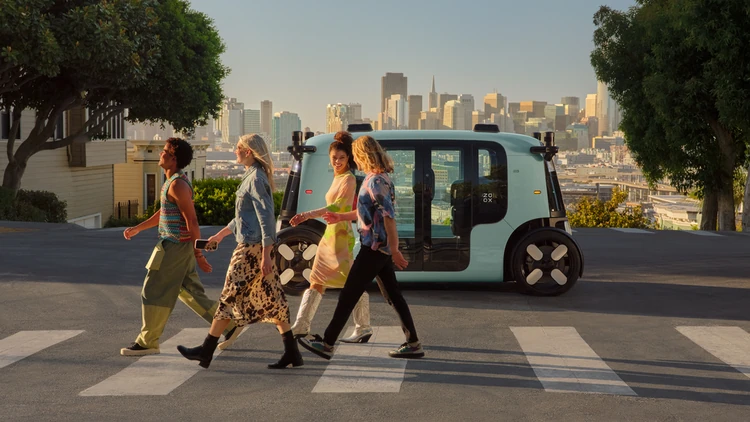

Zoox opened its autonomous taxi service to members of the public in San Francisco today, a milestone that positions Amazon’s robotaxi unit as a direct challenger to Waymo in the nation’s most scrutinized proving ground for driverless cars. But while Zoox is expanding, the safety gulf between the companies remains wide — and consumer trust may hinge on how quickly Zoox can close it.
For years, Waymo has dominated not only deployment but also transparency. The company has logged more than 25 million fully driverless miles, released detailed crash-type data, and partnered with outside researchers and insurers to benchmark its safety performance against human drivers. Independent analyses have consistently found Waymo vehicles dramatically reduce crash rates across multiple categories — including intersection collisions and pedestrian injuries — compared with comparable human-driven miles.
That puts Zoox in a bind: it is entering the conversation late, and with far less publicly available safety data.
To its credit, Zoox is not simply another operator retrofitting a car with sensors. Its vehicles are purpose-built robotaxis, with no steering wheel, pedals, mirrors, or conventional cabin layout. Riders face each other in a symmetrical cabin, and the vehicle drives equally well in either direction. That futuristic design has long been one of Zoox’s selling points — but also the very reason it required a federal safety exemption before operating on public roads. Regulators have repeatedly emphasized that purpose-built AVs must meet higher scrutiny because their control layouts diverge so dramatically from traditional automotive safety expectations.
A mixed record so far
Zoox’s early safety record has been mixed. The company weathered an NHTSA probe triggered by sudden braking incidents that injured motorcyclists and contributed to at least one Las Vegas crash. The investigation closed only after Zoox issued a software update addressing the conditions that caused the erratic braking. While regulators ultimately allowed operations to continue, the probe remains part of Zoox’s public safety narrative — especially as it expands into more complex urban environments.
By contrast, Waymo’s service in San Francisco and Phoenix has quietly accumulated safety-performance credibility. Peer-reviewed studies show statistically significant reductions in nearly every major crash category compared with human drivers. Its detailed, publicly accessible “Safety Impact” database gives researchers, journalists, and regulators unprecedented visibility.
That openness has become a competitive advantage — one Zoox, to date, has not matched.
Rides will remain free for now
Still, Zoox’s San Francisco launch marks a meaningful new chapter. The company has been offering free, waitlist-based rides in Las Vegas since September. Its expansion into San Francisco — a city with dense cyclist traffic, unpredictable pedestrians, tight intersections, and far less margin for error — suggests Zoox believes its system is ready for deeper real-world exposure.
Rides will remain free for now as part of a demonstration phase. Zoox is still awaiting California approval to charge fares, a regulatory milestone that requires consistent safety performance and incident reporting. The company says it has several dozen vehicles operating between San Francisco and Las Vegas, and it has publicly identified Austin and Miami as potential next markets.
But if Zoox hopes to catch Waymo, it will need not just service expansion — it will need transparency. Consumers, policymakers, and researchers increasingly expect robotaxi companies to publish granular crash reports, disengagement data, and claims records. In that regard, Waymo has set a benchmark the entire industry now faces.
Zoox’s go-slow approach to public disclosure may have kept expectations modest, but its move into one of America’s most challenging urban driving environments raises the stakes. San Francisco riders will ultimately decide whether Zoox feels as safe and predictable as its more seasoned competitor. Regulators will watch closely.
How to Compare Robotaxi Safety Records
1. Look for published autonomous-mileage and crash-type data
Waymo publishes millions of miles of crash-type analysis. Zoox has published far less so far.
2. Check whether the service is “demo” or revenue-generating
Demo phases often mean lighter oversight and free rides; fare-charging requires additional regulatory approval.
3. Understand where the cars operate
Dense urban environments (like San Francisco) pose tougher reliability tests than controlled routes in less complex areas.
4. Ask what happens after an incident
Does the company publish details? Do regulators require updates? Who’s liable for property or injury claims?
5. Does the vehicle have traditional controls?
Waymo uses modified production cars with steering wheels/brakes. Zoox uses a purpose-built pod with none — a fundamental difference with regulatory implications.