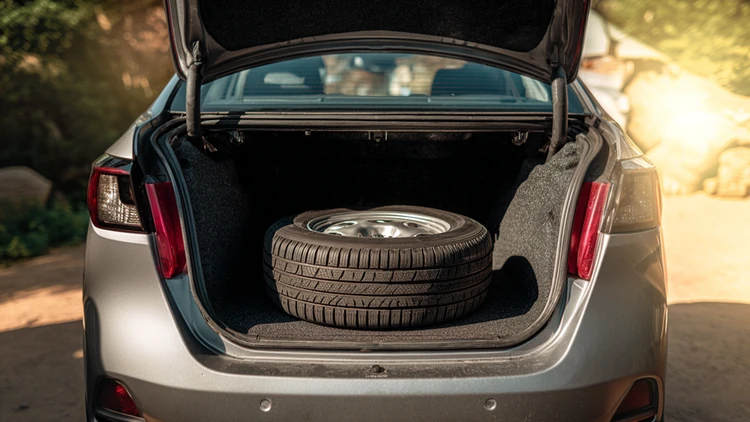

Many new cars no longer include a spare tire — automakers are cutting them to save weight and boost fuel economy, leaving many drivers without a true backup.
Fix-a-flat kits have serious limits — they won’t work for blowouts, sidewall damage, or large punctures, which are some of the most common flat-tire scenarios.
Check your car now, not later — lift the trunk floor, confirm what your trim level includes, and decide if buying a spare is worth it before you’re stuck waiting for a tow.
Drivers across the country are discovering that many new cars no longer come with a spare tire. The issue was highlighted in a recent report by WCPO-9 News, after multiple drivers opened their trunks expecting to find a spare and found… nothing.
In one case, a new Toyota Prius owner discovered her trunk only contained Styrofoam and a tire inflation kit. Another driver learned her Jeep didn’t even include a temporary “donut” tire, just a small air compressor that was useless for a sidewall puncture.
And these aren’t rare exceptions anymore.
Why spare tires are disappearing
According to Consumer Reports, automakers have been removing spare tires to remove some weight from the car which improves the overall fuel economy.
Their testing found that since 2020:
- Only 9% of cars come with a full-size spare.
- 46% include a space-saver or donut tire.
- 34% come with only a compressor and sealant kit.
- About 4% come with nothing at all.
That means many drivers are one pothole away from being completely reliant on a tow truck.
Why the 'fix-a-flat' kit often isn’t enough
The small tire repair kits included in many vehicles sound somewhat reassuring, but they have some serious limits.
For example, they do not work if:
- The hole is in the sidewall
- The tire is blown out
- The damage is too large
- The tire pressure dropped too low before you noticed
In other words, they’re not a universal fix. Several drivers in the WCPO report said the kits included in their vehicles failed completely.
What to do right now:
With a little bit of forethought, you can avoid an expensive tow or repair down the road. Here are some things to consider.
Check your car first (don’t assume anything)
Look under your vehicle, in the rear, for a hidden spare tire. If a spare isn’t under your car, then open the trunk, lift up the cargo floor mat, and look underneath.
If you see molded foam, a small air compressor, or a sealant bottle, you don’t have a spare.
Pro tip: Check again after dealer-installed accessories. Some dealers remove spares to make room for subwoofers or storage trays.
Confirm what your exact trim level includes
Two versions of the same car can be completely different.
Lower trims are far more likely to skip a spare, while higher trims may include a donut or full-size spare. The smart thing to do is check out the vehicle’s window sticker (if you still have it) or owner’s manual by VIN to see what was supposed to be included.
If you’re buying used, don’t trust the listing. Sellers often assume there’s a spare when there isn’t, so visually inspect to see what’s included.
Ask the dealer to physically show you
If you’re shopping for a new or used car, don’t ask if it has a spare. Instead, ask them to open the trunk and show it to you.
If it doesn’t have one, do the following:
- Ask if a spare is available as an add-on. Better yet, often times you can get them to throw a spare tire into the deal for free.
- Ask whether the vehicle is pre-wired or fitted to store one safely.
- Ask if adding one affects cargo space or fuel economy.
Getting this answered before you sign any paperwork can save you hundreds later.
Decide whether a spare is worth buying separately
Buying a spare or donut tire isn’t cheap, but neither is being stranded, especially if you don’t have roadside assistance that includes free towing.
Before buying a spare:
- Confirm the correct wheel size and bolt pattern of your vehicle.
- Make sure it clears the brake calipers (especially important on hybrids and EVs).
- Check whether your vehicle has a jack and lug wrench (many don’t).
Reality check: A spare often costs way less than a single tow, especially if you need a tow after-hours or if your car is stuck in a garage where flatbeds can’t fit.