
How ConsumerAffairs uses cookies

This website utilizes technologies such as cookies to enable essential site functionality, as well as for analytics, personalization, and targeted advertising. To learn more, view the following link:

2024 Sustainability

Article Image

California limits sales of diesel and gasoline-powered recreational vehicles

Newly adopted clean air regulations could limit the sale of large motor homes or recreational vehicles (RV) in California. Late last month the California Air Resources Board amended the Advanced Clean Truck regulations, placing new requirements on this class of vehicles.

Specifically, the regulations say the share of vehicles weighing over 8,500 pounds that have diesel engines must decline while the percentage of vehicles that produce no emissions must increase.

While most of the RVs in this class are powered by diesel, it’s likely the new regulations will affect some RVs that use gasoline. The clock may be ticking on these vehicles anyway since California has the goal of phasing out all internal combustion engines by 2035.

The new state regulations require all vehicles weighing over 8,500 pounds to have zero-emission powertrains but allow for a credit system. Vehicles with an internal combustion engine may continue to be sold as long as there is an offset by electric RVs.

“Two major diesel chassis builders, Spartan and Freightliner, have told Nemar RV that they can’t meet that requirement,” RV Travel, an industry publication, recently reported. “In a letter to dealers, Newmar says that effective [Nov. 4], they will no longer be able to provide any diesel-fueled motorhomes on those platforms.”

California is not the only state to take this step. Oregon, New York, Washington, New Jersey and Massachusetts are adopting rules to limit internal combustion RVs. Needless to say, the rules are expected to severely limit RV sales in those states.


Article Image

Starbucks' new cold cups will use 20% less plastic

Starbucks is taking steps towards being more sustainable with a new line of cold cups that use less plastic. 

With the coffee chain’s plans to cut carbon, water, and waste footprints by 2030, these remodeled cups are another step in that direction. The cups use 10%-20% less plastic compared to the original designs, and will now all use the same size lids. 

A team of researchers led by Kyle Walker has been testing different methods to cut back on plastic use while keeping the integrity of the cups at Starbucks’ testing lab the Tryer Center. Over the last four years, Walker’s team has created a new cup that doesn’t compromise on sturdiness or keeping drinks cold. 

“We invented new ways to test the cup that we didn’t have before,” Walker said. “Like, what if we take this feature and we move it up or down? Or what if we change the shape or the radius in this very small way? We were making all these micro-adjustments, and when we found the optimal combination, it was a real Eureka moment!” 

Sustainability benefits

In taking a look at the cups from the outside, regular Starbucks-goers aren’t likely to notice much of a difference. Each of the cold cups – tall, grande, venti, and trenta – will still all be the same size. The major difference is in how they’re going to be made. 

Starbucks has projected some of the key sustainability benefits over one year, which include: 

  • Save emissions equivalent to taking 5,200 cars off the road

  • Conserve about 2,800 Olympic-sized swimming pools of water

  • Keep more than 13.5 million pounds of plastic from landfills 

Accessibility benefits

The new cups will also include accessibility features that will make it easier for baristas in the midst of a busy rush. 

There will be two ways of identifying which cup is which: the new cups will be embossed with the letter indicating the size, and there will also be raised dots on each cup that will correspond to the different sizes. 

Starbucks cups also feature different measurement and fill lines. With these new cups, those lines will be black and white, so regardless of the drink customers order, baristas will be able to see the lines and accurately make the drink. 

Additionally, Starbucks has created one lid for all of the newly designed cold cups. This will make storage easier, as well as make things easier for baristas. 

The new cups are being rolled out at Starbucks stores across the country this month.  

Article Image

Electric cars could improve kids' health, study finds

A new report published by the American Lung Association dove deep into the ways that switching to electric vehicles (EVs), and other sources of clean power, could greatly benefit the youngest population. 

The report, which focused on kids in Michigan, found that clean power could solve a great deal of kids’ health concerns. Perhaps the biggest finding: nearly three million childhood asthma attacks could be prevented by 2050 with the shift to EVs and clean electricity. 

“Here in Michigan, the transportation sector is a leading source of air pollution and are the biggest source of carbon pollution that drives climate change and associated public health harms,” said Ken Fletcher, advocacy director at the American Lung Association. “This affects our children’s health and well-being today, and as the impacts of climate change intensify, it will impact their futures.” 

Zero-emission vehicles and electricity

For this report, experts looked at the ways that transitioning to zero-emission transportation and non-combustion clean electricity could benefit children’s health. 

The study projected the health impacts on children assuming: 

  • All new passenger vehicles sold are zero-emission by 2035

  • All new trucks sold are zero-emission by 2040

  • The electric grid will be clean-powered by 2035

Ultimately, the researchers found that should these changes go into effect over the next decade, there would be several health benefits for children by 2050. These include: 

  • 500+ fewer infant deaths

  • 2.8 million fewer asthma attacks

  • 2.7 million fewer upper respiratory symptoms (wet cough, runny nose, burning eyes)

  • 1.9 million fewer lower respiratory symptoms (coughing, wheezing, chest pain)

  • 147,000 fewer acute bronchitis cases 

The impact on children’s health

The focus of the study was on children for a few reasons. The report explains that children are uniquely vulnerable to air pollution because their bodies are still developing and they have greater exposure to air pollution than adults. 

Additionally, the 2023 State of the Air report from the American Lung Association found that 27 million U.S. children live in counties that have unhealthy air pollution levels. 

“Policymakers at the federal, state, and local levels must focus strategies to rapidly move away from combustion technologies and toward zero-emission technologies to best protect health today and ensure children have safe and sustainable communities in which to grow,” the report says. 

Article Image

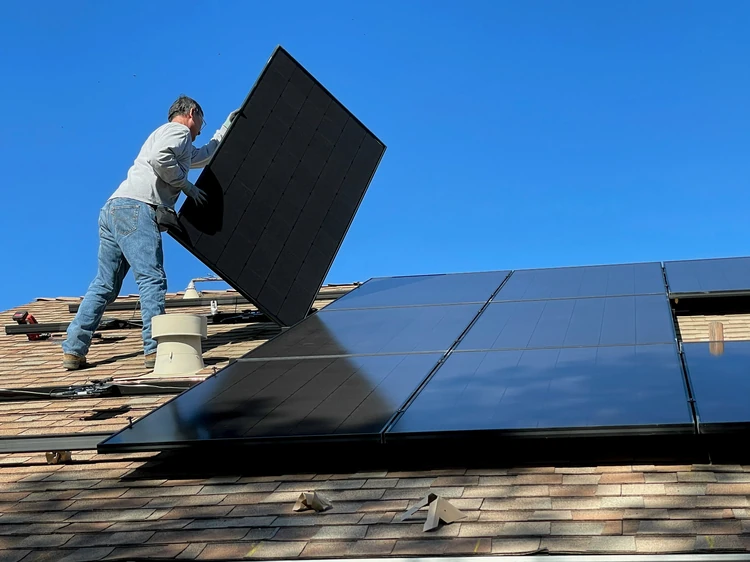
Some states are reducing payments to solar customers

Besides federal and state tax credits, another advantage of residential solar installations is the ability to sell unused electricity back to the utility company. But a solar industry group warns that some states are changing the agreement.

According to E&E News, several states are rolling back or reducing those payments, a move seemingly at odds with the federal government’s goal of significantly increasing solar energy generation by 2035.

In Arizona, utility regulators recently voted to reopen their “value of solar” docket. The Arizona Corporation Commission says the rate paid to solar users who sell electricity back to the grid needs to be reduced, calling the present rate structure “unsustainable.”

Commissioner Nick Myers complained that the present structure increases the monthly cost for traditional customers.

Not so fast

Many solar advocates reject that premise, saying the benefits of renewable energy are undercounted. They are expressing concern, even though the rate adjustment would not affect current solar customers, only future ones.

“Any time that rate changes, it creates uncertainty and makes it difficult to pay off the cost of that system,” said Autumn Johnson, executive director of the Arizona Solar Energy Industries Association.

According to E&E News, more than a dozen states have ended their net metering policies in the past decade. More troubling, the recent pullbacks are occurring in some of the largest solar states — and political battlegrounds — just another headache for an industry that is facing pressure from supply chain constraints and inflation.

In March, North Carolina cut its rates and replaced them with tariffs that match the electricity price a customer pays. Other states — including Colorado, Idaho and Wisconsin — are weighing their own changes.