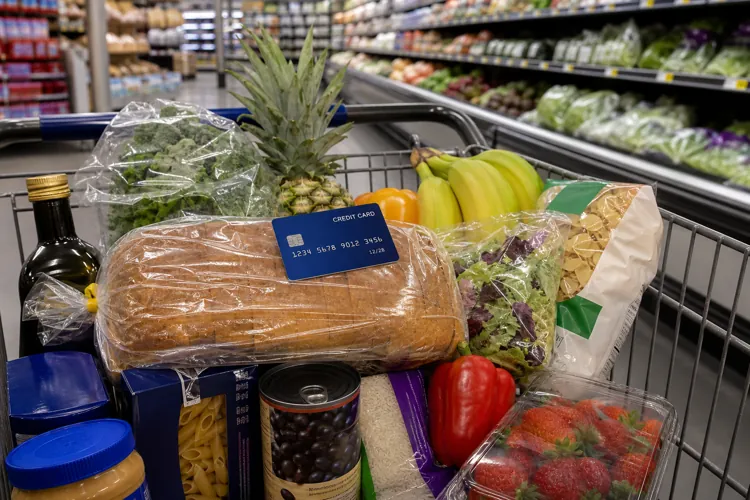

Millions of Americans are relying on credit cards, savings, and even buy now, pay later loans to pay for groceries, according to a new Urban Institute report.
Nearly one in five working-age adults used non-emergency savings to buy food, while repayment problems on grocery-related credit card debt have increased since 2023.
Researchers say middle-income households are increasingly feeling the squeeze as food prices remain roughly 32% higher than five years ago.
Millions of Americans are tapping savings, carrying credit card balances, and turning to buy now, pay later (BNPL) financing just to put food on the table, underscoring the financial strain that continues to weigh on household budgets despite easing inflation.
A new report from the Urban Institute finds that grocery bills remain a major source of financial stress after food prices climbed about 32% over the past five years. While inflation has slowed from its pandemic-era highs, many families continue to struggle with the cumulative increase in food costs.
The analysis, based on the Urban Institute's nationally representative 2025 Well-Being and Basic Needs Survey, found that more than one-quarter of working-age adults relied on some form of debt or savings to purchase groceries.
A look at the findings
Among the findings:
About 34.8% of adults ages 18 to 64 said they use a credit card to buy groceries but pay the balance in full each month.
Another 19.4% said they carry a balance but at least make the minimum payment.
Nearly 8.7% reported they do not always make even the minimum payment on grocery-related credit card debt, up 1.6 percentage points from 2023.
Nearly 20% said they dipped into non-emergency savings to pay for groceries.
Almost 10% used buy now, pay later financing for food purchases, and more than one-third of those borrowers said they had missed at least one payment.
Researchers say the increase in missed payments suggests financial conditions have worsened for many households over the last two years.
"The challenge is, are folks able to effectively repay their credit card or buy-now-pay-later debt without experiencing hardship or putting their future financial stability at risk?" lead researcher Kassandra Martinchek said in the report.
Middle-income households feeling the pressure
The report found that repayment struggles are not confined to lower-income families.
Households with incomes between two and four times the federal poverty level experienced one of the sharpest increases in missed minimum payments on grocery-related credit card debt since 2023. Researchers said that suggests financial pressure is spreading beyond traditionally vulnerable households.
The findings come as Americans continue to carry historically high levels of credit card debt. Although some consumers have become more diligent about paying balances in full, many others continue to rely on revolving credit for everyday necessities, including groceries.
The role of bad choices
Marcus Sturdivant, founder of The ABC Squared, a registered investment advisory firm, says some of the ways consumers are using BNPL are far beyond the scope of its intention.
“The goal of this system (BNPL) was to bridge a purchase for families, at zero interest in most cases, for something not quite a need but that is very high on the want list,” Sturdivant told ConsumerAffairs. “They could make several installments to pay this debt off while increasing current cash flow. That is nearly utopian, and anyone who knows human fallacies should see the potential downfalls.”
The problem begins when the consumer makes multiple BNPL purchases and is presented with multiple payment demands four weeks after the purchases. The problem is magnified, Sturdivant told us, when consumers begin using BNPL for everyday purchases. He cites a recent interview with a woman who is now deep in debt.
“She lives with her parents as an adult. She ordered food delivery, the total was $40, and she split the payment,” Sturdivant said. “The payments were split not because she could not afford the total, but it simply seemed easier to pay less now. That is it! That is what the world is missing. A complete mindset shift in consumers, and it is not pretty.”
Long-term financial risks
Using credit cards or savings to cover grocery expenses can help families weather temporary financial setbacks. But researchers warn that those strategies become problematic when they persist over time.
Carrying high-interest credit card balances can make it harder for households to recover financially, while repeatedly drawing down emergency savings leaves families more vulnerable to unexpected expenses such as medical bills, car repairs, or job losses.
The Urban Institute suggests that strengthening food assistance programs and helping eligible households enroll in benefits such as the Supplemental Nutrition Assistance Program (SNAP) could reduce reliance on costly borrowing while improving food security.