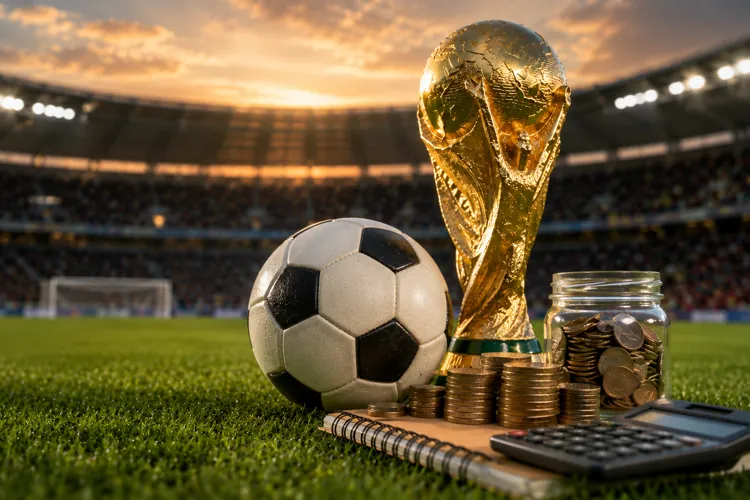

The World Cup offers surprising money lessons. Success comes from preparation, discipline, and smart decisions — not one spectacular play.
Focus on the fundamentals. Build an emergency fund, avoid costly mistakes, and stick to your long-term financial plan.
Don't quit after a setback. Like championship teams, successful savers recover from mistakes and keep moving toward their goals.
The World Cup may be about soccer, but it also offers a master class in personal finance.
Winning teams rarely rely on one spectacular goal or superstar player. Even legends like Lionel Messi, Kylian Mbappé, and Norway’s Erling Haaland depend on preparation, discipline, and teammates who understand their roles.
Building financial security works much the same way.
You probably won’t become wealthy because of one brilliant investment, a single raise, or a lucky break. Your long-term results are more likely to depend on the everyday decisions you make with your money.
Here are seven personal finance lessons hiding in plain sight during every World Cup match.
1. You don’t win the World Cup in the final
The championship match gets the attention, but World Cup winners begin preparing years before they reach the final.
Messi’s 2022 World Cup victory is a perfect example. The trophy represented the culmination of a career spent developing his skills, surviving disappointments, and continuing to compete at the highest level.
Retirement works the same way.
You don’t build a comfortable retirement during the final years of your career. You build it through decades of regular contributions, compound growth, and steadily increasing the amount you save.
Even small contributions made early in your career can have more time to grow than much larger contributions made closer to retirement.
Money move: Automate a retirement contribution every payday. When you receive a raise, be sure to increase your contribution before allowing your spending to expand.
2. Defense wins championships
Scoring goals is exciting, but a team that cannot defend will rarely survive a knockout tournament.
Your financial defense includes the safeguards that prevent one unexpected event from destroying years of progress.
That means having an emergency fund, adequate insurance, and enough room in your monthly budget to absorb an occasional surprise.
Without savings, emergencies such as car repairs, medical bills, or a loss of income frequently end up on a credit card, where interest can turn a temporary setback into a lasting financial problem.
Money move: Start with a small emergency savings target, then gradually work toward enough money to cover several months of essential expenses.
3. Stop chasing the ball
Strong teams maintain their positions and resist the temptation to run towards the ball. They trust the strategy rather than reacting to every movement on the field.
Investors often make the financial version of chasing the ball by rushing into whatever investment is making headlines. They buy an investment after its price has soared, panic when the market falls, and jump from one hot trend to another. By the time they react, much of the opportunity may already be gone.
Even a player with Mbappé’s speed cannot simply sprint after the ball for an entire match. He has to choose his moments, remain in position, and wait for the right opportunity.
Money move: Create an investment plan based on your goals and timeline, then avoid changing it because of every alarming headline or social media prediction.
4. Avoid financial yellow cards
Some soccer fouls do not immediately remove a player from the game, but they create consequences.
Personal finance has plenty of yellow cards:
Late-payment fees
Overdraft charges
Credit card interest
Subscription renewals
Investment expenses
ATM fees
While one fee may seem insignificant, if repeated month after month, these charges can drain hundreds or thousands of dollars from your budget.
A player carrying a yellow card has to be more careful for the rest of the match. Consumers carrying high-interest debt face similar limitations because more of every paycheck is already committed before it arrives.
Money move: Review three months of bank and credit card statements. Then circle every fee and recurring charge, then decide which ones can be eliminated.
5. Take the easy goals
Not every World Cup goal is a spectacular shot from outside the penalty area. Sometimes the smartest play is a simple pass to a teammate standing in front of an open net.
Haaland is famous for putting himself in excellent scoring positions. Many of his goals come not from attempting the impossible but from anticipating where the ball will arrive and being ready to finish.
Personal finance has easy goals, too, yet many consumers overlook them.
One of the clearest examples is an employer retirement match. If your workplace contributes money when you contribute to a 401(k), failing to participate may mean leaving part of your compensation unused.
Other relatively easy wins include automating savings, paying bills on time, using cash-back rewards, and shopping around before renewing your insurance.
Money move: Check whether your employer offers a retirement match and then determine how much you must contribute to receive the full amount.
6. Don’t score an own goal
In soccer, an own goal occurs when a player accidentally puts the ball into the team’s own net.
Financial own goals are mistakes that undermine your progress even though they are completely avoidable.
Common examples include:
Carrying a credit card balance while money sits in a low-interest savings account.
Buying more stuff simply to earn credit card rewards.
Financing an expensive vehicle immediately after receiving a raise.
Withdrawing retirement money for a non-emergency.
Ignoring a bill because you are afraid to open it.
The opposing team did not beat you. You made the situation more difficult for yourself.
Even Mbappé’s scoring ability would not help much if his team repeatedly gave away penalties or made careless mistakes near its own goal.
Money move: Identify the one repeated habit doing the most damage to your finances. Fixing that problem may help more than finding several tiny ways to save.
7. Keep playing after falling behind
Even elite soccer teams give up goals. The difference is that great teams do not abandon their strategy simply because they fall behind.
Financial setbacks happen, too. You may face medical bills, job loss, divorce, an expensive repair, or a poorly timed investment loss. You may also reach a certain age and realize you have saved less than you hoped.
That does not mean the game is over.
Messi endured years of criticism and several painful international tournament defeats before finally winning the World Cup. His story is a useful reminder that falling short of a goal does not mean you stop working toward it.
You can cut expenses, redirect a raise, increase retirement contributions, delay a major purchase, or find ways to earn more. Progress may be slower than you wanted, but small improvements still change the final outcome.
Money move: Don’t try to repair everything at once. Instead, choose the next achievable goal, perhaps paying off one credit card or saving your first $1,000, and become hyper-focused on that.