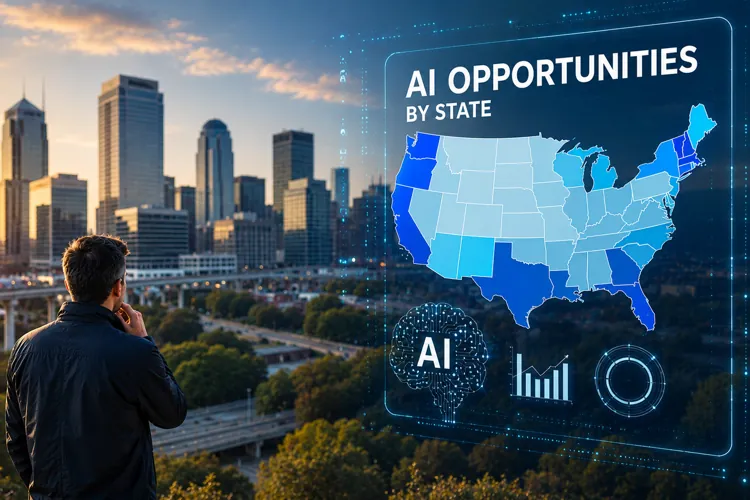

AI’s impact may depend on where you live: Virginia, Colorado, and Utah rank among the states best positioned for new opportunities.
High AI adoption doesn’t guarantee jobs: Some states have strong adoption but fewer opportunities for workers.
Check your job market now: Find the skills employers want and start building them before you need them.
The debate over artificial intelligence and jobs usually centers on one scary question, “Is AI going to replace me?”
But there may be another question worth asking: “If it does change my job, are there new opportunities where I live?”
A new analysis from IP address provider Floxy suggests the answer varies considerably across the country. The company examined all 50 states using measures including AI adoption, digital job openings, technology employment, STEM graduates, and data center and AI jobs.
Virginia came out on top, followed by Colorado, Utah, Georgia, and Massachusetts.
The findings don't mean workers in those states are protected from AI-related job losses. Instead, they suggest some states may have stronger job markets and infrastructure for absorbing workers as AI changes the economy.
Here is how Floxy ranked the top 10 states where AI has created the most opportunities, rather than replacing jobs:
Virginia: More than 27% of businesses use AI, while a large tech workforce and strong STEM pipeline helped Virginia earn the study’s top overall ranking.
Colorado: Colorado has the highest AI adoption rate of the top 10 at 30.1%, backed by a sizable tech workforce and strong demand for digital workers.
Utah: Utah combines fast-growing AI adoption with 228.3 data center and AI jobs per 100,000 residents and a strong concentration of tech workers.
Georgia: Nearly one-quarter of businesses use AI, while Georgia also has strong digital job demand and more than 211 data center and AI jobs per 100,000 residents.
Massachusetts: A deep technology workforce and strong STEM talent help Massachusetts score well even though it has fewer data center and AI jobs per capita than the leaders.
California: California pairs 24% AI adoption with the second-highest tech employment share among these 10 states, at 9.8% of its workforce.
Washington: Washington stands out for future opportunity, with 289.8 data center and AI jobs per 100,000 residents and 12.2% of its workforce employed in tech.
Arizona: AI adoption is relatively modest at 20.5%, but Arizona has the highest share of digital job openings among the top 10 at 7.3%.
Delaware: More than 26% of businesses use AI, but Delaware's much lower opportunity score suggests its job market may be less prepared to capitalize on that adoption.
Nevada: Nevada has the second-highest AI adoption rate among the top 10 at 27.4%, but relatively low tech employment and STEM graduation rates hold down its opportunity score.
Virginia may be particularly well positioned
More than 27% of Virginia businesses are already using AI, according to the study, helping make the state one of the country's stronger markets for AI adoption. Technology workers also account for 8.8% of its workforce.
That combination earned Virginia an AI Exposure Index score of 83.6 and an AI Opportunity score of 59.9, putting it in what researchers call the “high exposure, high opportunity” category.
Colorado, Utah, Georgia, Massachusetts, and California also landed in this category. In plain English, AI is already making significant inroads, but there's also an economy capable of creating jobs around it.
Washington offers an interesting surprise
One of the most interesting states in the analysis is Washington. Its AI Exposure score was only 48.1, but its Opportunity Index reached 91.4. Easily the highest among the 10 states highlighted in the report.
Why? Because Washington had 289.8 data center and AI jobs per 100,000 residents, 12.2% of its workforce employed in technology, and a 7% STEM graduate rate.
Arizona also fell into the study's “low exposure, high opportunity” category. That suggests workers shouldn't necessarily judge their state's AI prospects simply by how many companies are currently adopting the technology.
Don't confuse AI adoption with job security
Here's an important caveat to this study.
Two states highlighted in the top 10 — Delaware and Nevada — actually landed in the “high exposure, low opportunity” category. Delaware, for example, had a relatively high 26.3% AI adoption rate but an Opportunity Index score of just 18.6.
The takeaway here is that widespread AI adoption doesn't automatically mean widespread AI employment.
Floxy CTO Aimen Hallou argues that the bigger issue is whether workers have somewhere to go when their existing jobs change. “The geography of opportunity matters more than the number of jobs lost,” Hallou said. “And that geography is not evenly distributed.”
What workers can actually do with this information
Moving to Virginia because you're worried about ChatGPT taking your job probably isn't the takeaway here. Instead, look at what's happening in your own local job market before you need another job.
Search job boards for positions requiring AI or digital skills within 25 or 50 miles of your home. Pay attention to which skills repeatedly appear in listings. Then look for inexpensive ways to acquire one or two of them.
You don't necessarily need to become an AI engineer. Depending on your occupation, that could mean learning how to use AI tools within accounting, marketing, customer service, healthcare, or another field you already understand.
Pro tip: Search job listings for the position you'd like to have two years from now, not just the job you qualify for today. Write down the five skills employers repeatedly request that you don't currently have. Then it’s smart to consider that your personalized re-training list.