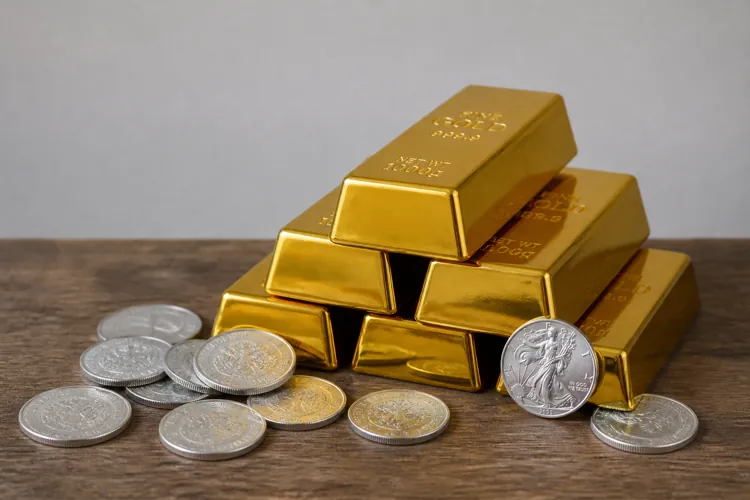

Gold has climbed above $4,700 an ounce as investors seek protection from geopolitical conflict, inflation, and concerns about rising government debt.
Silver has rallied along with gold but is also benefiting from strong industrial demand and a persistent shortage of physical metal.
A weaker U.S. dollar and expectations that interest rates may stabilize have made precious metals more attractive, though prices remain volatile.
Gold and silver prices have risen sharply in recent weeks as investors react to a mix of geopolitical turmoil, government debt concerns, a weaker U.S. dollar, and tight supplies of silver.
Gold futures moved above $4,700 an ounce Monday, their highest level since mid-May. Silver recently traded near $69 an ounce after gaining about 19% during August, although it pulled back slightly in Monday trading. Gold has risen about 15% this month.
The immediate catalyst for the latest rally was the U.S. Treasury Department’s decision to expand its purchases of longer-term government bonds. The move is intended to improve trading conditions and reduce some upward pressure on long-term interest rates.
However, some investors interpreted the larger bond-buyback program as a sign that the government is becoming increasingly concerned about high borrowing costs and the size of the national debt. That prompted a sell-off in the dollar and increased demand for assets, including gold, that are viewed as stores of value.
Gold rose above $4,600 late last week as the Treasury announcement contributed to dollar weakness and concerns about U.S. fiscal stability. It then extended its gains Monday, climbing above $4,700 in early trading, according toThe Wall Street Journal.
Why a weaker dollar helps gold and silver
Gold and silver are generally priced in U.S. dollars. When the dollar loses value, the metals become less expensive for investors using euros, yen, or other currencies, potentially increasing demand.
A weaker dollar can also raise concerns about inflation and the long-term purchasing power of cash. Some investors buy precious metals as a hedge against those risks.
Interest rates are another important factor. Gold and silver do not pay interest, so they may become less attractive when investors can earn high inflation-adjusted returns from Treasury securities or savings accounts.
But expectations that interest rates could stabilize — or eventually decline — reduce that disadvantage. Investors are watching upcoming inflation data and Federal Reserve Chairman Kevin Warsh’s speech at the Jackson Hole economic symposium for clues about the central bank’s next move.
War and economic uncertainty boost demand
Geopolitical tensions have also added to the rally. Conflict involving Iran, continuing uncertainty surrounding Ukraine, and renewed trade disputes have increased demand for investments considered relatively safe during periods of instability.
Gold has traditionally filled that role because it is widely traded, cannot be created by a government, and is held as a reserve asset by central banks.
Central-bank purchases have provided another source of demand. The World Gold Council has said economic and geopolitical uncertainty, investment demand, and central-bank buying remain important supports for the gold market.
Silver has an additional advantage
Silver often moves in the same direction as gold, but it is also an important industrial material. It is used in solar panels, electronics, electrical grids, automobiles, medical equipment, and data-center infrastructure.
That gives silver two sources of demand: investors looking for a precious metal and manufacturers that need it to make products.
At the same time, the world is consuming more silver than mines and recycling operations are supplying. The Silver Institute projects that the silver market will record its sixth consecutive annual supply deficit in 2026.
Because the silver market is much smaller than the gold market, a relatively modest increase in investment buying can produce a much larger price movement. That helps explain why silver has recently outpaced gold.
What it means for consumers
Consumers who own gold or silver coins, exchange-traded funds, or mining stocks may have seen substantial gains. But anyone buying now should be aware that precious-metal prices can reverse quickly if the dollar strengthens, interest rates rise, or geopolitical tensions ease.
Physical gold and silver also usually sell at a premium over the quoted market price. Dealers may offer substantially less than the market price when an owner sells.
The recent rally does not necessarily mean metals will continue rising at the same pace. It does show, however, that investors are increasingly willing to pay for protection against economic, political, and currency risks.