
2025 Gas Prices and Trends

Article Image

Drivers spending near record-low share of income on gasoline

  • In 2025, drivers are expected to spend less than 2% of disposable income on gas — the smallest share in two decades.

  • The average price of regular gasoline is $3.12 per gallon, down compared to last week, last month, and last year, with most states seeing decreases except parts of the West Coast facing infrastructure-related increases.

  • Prices range from as low as $2.68 in Mississippi to as high as $4.64 in California and Washington, though the median U.S. price is $2.95 per gallon, with many common prices under $3.


While restaurant bills can put a dent in your wallet, paying for the gasoline to get you to the restaurant won’t. A report by the Energy Information Administration found that drivers are expected to spend the smallest share of their disposable income on gasoline this year than at any time in the past two decades.

The agency’s report said less than 2% of people's personal disposable income will be spent on gasoline in 2025, down from an average of 2.4% over the previous decade. Excluding 2020, when the pandemic made gas incredibly cheap, that’s the lowest percentage since 2025.

According to GasBuddy data, the national average price of gasoline is down 3.6 cents in just the last week and stands at $3.12 per gallon.

That’s 1.8 cents lower than a month ago and is 2.8 cents per gallon lower than a year ago. The national average price of diesel has decreased 2.6 cents in the last week and stands at $3.658 per gallon.

The West Coast is still expensive

“While gas prices fell in more states than they rose last week, the West Coast continues to face challenges, with Oregon and Washington seeing some of the largest increases due to regional infrastructure issues,” Patrick De Haan, head of petroleum analysis at GasBuddy, said in the company’s blog. 

“The good news is that the transition to cheaper winter gasoline begins across most of the nation, and with improvements underway in the West Coast market, I expect that average gas prices will continue to decline in the weeks ahead in most states — assuming hurricane season remains quiet.”

Drivers have benefited in two ways. First, gas prices have remained stable for months, making it easier to budget for fuel. Second, adjusted for inflation, gas prices are about the same as they were five decades ago.

In 1970, the national average retail price of regular gasoline in the United States was about $0.36 per gallon. To put that in perspective, adjusted for inflation, that’s roughly $2.80–$3.00 per gallon in today’s dollars.

Below $3 a gallon

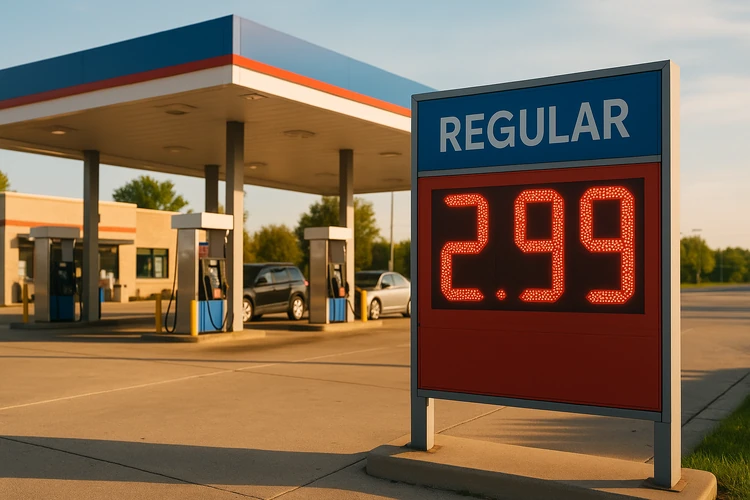
According to GasBuddy, the most common U.S. gas price encountered by motorists is $2.99 per gallon, unchanged from last week, followed by $2.89, $2.79, $3.09, and $2.69, rounding out the top five most common prices.

The median U.S. gas price is $2.95 per gallon, down 4 cents from last week and about 17 cents lower than the national average.

The top 10% of stations in the country average $4.45 per gallon, while the bottom 10% average $2.58 per gallon.

The states with the lowest average prices: Mississippi ($2.68), Oklahoma ($2.73), and Arkansas ($2.75).

The states with the highest average prices: California ($4.64), Washington ($4.64), and Hawaii ($4.45).

Article Image

Gas prices to fall due to tariffs, feds say

Key takeaways:

  • Changes in trade policy, namely tariffs, and oil production are expected to lower gas prices.

  • Gas prices are expected to come down to around $3.10 a gallon in 2025 and 2026 from $3.30 a gallon in 2024.

  • Still, there is uncertainty about how oil markets could react in the coming months if trade policy continues to change.

One benefit from tariffs could be seen at the pump.

Recent developments in global trade policy and oil production are expected to lower demand growth for U.S.-exported petroleum through 2026, sending gas prices down, according to the latest short-term outlook from the Energy Information Administration.

The EIA said it expects gas prices to be around $3.10 a gallon in 2025 and 2026, down from $3.30 a gallon in 2024.

"If the forecast holds, this price would be the lowest inflation-adjusted summer average gasoline price since 2020," the EIA said.

President Trump's announcements of tariffs sent the price of brent crude down 12% to $68 a barrel on April 2, the EIA said.

Inflation also declined in March for the first time in five years, largely because of lower gas prices, according to the Consumer Price Index.

But there is other uncertainty about the future of trade policy and how that will affect gas prices, the EIA said.

For instance, existing sanctions on Russia, Iran, and Venezuela, which could change, are also affecting oil prices, the EIA said.

Propane prices are also expected to lower due to tariffs weakening demand demand from China, which is a major importer of U.S. propane, the EIA said.

The EIA said it expects propane prices to fall to 50 cents a gallon in 2026 from 80 cents a gallon in 2025.

"Some propane previously exported to China will likely find new destinations." the EIA said.

Article Image

At least 23 states have average gas prices under $3 a gallon

Oil refineries in the U.S. get most of their crude oil from Canada, and after the U.S. slapped a 10% tariff on Canadian oil, industry experts predict gasoline prices would rise. So far, that hasn’t happened. Gasoline prices are falling, with the lowest March gas prices since before the pandemic.

AAA reports the national average price of regular gas is $3.08 a gallon, down two cents in the last week and six cents lower than a month ago. Last year at this time, a gallon of gas averaged 31 cents a gallon more.

So, what’s going on? For starters, the world price of crude oil is falling, thanks to growing supplies from Saudi Arabia. Oil futures markets have been weak lately over growing concerns about the global economy.

In the U.S., 23 states have average prices of regular gas below $3 a gallon. Mississippi has the lowest gas prices in the nation with an average of $2.64 a gallon. California has the most expensive gas in the nation, averaging $4.64 a gallon.

Bucking the seasonal trend

Normally, gasoline prices begin to rise at this time of year. Refineries reduce output so they can perform seasonal maintenance. In another few weeks they will switch over to producing summer grades of fuel, which are more expensive.

Even though motorists may be enjoying lower gas prices now, the lower prices may be a sign of economic trouble ahead. 

“Concerns about the direction of the economy could have a major influence on fuel prices in the months ahead, especially with the high level of uncertainty surrounding tariffs,” Patrick DeHaan, GasBuddy’s head of Petroleum Analysis wrote on the company’s blog.

“Additionally, OPEC+ announced last week that it would gradually begin restoring oil production after nearly two years of cuts, adding further downward pressure on oil prices. As a result, the typical seasonal rise in gas prices has yet to materialize, and if and when it does, it may be considerably smaller than expected.”