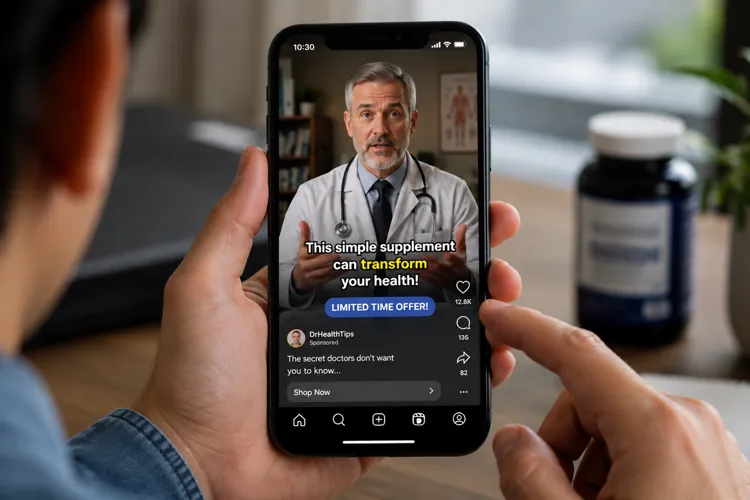

Fake AI “doctors” are promoting supplements online. They sometimes impersonate real medical professionals without their permission.
Verify the expert before you buy. Search their name, credentials, and medical affiliation — and be skeptical if they exist only on social media.
Watch for miracle claims and pressure tactics. Promises of dramatic results, “secret” cures, and limited-time offers are strong signs to slow down and investigate.
That friendly doctor or wellness expert showing up in your social media feed may not be a real person.
A recent New York Times investigation found that scammers are increasingly using artificial intelligence to create convincing-looking health influencers who promote supplements with exaggerated, or completely false, claims. Some videos even use AI to imitate the faces and voices of real doctors without their permission.
As AI tools become more sophisticated, it's getting harder to tell what's real and what's fake. But there are still several warning signs consumers can watch for before clicking "Buy Now."
The 'expert' doesn't seem to exist
Before trusting health advice, take a minute to verify who's giving it.
Go to Google and search for the person's name along with terms like "MD," "clinic," or "hospital." A legitimate physician or registered dietitian should have an online presence beyond just social media. These should include either a medical practice website, hospital profile, or a professional licensing record of some sort.
If the only search results you find are copies of the same ad or social media accounts, consider that to be a big red flag.
The claims sound too good to be true
Promises of dramatic results are one of the biggest warning signs.
Be skeptical of supplements that claim to reverse chronic diseases, melt away fat without diet or exercise, erase wrinkles overnight, or deliver "miracle" results. Legitimate health experts generally discuss both the benefits and limitations of a product rather than guaranteeing life-changing outcomes.
Watch for subtle AI clues
Many AI-generated videos are remarkably realistic, but some still contain telltale signs.
Look for lip movements that don't quite match the audio, unnatural blinking, overly smooth skin, awkward facial expressions, or hands that briefly appear distorted. While these flaws are becoming less common, they can still reveal that a video was generated by AI.
High-pressure sales tactics
Scam ads are designed to make you buy before you think.
Phrases like "Only today," "Limited supply," or "Doctors don't want you to know this secret" are meant to create urgency and discourage you from doing your own research.
A reputable company won’t mind if you take a day to compare products and read independent reviews. They’d actually encourage it.
Verify the company — not just the product
Before purchasing, spend a few minutes looking at the company's website.
Missing contact information, vague "About Us" pages, poor grammar, and unrealistic customer testimonials can all signal that a seller isn't trustworthy. It's also smart to search the product name along with terms like "FDA warning," "lawsuit," or "consumer complaints" to see whether problems have already been reported.
The bottom line
Artificial intelligence is making fake health influencers more convincing than ever, and experts expect these scams to become even more common.
Before spending money on a supplement recommended by someone on social media, pause, and do a little homework. Verifying who's behind the recommendation, checking for independent evidence, and resisting high-pressure sales tactics can help protect both your wallet and your health.
When it comes to medical advice online, remember that a white lab coat and a polished video are no longer proof that the person on your screen is actually real.