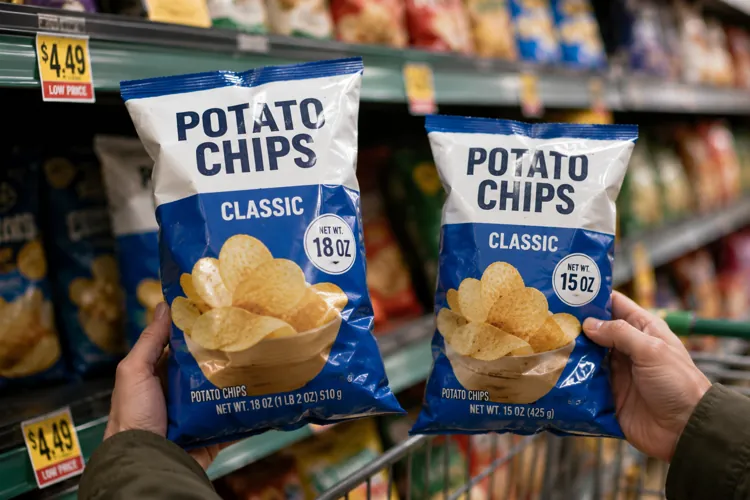

Shrinkflation is everywhere: 89% of Americans say they've noticed products getting smaller while prices stay the same.
Paying more isn't always obvious. Smaller packages, lower quality, creeping subscriptions, and convenience costs can quietly drain your wallet.
Look beyond the sticker price. Check unit prices, compare competitors, and question whether a “sale” is really a deal.
The price tag doesn't always have to change for something to become more expensive.
If it feels like the bag of chips you're buying has gotten suspiciously lighter, you're probably not imagining things.
A new Omnisend survey found 89% of Americans have noticed shrinkflation, the practice of reducing the amount of product in a package while keeping the price the same. Even more telling, 59% say they notice it regularly, and 29% call it the most unfair type of price increase.
Groceries are where shoppers are noticing it most, with 65% of Americans saying that's where shrinkflation is most obvious.
But shrinking the package isn't the only way something can effectively become more expensive. From smaller portions to deteriorating service, consumers increasingly need to look beyond the number printed on the price tag.
Here are seven ways you can wind up paying more without immediately realizing it, along with tips to fight back.
1. Shrinkflation: Same price, less stuff
Shrinkflation is the classic example. Your cereal still costs $5.49, but instead of getting 18 ounces, you're only getting 16.5. Or the bottle of detergent looks almost identical, but it handles fewer loads.
The easiest defense is to stop comparing package prices, and instead, start comparing the unit prices. For example, if one box costs $4.99 and another costs $5.49, the cheaper box isn't necessarily the better deal. Check the shelf tag for the cost per ounce, pound, count, or whatever other unit is being used.
Pro tip: When you regularly buy an expensive household staple like coffee, detergent, pet food, or paper products, be sure to take a picture of the package's net weight and store it in a "grocery" folder on your camera roll. If the packaging changes later, you'll have something to compare it with.
2. Skimpflation: Same product, worse experience
Shrinkflation removes some of the product while skimpflation can remove some of the quality.
For example, a company might change ingredients, reduce staffing, eliminate a service, or otherwise deliver less value while charging roughly the same price. Think fewer employees available to help customers, reduced hotel housekeeping, or a food product reformulated with cheaper ingredients.
It's harder to spot because there's no convenient "price per ounce" comparison.
Before assuming a familiar product is still the best choice, periodically look at competing brands. Loyalty gets expensive when you're paying yesterday's price for a worse version of yesterday's product.
3. The package changed — so your price comparison disappeared
Packaging changes can make price comparisons surprisingly difficult.
For example, maybe you normally buy a 12-pack of a product, but now you're looking at a 10-pack. Or one retailer sells 16 ounces while another sells 18.
All of a sudden, comparing an $8.99 price tag with a $9.79 tag tells you very little.
This is another reason unit pricing is your friend.
And be especially careful with warehouse club and "family-size" packages. Bigger doesn't automatically mean cheaper. For this reason, be sure to calculate the price per unit before assuming the giant package is the bargain.
4. The "sale" is doing psychological heavy lifting
A big red SALE sign doesn't tell you whether the price is actually good.
Consumers have become conditioned to expect discounts. Separate Omnisend research found 50% of Americans regularly wait for sales or promotions, while 43% compare prices across multiple websites and 40% search for discount codes before checking out.
That makes the reference price, which is typically the crossed-out number sitting beside today's price, extremely persuasive.
Don't focus on how much the retailer says you're saving. Instead, focus on what you'll actually pay and whether competitors are selling the same item for less.
For expensive purchases, start watching prices several weeks before you intend to buy. You'll quickly learn what a genuine sale looks like.
5. Subscriptions creep upward a few dollars at a time
A $2 monthly increase in Spotify or Netflix doesn't feel particularly threatening to your monthly budget.
But multiply it across multiple streaming services, apps, cloud storage, memberships, and software subscriptions and suddenly you're spending another $30 or $40 every month. That's $360 to $480 per year.
Subscription increases are especially easy to miss because the purchase decision happened months or years ago. You're not consciously deciding to buy the service every month; your credit card is doing all the work for you.
Pro tip: Get in the habit of searching your credit card and bank statements for any recurring charges twice a year. For every subscription you find, ask yourself, “If I weren't already subscribed, would I sign up today at this price?” If the answer is no, get rid of it.
6. Convenience can disguise what something really costs
While there's nothing inherently wrong with paying for convenience, the problem comes when you don't realize exactly how much you're paying.
Grocery delivery is the perfect example. The convenience of getting groceries delivered might include higher prices, a delivery charge, service fees, and even a tip.
The $75 grocery order you think you're making might ultimately cost considerably more than going to the store yourself.
Try this: Before using a convenience service, do an experiment. Build the same basket for pickup or in-store purchase and compare the final totals. Then decide whether the convenience is worth the extra money. It may actually be. But at least you'll know what you're paying for it.
Use the 30-second price test
You don't need an Excel spreadsheet to protect yourself from those stealthy price increases.
Before making a purchase, particularly something you buy regularly, ask yourself:
Did the package size change?
What's the unit price?
Is the quality or service still the same?
What is the final price after fees?
Would I buy this if it weren't advertised as being on sale?
Those five questions can reveal a surprising amount.
And consumers appear increasingly willing to push back. Omnisend found 67% of Americans say higher prices have changed how they feel about brands or stores they previously liked.
Some shoppers have even stopped buying certain brands altogether while others say they trust them less.
The consumer takeaway
Consumers understand that prices sometimes need to rise. In fact, the Omnisend survey found some Americans are willing to accept higher prices when they're tied to things such as better quality, higher worker wages, or increased ingredient and material costs.
What frustrates shoppers is paying more without realizing they're getting less.
So don't judge a deal by the sticker price alone.
Look at the quantity. Check the unit price. Examine the fees. Question the "sale." And every once in a while, reconsider whether the brand you've bought for years is still earning your money.