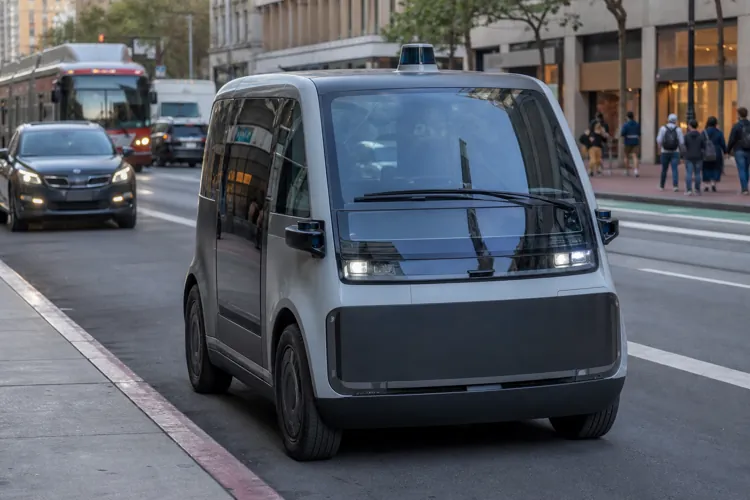

NHTSA has granted Amazon-owned Zoox approval to begin limited commercial deployment of its purpose-built robotaxis that have no steering wheel or pedals.
The exemption allows Zoox to operate up to 2,500 vehicles annually for the next two years while charging passengers for rides.
The decision marks the first federal approval for a commercially deployed, purpose-built autonomous passenger vehicle without traditional human driving controls.
Amazon's self-driving vehicle company Zoox has cleared a major regulatory hurdle after the National Highway Traffic Safety Administration (NHTSA) approved limited commercial deployment of its steering-wheel-free robotaxis, paving the way for the company to begin charging passengers for rides.
The temporary exemption allows Zoox to deploy up to 2,500 of its purpose-built autonomous vehicles each year for the next two years, despite the vehicles lacking many features required under current federal motor vehicle safety standards, including a steering wheel, brake pedal, accelerator pedal, rearview mirrors, and other equipment designed for human drivers.
The approval makes Zoox the first company in the United States authorized to commercially operate a purpose-built robotaxi that was designed from the ground up without human driving controls, a milestone for the autonomous vehicle industry.
From free rides to paid service
Until now, Zoox had been limited to offering free demonstration rides in San Francisco and Las Vegas under an earlier testing exemption. The new approval allows the Amazon subsidiary to begin charging passengers, with commercial service expected to launch first in Las Vegas as early as next month before expanding to other markets, including Miami and Austin.
Unlike competitors that retrofit existing passenger vehicles with self-driving technology, Zoox designed its electric robotaxi specifically for autonomous operation. The shuttle-like vehicle seats four passengers on inward-facing benches, uses sliding doors, and can travel in either direction without needing to turn around.
Safety requirements remain
NHTSA said Zoox demonstrated that its vehicles provide a level of safety equivalent to or greater than conventionally designed vehicles, despite not complying with several federal safety standards written for cars operated by human drivers.
The approval does not remove federal oversight. Zoox will remain subject to enhanced monitoring by regulators, and the company recently issued a software recall after investigators found its robotaxis needed improved responses to smoke-related incidents.
A changing regulatory landscape
The approval follows months of regulatory review after NHTSA sought public comment on Zoox's petition for an exemption from eight federal vehicle safety standards that assume a human driver is behind the wheel. Transportation officials have said they are also working on broader updates to national autonomous vehicle regulations that would better accommodate vehicles designed without traditional controls.
The decision intensifies competition in the robotaxi market. Waymo currently operates commercial autonomous ride-hailing services using modified production vehicles equipped with steering wheels and pedals, while Tesla is pursuing its own purpose-built Cybercab. Zoox's approval establishes a regulatory pathway for fully autonomous passenger vehicles built without any manual driving controls.