

Key insights
Consider other commercial storage options, storing with a friend or family member or making space in your own home for short-term storage.
Jump to insightPer-box storage is often more affordable and more convenient, and some movers offer short-term storage options for an all-in-one solution.
Jump to insightIf access and security aren’t primary concerns, consider peer-to-peer storage, or use space in a friend’s or family member’s home if you have one nearby.
Jump to insightAlternatives to storage units overview
There are three primary alternatives to storage units to think about:
- Similar commercial storage options that offer more flexibility
- Storing your belongings in another residence
- Storing your belongings on your own property, including on-site storage units
Each of these routes has a few different options you can explore. The alternative you choose depends on your budget, the value of your belongings, your tolerance for security and ongoing access and the length of time you need storage.
Understanding how these alternatives compare is a good place to start to find the option that works best for you. For example, if the cost of a storage unit is your primary concern, you can explore the free options in the table below. If access and security are most important to you, prioritize options that allow ongoing access and don’t rely on others for oversight.
| Typical cost | Best for | Access | Climate control | Security level | |
|---|---|---|---|---|---|
| Per-box commercial storage | Small moves with no room on-site | Low | Possible | Moderate | |
| Moving company storage | High reliability for delivery | Low | Possible | Moderate | |
| Shared storage space | Low cost, off-site storage | Low to moderate | Possible | Low | |
| Storing with friends/family | Flexibility and no/low cost | High | Possible | High | |
| In-home storage | People with room to spare | High | Possible | High | |
| On-site storage unit | Packing convenience | High | No | Moderate | |
| Outbuilding | Also adding value to the property | High | Usually no | High |
Portable storage options for short-term storage
There are two main commercial options for moving and storing individual boxes for short periods: per-box storage and mover storage. These are good options if you want or need your belongings stored off-site and have some room in your budget for paid storage. Best of all, you don’t need to do any work beyond the initial packing.
Per-box storage
Some companies, like Endless Storage and Clutter, offer per-box commercial storage, which is convenient and can be less expensive than storage units. Most charge by the box, which is flexible, especially for small moves. You pack individual boxes, sometimes provided by the company, and then employees come to pick them up and move them into storage.
You’ll usually have minimal access to your belongings, though, and while your boxes will be in a secure warehouse, you’re still relying on other people to maintain security. Plus, you’ll need to coordinate box delivery after your move, which is another step some people may not want.
Mover storage
Another option is storage offered by your movers. This is a similar arrangement in that you pack individual boxes for pick-up, but you don’t have to find, vet and rely on another company to get your belongings where they need to go. Instead, your mover picks them up and moves them to its own storage facility.
Some movers may provide access to your belongings within their storage units, but it’s usually limited. Pricing varies widely among different companies and may depend on their total storage space. Security is similar to what you’d get with per-box storage, although you have one fewer company to rely on, so it’s a bit safer.
Non-commercial storage
You also have two options for non-commercial storage: peer-to-peer storage or space sharing, and storing with friends or family. These options vary widely in cost and security. They’re often less secure than commercial storage, but are usually more affordable.
Peer-to-peer storage
Websites like Neighbor.com provide a marketplace where people with extra room can rent out storage space. It works similarly to short-term rental sites, like AirBnB and VRBO, but instead of a vacation home, you get short-term storage space.
Pricing varies widely and depends on the type of space you rent, your location, the timeline for your move, demand in your area and more. In many cases, peer-to-peer storage will be less expensive than a traditional self-storage unit, but you’re relying on a stranger for security, so it’s only a good route if you have low-value items to store.
Peer-to-peer storage also doesn’t include any packing or moving assistance, so it’s less convenient than commercial options. You may have more limited access to your belongings, as well, so low-value non-essentials are the best bet for this option.
Storing with friends or family
For those with friends or family members nearby, it may be possible to store some of your belongings in their spare rooms, garages or sheds until you’re ready for them in your new home. Of course, access to this option isn’t always available, as you need reliable people nearby who have space to spare.
This option is often free, and you’re more likely to have ongoing access to your belongings in storage. Plus, you’re relying on people you know, so security is almost always going to be better than what you’d get from a commercial storage unit provider.
Depending on the storage area, your belongings could be in a climate-controlled area with active pest control and security monitoring.
Home storage options without rental fees
Finally, you have some options to store your belongings on your own property, some of which could work for you even if you don’t think you have room.
In-home storage
One of the simplest alternatives to a storage unit is storing your belongings in your own home. This may not be an option for everyone, but it might be possible to clear out a garage, attic, or spare room and keep your belongings there until you’re ready to move.
In-home storage is, of course, free aside from the cost of boxes, so it’s the most affordable option. You also have total control over your personal property, so it’s the most secure route, with constant and unimpeded access to everything in storage. If you can make space for your stuff, the flexibility is unmatched.
Here are some tips for making room in your existing home for short-term storage:
- Invest in organizational solutions, like labeled totes and closet systems
- Make use of vertical spaces with shelving and wall storage
- Install overhead storage racks in your garage
- Declutter and donate unwanted clothes and other goods
- Consider outdoor storage options, like deck boxes
- Clear out basements and garages to make room for storage items
- Consider partially finishing the attic to add space
- Invest in dehumidification for basement and attic storage
- Use vacuum-sealed bags to compress bedding and clothing
- Make use of the space under beds and in closets
The only fees you may need to consider are delivery fees, as you’ll need your movers to move everything along with your other belongings, like furniture.
On-site storage
Storing your belongings on your property may still be possible if you don’t have space inside your home. You can rent a self-storage unit from a company like PODS or 1-800-PACK-RATS.
The provider will deliver an exterior storage container to your driveway or lawn and then pick it up and drive it to your new home when you’re ready. This gives you flexibility for packing and ongoing access to your belongings, and it’s often cheaper than a self-storage unit.
Your property remains relatively secure, as you’re the only one with access to the container, although it’s less secure than belongings you store in your living space.
Outbuilding storage
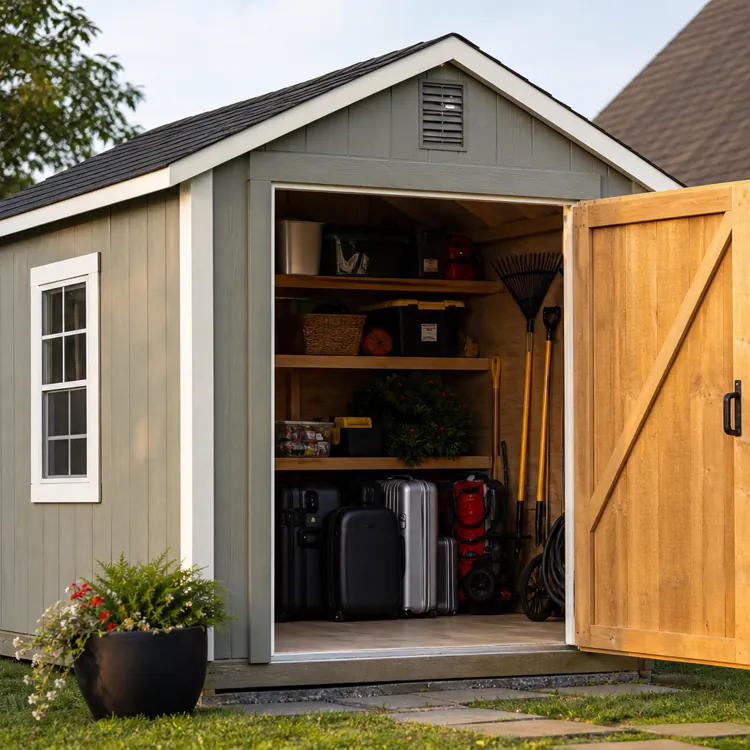
Finally, you could opt to build an outbuilding, like a shed or a detached garage, just for short-term storage. This option can be expensive, usually costing between $2,000 and $4,000 for a shed and much more for a detached garage. But it’s likely to add value to your home, so you could recuperate some of your investment.
An outbuilding gives you more security for your belongings than an on-site storage container, similar flexibility and constant access. However, it’s less convenient when it comes time to relocate, as you’ll need your movers to haul out boxes and containers manually on both sides of the move.
With both on-site storage and outbuilding storage, it’s a good idea to seal your belongings in plastic bags or vacuum-sealed bags to prevent damage from moisture, mold and pests.
»FIND OUT: Best storage unit locks



FAQ
Are home storage solutions better than renting a unit?
Home storage solutions are sometimes better than renting a unit, particularly if you want maximum security for high-value items, climate control to avoid mold, water and pest damage, ongoing access to your belongings or more flexibility when it comes to packing and unpacking. Home storage solutions are often more affordable than renting a storage unit, making them better for those on tight budgets.
What items should not be stored in alternative storage spaces?
Avoid storing unsealed clothes, bedding and other fabrics in areas without moisture and pest control, such as some garages, basements, attics, sheds or on-site storage units. It’s also a good idea to keep high-value items inside your living space for maximum security, as well as items you might need before you complete your move, like kitchen utensils, small kitchen appliances and bathroom items.
How much can I save by using storage alternatives?
You could save an average of between $90 and $290 per month, which is how much storage units typically cost. For example, storing your belongings in your own living space or in a friend’s home usually won’t cost you anything, so you’ll see substantial savings. Storing in an on-site storage container costs between $150 and $250 a month, so you could save up to between $40 and $140 every month while maintaining easier access to your belongings.
Is it cheaper to get a POD or a storage unit?
Storage units cost between $90 and $290 per month, on average, while PODs and equivalent solutions cost between $150 and $250 per month. In many cases, you’ll save by going with a POD, plus you’ll have easier ongoing access to your belongings. They’ll also remain more secure, as you’ll be the only one with a key.
Article sources
ConsumerAffairs writers primarily rely on government data, industry experts and original research from other reputable publications to inform their work. Specific sources for this article include:
- Endless Storage Ventures LLC, "Simple, Easy Pricing." Accessed March 18, 2026.
- Clutter, "Smart Storage." Accessed March 18, 2026.
- PODS Enterprises LLC, "How PODS Storage Prices Are Calculated." Accessed March 18, 2026.
- 1-800-PACK-RAT, LLC, "Moving & Storage Made Simple." Accessed March 18, 2026.
- The Home Depot, Inc., "Shed Installation Cost Guide." Accessed March 18, 2026.
- Lowe's Home Improvement, "Wood Shed Installation." Accessed March 18, 2026.