


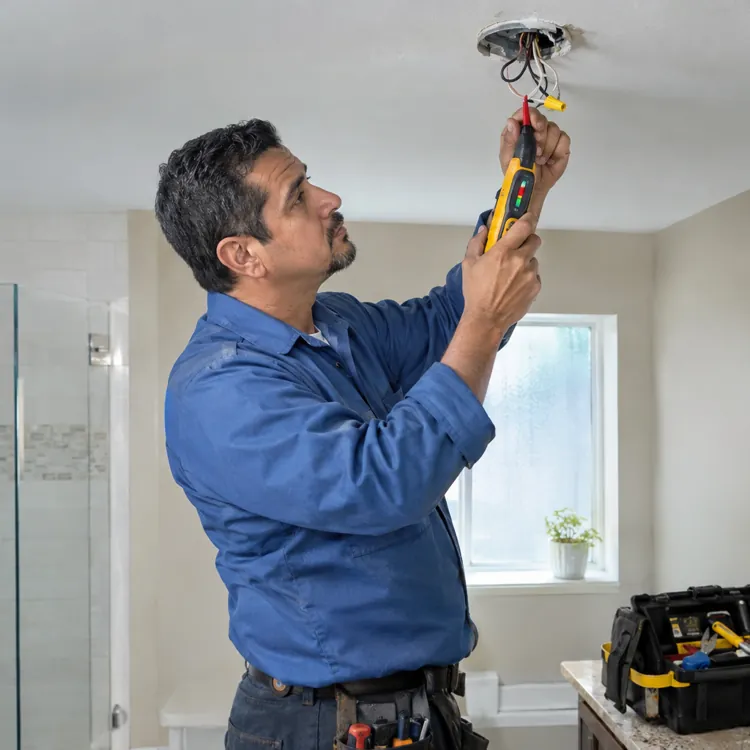
When you should call an electrician
In most cases, you can replace your current lighting fixture yourself, without an electrician.
However, replacing a lighting fixture requires some electrical knowledge, especially in more complicated situations, like working in an older home, when the new fixture is heavier than the old one or when you’re replacing an outdoor light.
Knowing which factors complicate light fixture replacement and require hiring an electrician can save you money, even if it means paying more upfront.
Generally, it’s best to hire an electrician to replace your light fixture if these situations apply:
Unsure about wiring or no grounding wire
If you're unsure how to connect your home’s wiring to the new light fixture, or whether it can support it, it’s best to play it safe and call an electrician. Also, if your wiring setup lacks a grounding wire, you should use an electrician.
Old homes with old or damaged wiring
Old homes’ electrical circuits were often designed to handle less power than today’s light fixtures require, and many of them don’t have a grounding wire. If your home was built before 1970, the wiring system may use outdated materials that a professional should handle.
Outdoor lighting
Since it’s exposed to the elements and precipitation, outdoor lighting is more complicated than indoor lighting. An electrician will ensure code compliance and use conduits that protect the wiring from moisture.
Bathroom or kitchen
Areas in your home that are vulnerable to humidity and water, such as your kitchen and especially your bathroom, have specific ingress protection (IP) rating requirements that specify waterproof security for your light fixtures. An electrician should always handle lighting in these rooms.
Loose or missing electrical box
A light fixture’s electrical box secures its wired connections and supports the fixture’s weight. If your junction box is loose, installed insecurely or missing, an electrician can ensure it properly supports the fixture.
New fixture is heavy
If the new light is significantly heavier than the old one, or if you’re installing a chandelier, it may need additional support through special mounting hardware or a new junction box. To make sure it’s done properly, consult an electrician.
High ceiling
If the room has a high ceiling, you'll usually need a ladder, which increases the risk of falling or the fixture falling and shattering. Electricians have the proper equipment to handle this, making the job safer.
Under warranty
If you are replacing a lighting fixture under warranty that a professional originally installed, the warranty may require a professional to handle the replacement. In that case, contact the original installer to confirm the warranty details.
Choose the right IP rating
A higher IP rating doesn’t automatically mean a light fixture is suitable for every location. Match the IP rating to the fixture’s exposure to dust and moisture.
Changing a light fixture yourself
Replacing a light fixture, like swapping a ceiling fan, can subtly improve your home’s appearance and value.
If you have some electrical savvy and a modern home, you may be able to replace your light fixture yourself without an electrician. In this case, you’ll need the right basic tools and a clear understanding of which wires you’ll find in your junction box.
Here’s what you need to know to change your own light fixture:
Gather required tools
To replace your own light fixture, you'll need a few tools, including wire cutters, a screwdriver, a work light, a voltage detector and possibly a ladder. You’ll also want to either reuse the wire connectors from your previous fixture or buy new ones.
Here are the tools you’ll need to change your own light fixture:
- Wire cutter or stripper: To strip the coating from the new fixture’s wires so you can connect them to the wires in the junction box
- Screwdriver: To remove the old light fixture and secure the new one in place
- Work light: To provide visibility while you work, since you’ll turn off the circuit breaker before replacing the fixture
- Circuit tester: To verify that the power is off before handling any wires
- Safety glasses: To protect your eyes from dust and falling debris
- Wire connectors: To join the fixture’s wires to the wires in the junction box
Can you reuse wire connectors?
You may be able to reuse the connectors from your old fixture if they’re in good condition and compatible with the new wiring.
Connect wires by color
Junction boxes and electrical fixtures in most modern homes have three wires: black, white and green or bare copper.
- Black: The wire that carries electricity into the fixture from your home’s panel
- White: The wire that carries electrical current back to the panel
- Green: The grounding wire that helps protect against electrical fires by providing a path for fault current that can trip the circuit breaker
Light fixtures also have three corresponding wires. When you connect your new light fixture, connect the fixture wires to the matching colors in your junction box.
When wiring isn't standard
If you have an old home, the wires may use a different coloring scheme or may not be color coded at all. Also, many fixtures in older homes lack a grounding wire and have only two wires.
In either case, contact an electrician to ensure your home’s wires are correctly matched and installed. Electricians can install a grounding wire, modernizing your home to meet safety codes.
» RELATED: Can you install ceiling fans yourself?
Safety steps for replacing a light fixture
While replacing your light fixture can be a DIY project, it’s critical to take the proper safety measures beforehand. This includes safely turning off your home’s power, confirming your home’s wiring setup and double-checking the junction box’s stability.
To ensure you safely replace your fixture, here are seven steps to take beforehand:
- Turn off the power: Before touching the fixture, go to your circuit breaker and turn off the circuit that powers it. To confirm, make sure the old light fixture no longer turns on.
- Confirm the power is off: Use a voltage tester to confirm that the power is off. After confirming the voltage tester works by inserting its probes into the outlet slots, touch the voltage tester to the hot and neutral wires connected to your previous light fixture to ensure it shows no power.
- Verify the grounding wire: Inspect the wires coming from your old light fixture for a third wire — a green or bare copper wire. This is the grounding wire, which is necessary for safety; if it’s missing, contact an electrician.
- Inspect the junction box: Visually check your junction box for loose wiring connections, burn marks, corrosion or rust.
- Photograph the wires beforehand: Before you remove your old fixture, take a photo of the wired connections. This will help you reconnect them properly to your new fixture.
- Secure the mounting plate or bracket: Some light fixtures mount directly to your junction box, but many use a mounting plate or bracket that you must fasten to the junction box before installing the new fixture.
- Check the wires on the new fixture: Read the manual and installation instructions for your new fixture, and visually confirm where to secure and screw the fixture and how the wires will connect.
Outdoor light fixture replacement considerations
Outdoor lighting has many uses, such as illuminating pathways, patios and providing floodlighting for large areas. However, because outdoor lights face the elements much more than indoor lights, they require specialized sealants and materials.
If you use a whole-house generator for emergencies, make sure your outdoor lighting is included in its power plan.
Weather-rated replacement fixtures
When replacing an outdoor fixture, make sure it’s weather-resistant. Outdoor placement exposes the fixture and its materials to rain and moisture, sun radiation, light damage, dust and large temperature swings.
Choose a replacement with at least an IP65 or IP66 rating to protect against precipitation, ideally with wires and parts made from rust- and corrosion-resistant materials like stainless steel or brass.
Moisture sealing and gaskets
The gasket is a rubber seal that fits inside the light fixture’s housing and compresses between parts to keep moisture and dust out. Because outdoor lights face more moisture, sunlight and temperature changes than indoor lights, they require more robust gasket materials.
Silicone and Ethylene Propylene Diene Monomer (EPDM) are popular outdoor gasket materials, but the best choice depends on an area’s climate. EPDM is the standard choice, while silicone tolerates wider temperature swings, making it better for places that get a lot of snow.
Corrosion and damaged wiring
If your old fixture’s gasket didn’t provide a complete seal, some internal components may have begun to corrode. These components, usually the wires, may need replacement or just a cleaning.
However, if you notice performance issues — such as a light flickering when you move the fixture or cable, or several lights dimming consecutively after a certain splice point — corrosion or damaged wires may be the cause. In this case, you may need to cut the wire back to a noncorroded or undamaged section and reconnect it to the new fixture.
FAQ
Is a licensed electrician required to change a light fixture?
No, you can replace your own light fixture without an electrician, but we recommend this only if you have electrical experience.
How much does an electrician charge to replace a light fixture?
An electrician usually charges between $75 and $125 to install or replace a light fixture, though the final price can vary based on factors like their hourly rate.
Is it safe to replace a light fixture myself?
You can safely replace a light fixture only if you have electrical know-how and follow precautions like turning off the power before you start.
Is a handyman qualified to change a light fixture?
A handyman is probably qualified to change a light fixture, provided they have some electrical experience.
Article sources
ConsumerAffairs writers primarily rely on government data, industry experts and original research from other reputable publications to inform their work. Specific sources for this guide include:
- Better Homes & Gardens, “How to Use a Voltage Tester.” Accessed Oct. 27, 2026.
- Bharat Flameproof, “Common Issues with Junction Boxes and How to Fix Them.” Accessed Oct. 27, 2026.
- Golden Lighting, “Ground Wire Connections: A Safety-First Home Guide.”Accessed Oct. 27, 2026.
- Ideal Home, “The 3 bathroom lighting rules you must follow for a safe home – according to an electrician.” Accessed Oct. 27, 2026.
- Leviton, “How Do I Know If I Have An Earth Ground?” Accessed Oct. 27, 2026.
- Lowe's Companies, “How to Change a Light Fixture.” Accessed Oct. 27, 2026.
- Mister Sparky of Clearwater, “Do You Need an Electrician to Install a Light Fixture?” Accessed Oct. 27, 2026.
- Mister Sparky of Ocala, “Why Do Older Homes Not Have Ground Wires?” Accessed Oct. 27, 2026.
- Starnes Electric, “Do You Need an Electrician to Replace a Light Fixture?” Accessed Oct. 27, 2026.
- The DIY Playbook, “How to Install a Light FixtureTitle Missing.” Accessed Oct. 27, 2026.
- The Home Depot, “Light Fixture Installation.” Accessed Oct. 27, 2026.
- This Old House Ventures, “Everything You Need To Rewire a Light Fixture.” Accessed Oct. 27, 2026.