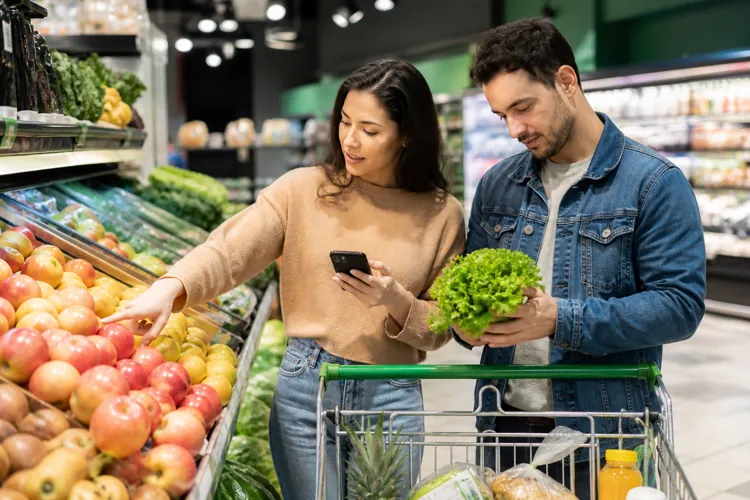

Grocery inflation has slowed, but prices remain elevated after several years of increases, and some staples — including beef, coffee, and sweets — are still rising sharply.
Higher energy, labor, transportation, and processing costs are built into the price consumers pay, making it difficult for supermarket prices to return to earlier levels.
Weather, animal disease, and tight supplies continue to create price pressure, while USDA expects grocery prices overall to rise again in 2026.
Consumers looking for relief at the supermarket are getting some good news: grocery prices have largely stopped rising month to month.
The bad news is that they aren't falling much either.
The government's latest Consumer Price Index shows food-at-home prices were unchanged in August from July but remained 2.2% higher than a year earlier. Overall inflation during the same 12 months was 3.4%.
That helps explain a frustration many consumers have experienced. A lower inflation rate doesn't mean groceries are getting cheaper. It means prices are increasing more slowly. After the large food-price increases of the early 2020s, today's smaller increases are being added to an already high base.
The U.S. Department of Agriculture (USDA) forecasts grocery prices will rise about 2.5% during 2026. But what's happening to individual products varies dramatically.
Beef is a major pressure point
One of the biggest problems is in the meat case.
USDA said beef and veal prices in July were 9.4% higher than a year earlier and forecasts a 9.8% increase for 2026. Federally inspected beef production declined nearly 5% in July, and tight cattle supplies are expected to restrain beef production during the second half of the year.
The latest USDA cattle outlook, released Sept. 18, says fed-cattle slaughter remains historically low and forecasts lower beef production in both 2026 and 2027.
That means hamburger and steak prices could remain a sore spot even if overall grocery inflation continues to cool.
Coffee, candy, and produce are also expensive
Other supermarket aisles have their own problems.
Coffee prices were 6.1% higher in August than a year earlier, according to the Labor Department. Instant coffee was up 11%. Sugar and sweets were up 6.1%, including an 8.1% increase in candy and chewing gum.
Produce has also been expensive. Fruits and vegetables as a category were 3.2% higher than a year earlier in August, although prices fell 0.4% from July.
USDA notes that weather and plant and animal diseases can have an outsized effect on particular foods. A drought, freeze, flood, or disease outbreak can reduce supply long before shoppers see the consequences in the supermarket.
The price of food isn't just the price of the food
One reason grocery prices don't immediately fall when farm commodity prices decline is that farmers account for only part of the final supermarket price.
Food has to be processed, packaged, refrigerated, transported, warehoused, stocked, and sold. All of those steps cost money.
USDA says processing and retailing costs generally play a greater role in supermarket prices than the underlying farm commodity. Its Food Dollar research shows that wages and benefits are particularly important: labor represented 54.1 cents of the overall U.S. food dollar in 2024.
That means higher wages, electricity bills, fuel prices, trucking expenses, packaging costs, and rents can keep grocery prices elevated even when the price farmers receive for a commodity falls.
Energy is an especially important factor because it touches nearly every stage of the supply chain — from operating farm equipment and manufacturing fertilizer to running processing plants and refrigerated trucks.
That pressure has become more noticeable again in 2026. Energy prices were 16.3% higher in August than a year earlier, while gasoline was up 27.4%, according to the latest CPI report.
Why prices probably won't return to their old levels
Consumers sometimes expect prices to retreat once inflation subsides. Historically, that's not usually how broad food inflation works.
Instead, prices tend to establish a new level and then rise more slowly. USDA data show grocery prices increased 11.4% in 2022, another 5% in 2023, 1.2% in 2024, and 2.3% in 2025.
So even modest inflation in 2026 is being piled onto those earlier increases.
There are exceptions. Egg prices, for example, have fallen substantially as poultry producers rebuild flocks following losses associated with highly pathogenic avian influenza. USDA expects egg prices to decline sharply for 2026 as a whole.
But across the supermarket, the picture is uneven. Consumers may find bargains on eggs, poultry, or some dairy products while continuing to pay significantly more for beef, coffee, produce, and sweets.