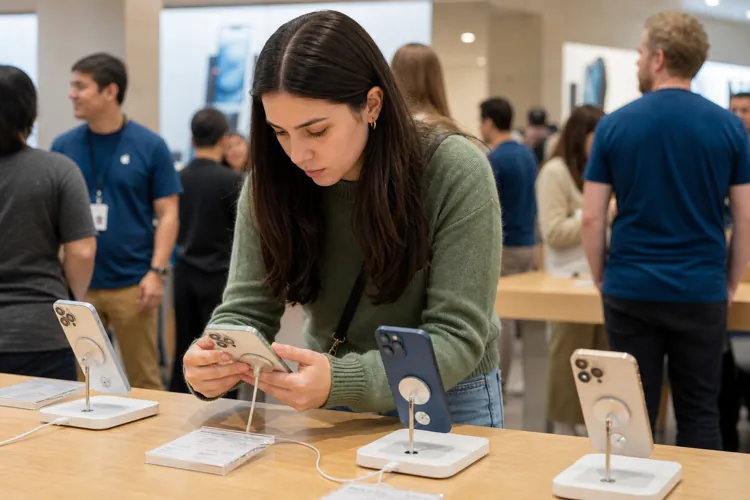

Apple’s new Apple Upgrade program lets consumers lease an iPhone for 12 or 24 months rather than buying it outright.
Monthly payments can be considerably lower than financing payments, but the customer does not own the phone when the lease ends unless they pay the remaining purchase price.
Consumers should compare the total cost with buying, financing and carrier promotions — and pay close attention to damage charges, early termination costs and end-of-lease deadlines.
Apple has introduced a new way to get an iPhone that looks a little more like leasing a car than buying a smartphone.
The program, called Apple Upgrade, allows eligible U.S. customers to lease an iPhone for either 12 or 24 months. The leases are provided by Klarna and are available through Apple's website, Apple Store app and retail stores.
Apple launched the program in July, replacing its previous iPhone Upgrade Program and iPhone Payments program in the United States. The important distinction for consumers is that Apple Upgrade is explicitly a lease, not a loan or installment purchase.
That can make the monthly payment attractive, especially for consumers who like getting a new phone every year or two. But there's a trade-off: making all the scheduled lease payments doesn't automatically make the phone yours.
How the lease works
Customers select an eligible iPhone and choose a 12- or 24-month lease. Klarna handles the lease and approval process. Apple says applicants undergo a soft credit inquiry that doesn't affect their credit score.
For example, Apple's new iPhone 18 Pro with 256GB of storage, which has a $1,199 purchase price, can be leased for a typical $34.99 a month for 24 months, excluding taxes and any trade-in credit. A 12-month lease costs about $49.99 a month.
Those payments are much lower than simply dividing the $1,199 purchase price over 24 months. That's because the consumer isn't paying to own the entire phone during the lease.
At the end, there are essentially three choices: return the iPhone and leave the program, return it and enter a new lease for a newer device, or pay the remaining purchase amount and keep the phone. Apple says a consumer who buys the device pays its original list price, less the lease payments already made and applicable remaining trade-in credits.
A trade-in when joining Apple Upgrade can also reduce the monthly lease payment.
There's a carrier requirement
There is one restriction that could make Apple Upgrade unsuitable for some consumers.
An iPhone lease requires the customer to select AT&T, T-Mobile or Verizon, and prepaid service isn't eligible. However, the leased iPhone itself is unlocked, meaning the customer can later switch carriers, subject to the carrier's terms.
That's something consumers using lower-cost prepaid carriers should consider before being attracted by the advertised monthly lease price.
What happens at the end matters
Perhaps the biggest potential trap is doing nothing when the lease expires.
Apple says that if the customer doesn't return, upgrade or purchase the device at the end of the initial term, the agreement can convert to a month-to-month lease for as long as six months, and monthly payments may increase.
If the consumer still takes no action when that extension ends, the purchase fee specified in the lease can be charged.
So consumers should treat the lease expiration date much like the end of an automobile lease and decide beforehand what they intend to do.
Damage could also cost you
Because the phone belongs to the leasing company, its condition matters when it is returned.
If an iPhone isn't returned in good working condition and the consumer doesn't have AppleCare coverage, Klarna can assess a one-time damage charge. Consumers can have a damaged phone repaired before returning it to avoid that fee. With AppleCare, applicable service fees can still apply after the phone is inspected.
Insurance isn't included automatically in the lease, and a lost or stolen device can also result in additional costs.
Consumers should also be cautious about signing a lease if they aren't reasonably sure they'll keep it for the full term. Apple warns that terminating a lease early can result in "substantial fees."
Leasing versus buying
For consumers who routinely replace their iPhone every year or two, leasing offers an obvious attraction: a lower monthly payment and a relatively simple path to the next model.
But someone who normally keeps a phone for four, five or even six years may find ownership more economical. Once a financed or purchased phone is paid off, there are no more device payments. A lease, by contrast, can create a continuing cycle of monthly payments if the consumer repeatedly upgrades.
Carrier promotions are another consideration. Apple says carrier offers on the new iPhone 18 Pro can provide as much as $1,200 in credits with an eligible trade-in, although such deals generally come with their own eligibility requirements and conditions.
The simplest comparison is to look beyond the advertised monthly payment. Consumers should calculate how much they will have paid at the end of the lease, determine what it would cost to keep the phone, and compare that with buying outright, traditional financing and available carrier deals.