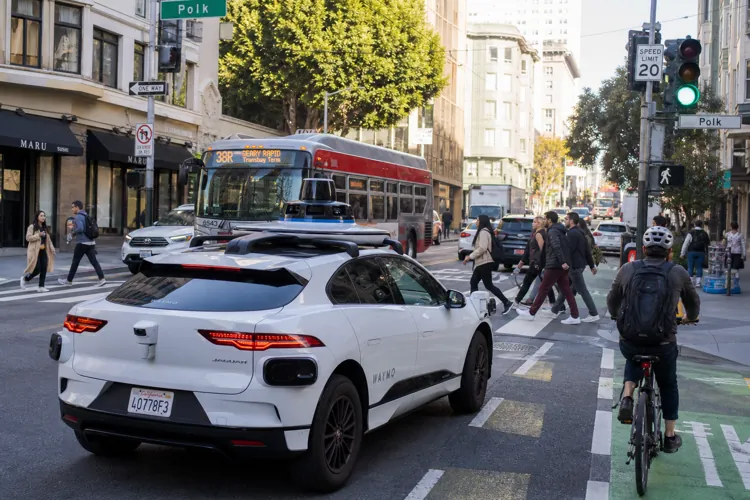

Waymo’s driverless vehicles had a crash rate 68% lower than human-driven vehicles, according to new research.
The vehicles were involved in 81% fewer injury crashes and 85% fewer single-vehicle crashes per mile traveled.
Researchers said federal reporting requirements must improve as driverless technology expands.
Waymo’s driverless vehicles are involved in substantially fewer crashes than vehicles operated by human drivers, according to a new study from the Insurance Institute for Highway Safety (IIHS).
The IIHS study found that Waymo vehicles operating without a human driver had 68% fewer police-reportable crashes per mile traveled than human-driven vehicles in the same cities.
Researchers examined crashes involving Waymo vehicles in San Francisco, Phoenix, Los Angeles, and Austin. The company’s vehicles traveled approximately 50 million miles in driverless mode during the study period, compared with about 222 billion miles traveled by human drivers in the same locations and time periods.
“The results show that, on a limited scale, these driverless cars are safer than human drivers — who can be impaired or drowsy or suffer lapses in attention,” IIHS President David Harkey said.
Waymo’s results varied by city. Compared with human drivers, its crash rate was:
76% lower in Phoenix
71% lower in Los Angeles
35% lower in San Francisco
4% higher in Austin
IIHS cautioned that the Austin results were based on a relatively small sample and may not provide a reliable indication of the vehicles’ long-term performance there.
The study also found that Waymo vehicles were involved in 81% fewer injury crashes and 85% fewer single-vehicle crashes per mile than human drivers.
Comparing crashes is complicated
Researchers had to make significant adjustments to federal crash data before comparing driverless vehicles with human drivers.
Ordinary motorists do not report every collision. IIHS estimates that about half of all crashes and one-third of injury crashes involving human drivers are never reported to police. Drivers may avoid reporting minor crashes because of insurance concerns or because the damage does not meet a state’s reporting threshold.
Automated-vehicle companies, by contrast, have been required to report many minor incidents to the National Highway Traffic Safety Administration (NHTSA). Until federal rules were revised in 2025, even an incident such as a vehicle scraping its underside while entering a parking lot could be classified as a crash.
IIHS researchers reviewed 736 crashes involving automated driving systems on public roads from 2021 through 2024. They removed duplicate records and incidents in which the automation was not operating, the vehicle was not on a public road, or no actual collision occurred.
Researchers then estimated which crashes would probably have been reported to police if a human had been driving. Only 22% of the 736 incidents met that standard.
That left 89 crashes involving Waymo vehicles, 50 involving Cruise, 10 involving Zoox, and 10 involving other companies. Because only Waymo voluntarily provided mileage data, researchers could calculate a meaningful crash rate only for that company.
Of Waymo’s 89 likely police-reportable crashes, 64 occurred while the vehicles were operating without a human driver.
Better monitoring is needed
Waymo began as Google’s self-driving car project in 2009 and launched its public driverless taxi service in Phoenix in 2020. It later expanded to San Francisco, Los Angeles, and Austin.
Its vehicles are classified as Level 4 automated vehicles, meaning they can perform all driving functions without human supervision, but only within certain locations and operating conditions.
IIHS said the encouraging results should not eliminate the need for stronger oversight. Companies are required to report crashes, but they generally do not have to disclose how many miles their vehicles travel or whether those miles were driven autonomously.
Without mileage figures, regulators and researchers cannot determine how frequently other driverless vehicles crash or whether safety changes as fleets expand.