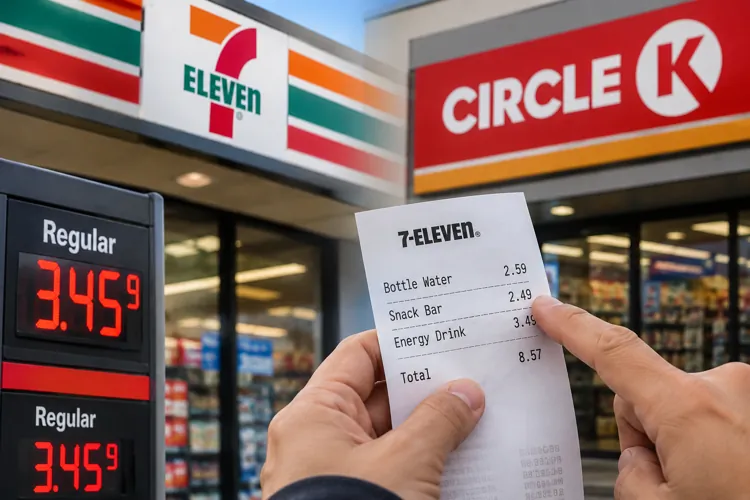

Prices didn’t always match: Circle K failed 82% of government price-accuracy inspections in Columbus, Ohio, while 7-Eleven failed 79% in one New York county.
It's not just snacks: Consumers also complained about gas pumps charging more than prices displayed on roadside signs.
Protect yourself: Photograph sale signs or shelf tags, watch the register, and keep your receipt until you've checked the prices.
That $3.99 bag of snacks might not cost $3.99 when you get to the register.
A new The Guardian investigation found widespread price discrepancies at 7-Eleven and Circle K, the country's two largest convenience-store chains, with shoppers sometimes paying more at checkout than prices displayed on shelves, sale signs, and even gas-station marquees.
Government inspection records examined by The Guardian found Circle K failed 35% of price-accuracy inspections in Florida, 62% in North Carolina, and a whopping 82% in Columbus, Ohio, between 2023 and 2025.
7-Eleven failed 47% of inspections in Colorado and Utah and 79% in Ontario County, New York.
And this isn't just a matter of a few pennies.
During one Arizona inspection this year, 12 of 25 products at a 7-Eleven rang up higher than their shelf prices. A $3.99 pack of gum rang up at $4.99.
The Guardian also reviewed 153 consumer complaints involving the two chains across 17 states. Roughly half involved food, drinks, and other merchandise, while the rest involved gasoline, including complaints that prices at the pump were higher than those advertised on roadside signs.
The problem may be bigger at convenience stores
Convenience stores had the highest price-inspection failure rate of any retail category examined in a 2024 National Council on Weights and Measures report cited by The Guardian.
Convenience stores failed 34% of inspections across 26 states, compared with 29% for dollar stores and 27% for auto-parts stores.
The problem can be particularly easy to miss at a convenience store. You're probably grabbing a drink, snacks, or a few gallons of gas and trying to get back on the road quickly. You’re not studying your receipt for a 40-cent discrepancy.
But those small amounts can add up.
7-Eleven told The Guardian that it takes pricing accuracy "very seriously" and has processes to correct discrepancies when they're identified. Circle K said it is committed to complying with applicable laws and regulations and works to correct unintentional pricing errors.
5 ways to protect yourself
Take a quick photo of sale signs. If you're buying something because the shelf says two for $5 or because of another promotion, snap a picture before heading to the register. It gives you quick evidence to show an employee if the discount doesn't ring-up.
Watch the price as items are scanned. Don't wait until you're in the car to look at the receipt. If a $3.99 item rings up at $4.99, it's much easier and quicker to question it while you're still standing at the register.
Check the pump before you start fueling. Compare the per-gallon price displayed on the pump with the large roadside sign. One North Carolina Circle K advertised gas at $3.459 a gallon while the pump showed $3.799, according to an inspection described by The Guardian.
Don't assume a loyalty discount is automatic. Look for any fine print requiring a rewards account, phone number, app, or particular payment method. If none is disclosed but the advertised price doesn't appear, ask why before paying.
Report repeat problems. Keep the receipt and photograph the shelf tag, sale sign, or gas-price sign. If the store won't correct a discrepancy, look for your state or local weights-and-measures agency or consumer-protection office. Complaints matter because some jurisdictions inspect convenience stores primarily in response to consumer reports.
A 20-cent mistake may not seem worth arguing over. But if the same error is happening across hundreds or even thousands of transactions, those pennies don't stay pennies for long.