
- CDL drivers who cannot read or write in English will now be pulled off the roads under new federal directive
- The order reverses an Obama-era relaxation of language rules, sparking industry debate and compliance concerns
- Trucking sector faces added strain amid labor shortages and ongoing regulatory pressures
A new executive order signed by President Trump is set to reshape the commercial trucking industry by requiring all CDL (Commercial Driver’s License) holders to demonstrate English language proficiency or face removal from the road.
In a move reversing Obama-era relaxations of English literacy standards, Trump’s directive mandates that drivers must now read, write, and speak English well enough to understand road signs, respond to authorities, and handle paperwork. The rule is rooted in a 2001 federal requirement, which was previously downplayed in 2016 but has now returned as a top regulatory priority.
Back to basics — or backward step?
The core justification, according to the administration, is public safety. “Proficiency in English… should be a non-negotiable safety requirement,” the order states, citing the need for drivers to communicate with law enforcement, weigh station officials, border patrol agents, and their own dispatchers.
“Federal law is clear, a driver who cannot sufficiently read or speak English—our national language—and understand road signs is unqualified to drive a commercial motor vehicle in America. This commonsense standard should have never been abandoned,” said U.S. Transportation Secretary Sean P. Duffy. “This Department will always put America’s truck drivers first.”
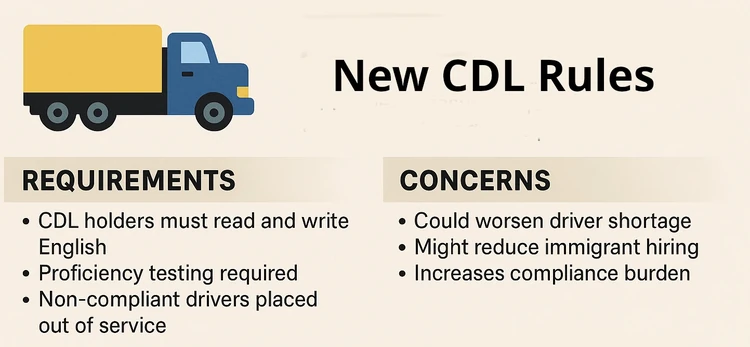
Under the rule, drivers who fail English literacy tests will be placed out of service. The Department of Transportation has already instructed the Commercial Vehicle Safety Alliance (CVSA) to integrate these standards into its compliance evaluations.
Divided opinions in a fractured industry
The policy has sparked sharp debate within the industry. While some see it as a return to fundamental safety measures, others say it could exacerbate driver shortages and marginalize immigrant workers.
According to Freight Waves, a sampling of over 500 comments submitted to the Department of Transportation found that only about 10% of respondents—mostly independent operators—supported stricter enforcement of the English requirement.
The CVSA itself previously voted to remove the language standard, stating it had no substantiated safety impact. Still, under the Trump directive, the alliance must now reverse course.
A complicated road ahead
For trucking companies already dealing with labor shortages, supply chain pressures, and automation demands, the rule adds another layer of complexity. Compliance will likely require new language screening procedures and could limit the hiring pool, particularly among non-native English speakers.
“This regulation lands at a time when the industry needs drivers more than ever,” said one transportation analyst. “Whether it improves safety or just worsens staffing problems remains to be seen.”
Regardless, the new order is already in motion — and noncompliant drivers could soon find themselves off the road for good.
Newsletter