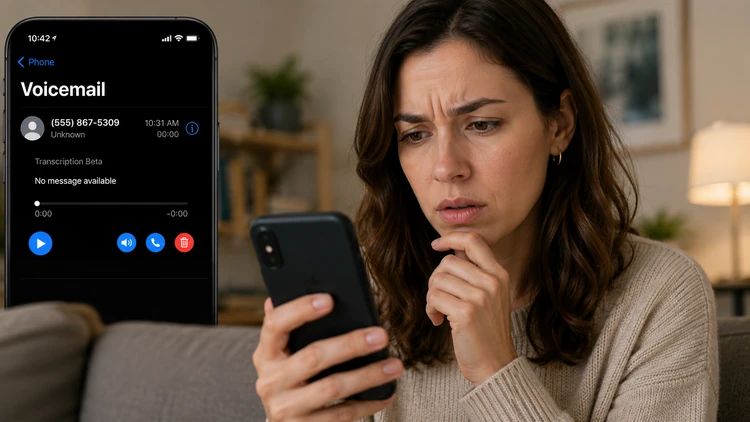

Consumers across the U.S. are reporting mysterious “blank” voicemails from unknown numbers, often without their phone ever ringing.
Experts say the messages are usually part of a robocall verification scheme designed to identify active phone numbers for future scams.
Consumers should avoid calling the numbers back, delete the messages, and use carrier spam-blocking tools to reduce future targeting.
Millions of smartphone users have experienced it: You glance at your phone and see a new voicemail notification, even though the phone never rang. When you listen to the message, there’s either silence, a brief rustling sound, or a robotic click before the message ends.
Cybersecurity experts say these “ghost voicemails” are rarely harmless glitches. In many cases, they are part of a larger robocall operation aimed at identifying working phone numbers and targeting consumers for future scams.
How the scam works
The scam typically begins with an automated dialing system that places thousands — sometimes millions — of calls in rapid succession. Rather than allowing the phone to ring normally, the system disconnects almost immediately or routes the call directly to voicemail.
That leaves behind a blank or nearly blank message.
While the message itself may seem meaningless, the real objective is data collection.
Scammers use the tactic to determine whether a phone number is active and monitored by a real person. If the voicemail system answers and stores a message, the number is flagged as “live.” That information can then be sold to telemarketers, scam networks, or criminals conducting phishing attacks.
Why your phone doesn’t ring
Several technologies allow calls to bypass the normal ringing process.
One common method involves “ringless voicemail” technology, originally developed for marketers. The system deposits a message directly into voicemail servers without completing a traditional phone call.
Legitimate businesses have used ringless voicemail for advertising campaigns, but scammers increasingly exploit the same technology because it avoids some robocall detection systems and reduces the chance consumers will immediately block the number.
In other cases, scammers simply hang up after one partial ring, too quickly for the consumer to notice, but long enough for the carrier to route the call to voicemail.
The bigger objective
The blank voicemail itself is usually only the first step.
Once scammers know a number is active, consumers may begin receiving:
Fake bank fraud alerts
Phony package delivery texts
Medicare or insurance scams
Tech support scams
Cryptocurrency investment pitches
AI-generated voice scams impersonating relatives or employers
Some operations also use verified numbers to build detailed consumer profiles that can later be combined with breached personal information purchased online.
The result is a more convincing and potentially more dangerous scam attempt down the road.
Can listening to the voicemail harm you?
In most cases, simply listening to a blank voicemail will not infect your phone with malware.
However, experts warn consumers not to call the number back, click links sent afterward, or respond to follow-up texts.
Returning the call confirms to scammers that the consumer is engaged and reachable, which can lead to even more robocalls.
There is also a financial risk in some cases. Certain scams direct consumers to international premium-rate numbers that generate charges when called back.
What consumers should do
Experts recommend several steps to reduce exposure to these schemes:
- Don’t call back unknown numbers: If the voicemail is blank or suspicious, avoid returning the call unless you can independently verify the caller.
- Block the number: Most smartphones allow users to block suspicious callers directly from the call log or voicemail screen.
- Use spam-filtering tools: Wireless carriers offer free or low-cost robocall filtering services, including:
AT&T ActiveArmor
Verizon Call Filter
T-Mobile Scam Shield
Third-party apps such as Hiya, Truecaller, and RoboKiller can also help screen suspicious calls.
- Report persistent scam calls: Consumers can file complaints with:
The Federal Trade Commission (FTC)
The Federal Communications Commission (FCC)
Their wireless carrier
- Keep voicemail passwords secure: Some scammers attempt to hack voicemail accounts using default PINs. Consumers should use strong, unique voicemail passwords whenever possible.