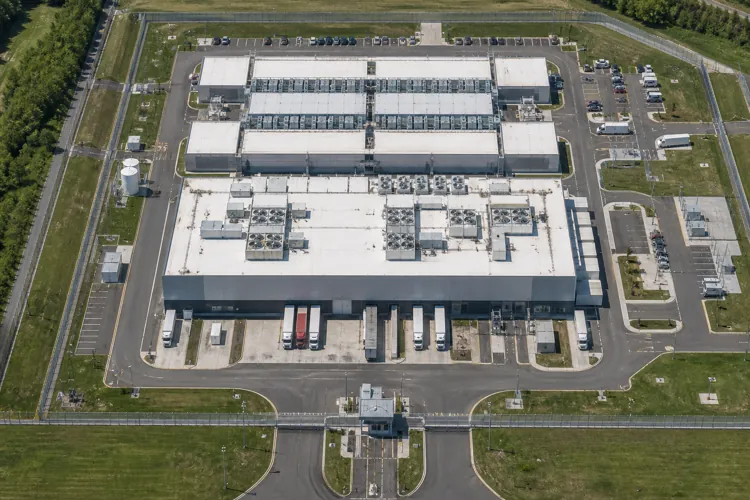

Data centers and cryptocurrency mining could raise the average U.S. household electric bill by about 8% by 2030, with increases topping 25% in some high-growth areas, according to research cited by the Congressional Research Service and Pew Research Center.
The Department of Energy says data centers could consume as much as 15.3% of all U.S. electricity by 2030, up from about 4.4% in 2023.
Federal and state regulators are increasingly adopting special rates and contracts designed to make data centers pay for the power plants, transmission lines, and other infrastructure needed to serve them rather than shifting those costs to households.
The artificial intelligence boom is creating an enormous new appetite for electricity, and government agencies and researchers are beginning to put numbers on what that could mean for household electric bills.
The estimates vary widely depending on where consumers live and how utilities divide the costs of new power plants and grid improvements. But some projections suggest data centers could add hundreds of dollars a year to household electricity costs in the areas experiencing the most rapid growth.
Research cited by Pew Research Center estimates that data centers and cryptocurrency mining could increase the average U.S. electric bill by about 8% by 2030. In the data-center-heavy markets of central and northern Virginia, the increase could exceed 25%.
For a household with a $150 monthly electric bill, an 8% increase would translate into about $12 more a month, or $144 a year. A 25% increase on the same bill would amount to an additional $37.50 a month, or $450 a year.
Those figures aren't forecasts of exactly what consumers will pay. Electricity bills depend on local utility rates, fuel costs, weather, consumption, and decisions by state regulators. But they illustrate the potential size of the impact if utilities are allowed to pass a significant portion of data center-related expenses on to residential customers.
Electricity demand is soaring
The Department of Energy's Lawrence Berkeley National Laboratory estimated that data centers consumed about 4.4% of U.S. electricity in 2023. Its latest update estimates that they could consume 11.8% by 2030, with scenarios ranging from 9.5% to 15.3%.
That rapid increase matters because utilities may have to build generating plants, substations, and transmission lines to accommodate enormous new loads.
The Congressional Research Service says the effect on consumers isn't automatic. If a utility already has enough unused capacity, adding a large data center could actually spread fixed costs over more electricity sales and potentially lower rates. But if utilities must make major investments specifically to serve data centers, rates could rise if those costs are shared with residential customers.
A 2026 Berkeley Lab analysis makes the same point. Some utilities project that data centers could eventually lower residential bills by spreading fixed costs among more customers. For example, NIPSCO has estimated data-center agreements in Indiana could eventually save residential customers $7 to $9 a month. But Berkeley Lab cautions that those benefits aren't guaranteed, particularly if new facilities don't materialize after utilities have invested in infrastructure for them.
Some consumers are already seeing the impact
The issue is especially visible in PJM, the huge regional electricity market covering all or parts of 13 states and the District of Columbia.
Previous increases in PJM's capacity-market costs, attributed in significant part to data-center demand, were expected to add about $18 a month to an average residential bill in western Maryland and $16 a month in Ohio, according to estimates cited by Pew.
Virginia offers perhaps the clearest example of the impact. The state has one of the world's largest concentrations of data centers, and its State Corporation Commission has approved a separate rate class for large data-center customers. The goal is to require those companies to shoulder more of the costs of generation, transmission, and distribution infrastructure required to serve them.
Regulators are trying to prevent cost shifting
The Federal Energy Regulatory Commission (FERC) is also addressing the problem. In a June 2026 order, FERC backed the use of "Cost Recovery Agreements" intended to ensure that large electricity users pay costs incurred to serve them even if a planned project doesn't ultimately come online.
The commission specifically said the agreements are designed so that when infrastructure is constructed for a data center that fails to materialize, residential customers aren't left paying for it.
That distinction may ultimately determine how much AI shows up on consumers' electric bills.
Data centers unquestionably require enormous amounts of power, but higher electricity demand doesn't necessarily translate dollar-for-dollar into higher residential rates. The key question is who pays for the billions of dollars in new generating capacity, transmission lines, and substations required to accommodate that demand.
Increasingly, regulators appear to be moving toward an answer: the companies creating the demand should pay a larger share of the bill.