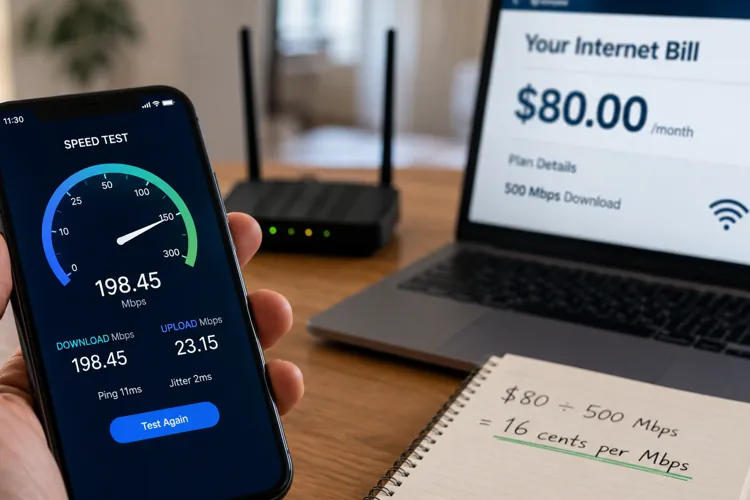

Americans average about 40 cents per Mbps: Dividing your monthly internet price by your plan's speed gives you a quick way to see how your deal compares.
Where you live matters: NetCredit found Connecticut has the most affordable internet relative to income, while Mississippi has the least affordable.
Don't pay for speed you don't need: A low cost per Mbps can look like a bargain, but a cheaper, slower plan could still save you more money each month.
Are you getting your money's worth from your home internet?
There's a surprisingly easy way to get an idea, and it takes about 30 seconds.
A new NetCredit analysis of internet prices found that Americans pay an average of about 40 cents per megabit per second, or Mbps.
That number gives you a handy benchmark that you can use to compare to your own bill. Simply take your monthly internet price and divide it by the download speed you're paying for.
If, for example, you pay $80 a month for 500 Mbps service, the math would look like this: $80 ÷ 500 = 16 cents per Mbps.
That's well below the 40-cent national average found by NetCredit.
But if you're paying $100 for 100 Mbps service, you're shelling out $1 per Mbps, which is more than twice the national average.
That's when it may be time to start shopping around.
Where you live can make a big difference
NetCredit compared internet affordability around the world and across the U.S., looking at both broadband prices and local incomes.
Interestingly, Connecticut came out as the most affordable U.S. state, with the average internet bill consuming about 1.5% of monthly income. On the other end, Mississippi was the least affordable at about 2.8%.
But keep in mind that "affordable" doesn't necessarily mean cheap.
West Virginia, for example, had one of the lowest average broadband bills in the study at about $91 a month, but average internet speeds were also below the national average.
The differences become even clearer at the city level.
NetCredit found Plano, Texas, offered some of the most speed for the money at about 33 cents per Mbps, while Honolulu residents averaged around $1.15 per Mbps.
That's nearly 3.5 times as much for each Mbps.
But don't fall for the 'more speed is better' trap
There's one big flaw with judging an internet plan solely by cost per Mbps: A blazing-fast plan you don't actually need isn't necessarily a bargain.
Imagine you're paying $90 for gigabit internet. That's just 9 cents per Mbps, which is fantastic according to our calculation.
But if a 300 Mbps plan would easily handle your household's streaming, video calls, and web browsing for $55, you'd save $420 a year by downgrading.
In other words, don't let an impressive cost-per-Mbps number convince you to buy more internet than you'll actually use.
Check the 'nutrition label' before switching
If your calculation tells you that you're overpaying, don't call your provider just yet. First, do a little homework and see what competitors are charging at your address.
Internet providers are required to display FCC-mandated Broadband Facts labels that work a lot like nutrition labels on food. They show the monthly price, introductory-rate details, additional charges, typical speeds, and data allowances, making it much easier to compare competing plans.
You can also enter your address into the FCC's National Broadband Map to see which providers report offering service at your home and the maximum advertised speeds available.
At that point, it's time to call your current provider and negotiate a better deal.
Tell them the competing price and speed you've found and ask whether they can match it, move you to a cheaper plan, or offer a retention discount.
And remember that your goal isn't to get the most Mbps for your money. It's to get all the speed you actually need for the lowest monthly bill.