

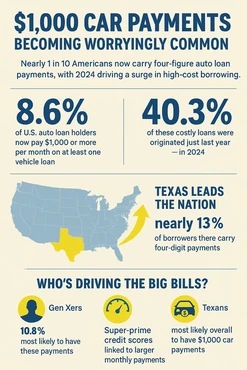
- 8.6% of U.S. auto loan holders now pay $1,000 or more per month on at least one vehicle loan.
40.3% of these costly loans were originated just last year — in 2024.
Texas leads the nation, with nearly 13% of borrowers carrying four-digit payments.
In a startling sign of financial strain and shifting consumer behavior, a new LendingTree analysis reveals that $1,000-plus monthly car payments are increasingly common in the U.S. The study, based on anonymized credit reports from roughly 180,000 Americans, found that 8.6% of auto loan holders were making at least one such high payment as of early 2025.
More strikingly, 40.3% of these large loans were originated in 2024, suggesting a recent acceleration in costly borrowing. With new vehicle prices nearing $50,000 and interest rates still elevated, more consumers are locking themselves into five- to six-year commitments for loans that stretch budgets and expose them to long-term financial risk.
While many high-payment borrowers likely have the income to manage, others may be walking a financial tightrope — especially if job markets tighten or inflation persists.
Texas is ground zero for four-figure car loans
Though every state has seen a rise in high-dollar auto loans, Texas stands out: 12.8% of the state’s borrowers are paying $1,000 or more monthly, the highest percentage in the nation. Other high-ranking states include Nevada (11.9%), Wyoming and Georgia (11.6%), and large-car cultures like California and Florida, where at least 10% of auto borrowers carry four-figure payments.
Notably, many of these states are geographically large and car-dependent, where pickup trucks and SUVs dominate and public transit is limited outside major metros. Yet income levels vary widely — a troubling indicator that some borrowers may be overextending themselves.
Northeast, Midwest see fewer jumbo auto loans
The lowest rates of $1,000 auto payments are concentrated in Northeastern and Midwestern states, where urban density and more modest vehicle preferences may play a role. Rhode Island (4.8%), Maine (5.1%), and Pennsylvania (5.2%) lead the bottom 10.
Interestingly, some of these lower-ranked states also have higher average household incomes, like Massachusetts and New Hampshire, suggesting that even high earners in these regions tend to borrow more conservatively for cars.
Who’s driving the big bills?
Gen Xers are the most likely to carry four-figure auto payments, with 10.8% making at least one such payment.
Baby Boomers (8.6%) and Millennials (8.0%) follow, while Gen Z remains the least affected (3.2%).
Borrowers with super-prime credit scores (720+) are more likely to have big car payments than those with poor credit, likely because lenders are more willing to extend large loans to creditworthy consumers.
The road ahead
With car prices still elevated and interest rates unlikely to drop quickly, $1,000 car payments may become a new normal for many Americans — even though they were rare just a few years ago. The LendingTree data paints a cautionary tale: even as vehicle ownership remains essential in many parts of the country, the financial burden of getting behind the wheel is rising fast.