


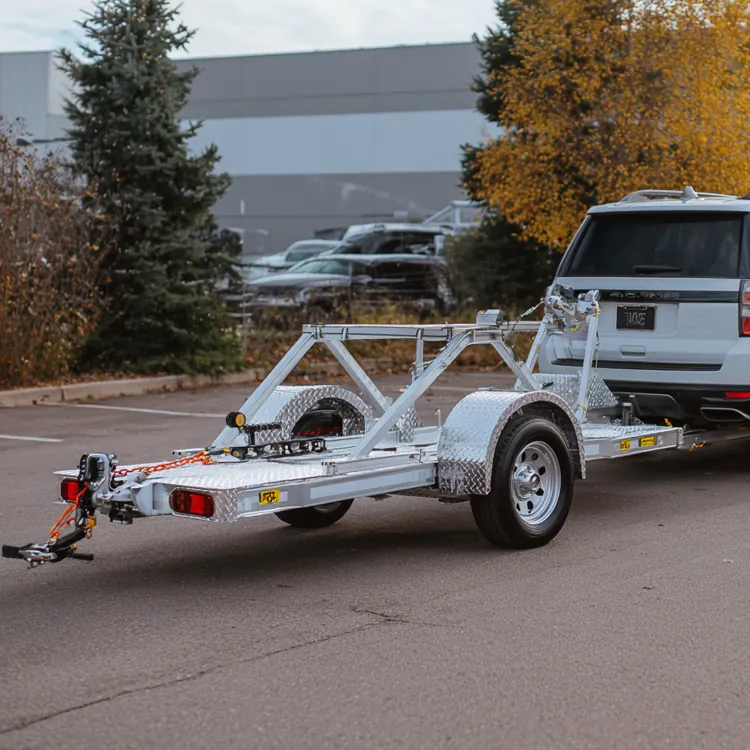
Cost comparison: tow dolly vs. trailer
Cost is often the first—and most decisive—factor when deciding between a tow dolly and a car trailer. Understanding how these costs stack up can help you choose the option that makes the most financial sense for your move.
Rental costs and pricing differences
Price is the most significant difference between these options. A car trailer costs approximately $350 per day to rent, while a tow dolly costs about $180 per day. This pricing pattern remains consistent regardless of distance. Prices may increase for trips over 200 miles and rise further during peak demand.
» RELATED: How to Rent a Car Trailer
Additional costs to consider
Beyond rental fees, you need to factor in several hidden expenses:
- Fuel costs: Your towing vehicle burns more fuel when pulling additional weight.
- Storage and space: Car trailers require more storage space than tow dollies.
- Insurance and liability: You may need additional coverage for the equipment and your vehicle during transport.
Trailers are easier to handle and protect vehicles better on long trips.
Long-distance cost analysis
The cost equation becomes more complex for extended moves. Renting a U-Haul truck capable of towing plus the towing equipment for trips over 250 miles can cost more than $1,000. While tow dollies offer lower upfront costs, car trailers provide better protection for your vehicle on long trips.
Ease of use and handling
Car trailers and tow dollies offer different levels of ease of use. Consider these factors when making your decision to rent one or the other.
Loading and unloading procedures
Car trailers are easier to handle than tow dollies, though both require practice. Each type of trailer has distinct loading requirements.
Car trailers include ramps for vehicle loading. You drive your vehicle onto the trailer and secure it with straps.
However, tow dollies can be more difficult to load and maneuver. You cannot reverse your vehicle while it's attached. Also, the hookup process requires more steps than using a car trailer.
Driving and maneuvering challenges
The driving experience differs significantly between options. Car trailers are better suited for long-distance moves and are easier to handle.
You cannot back up with a tow dolly without risking damage to the hitch system, the towed vehicle or the dolly itself. This creates limitations in tight spaces. If you must back up, disconnect the vehicles and move them individually.
» RELATED: How to tow a car on a trailer
Speed and distance considerations
Highway driving requires different approaches for each option.
Maintain a speed of 55 miles per hour (mph) or less when using a tow dolly. Tow dollies are harder to maneuver than car trailers on highways. Remember, they lack brakes and cannot reverse.
Car trailer manufacturers also recommend a maximum speed of 55 mph. However, trailers offer more stable handling at highway speeds.
When a car trailer is worth it
Consider using a car trailer if you have a long trip with a lot of highway miles or if you have an AWD vehicle. Trailers are easier to handle at highway speeds, and you'll cut down on wear.
Vehicle compatibility and safety
The type of vehicle you’ll be driving can impact whether to use a tow dolly or a trailer.
Drive type compatibility
Vehicle compatibility varies significantly between tow dollies and trailers.
Tow dollies:
- Work with most front-wheel-drive vehicles and many rear-wheel-drive vehicles
- Require driveshaft disconnection for rear-wheel-drive vehicles
- Cannot safely tow all-wheel-drive vehicles without driveshaft disconnection
Car trailers:
- Work with front-wheel, rear-wheel and all-wheel-drive vehicles
- Place the entire vehicle on the trailer
- Handle larger vehicles than tow dollies
U-Haul's auto transport trailers handle a maximum load of 5,290 pounds. The dual-axle design eliminates concerns about your vehicle's drive type.
Weight capacity and limitations
Understanding weight limits ensures safe towing.
Tow dollies can usually handle a maximum load of 4,080 pounds. Most models have weight limits between 4,000 and 5,000 pounds. Check your vehicle's weight against the dolly's capacity.
Car trailers are designed to handle heavier loads and transport larger vehicles. Most car trailers carry vehicles up to 5,000 pounds or more.
Safety features and requirements
Both options require proper safety equipment and procedures:
- Equipment requirements: You need a 2-inch hitch ball rated for at least 2,000 pounds. The hitch ball height cannot exceed 25 inches. You must have external mirrors on both sides of your towing vehicle.
- Towing vehicle requirements: Your tow vehicle must weigh at least 750 pounds more than the towed vehicle. The curb weight must exceed the loaded trailer weight.
Wear and tear on your vehicle
Consider how either of these options will impact the wear and tear on your vehicle.
Impact on tires and suspension
Tow dollies can increase wear on your car. For instance, a cross-country trip between New York and California can add thousands of miles to just your rear tires. This can be inconvenient when you need two separate tire replacement appointments later on.
Trailers provide complete protection. All four wheels stay off the ground, preventing additional mileage or wear.
Protection from road hazards
New or classic cars face exposure to outside elements during transport. This exposure varies by method.
With tow dollies, the rear portion of your vehicle sits lower to the ground. This increases the likelihood of damage from road debris.
Car trailers elevate all four wheels. Your vehicle sits higher and receives better protection from debris and weather.
Long-distance considerations
Towing on a dolly works for long distances but raises durability concerns.
Car trailers minimize wear on both vehicles for extended trips. The weight of towing another vehicle on a dolly adds wear to your towing vehicle.
Making the right choice for your move
Your choice between a tow dolly and trailer depends on several key factors.
Choose a tow dolly when:
- You need the lowest cost option.
- You have a small, front-wheel-drive vehicle.
- Your budget is tight.
- You're moving locally or regionally.
Choose a car trailer when:
- You're traveling long distances.
- You need to tow an all-wheel or rear-wheel-drive vehicle.
- You want maximum vehicle protection.
- You need the ability to reverse while towing.
Pros and cons
Tow dolly advantages
- Costs less to buy or rent
- Weighs less than a car trailer
- Requires less storage space
Tow dolly disadvantages
- Works only with front-wheel-drive vehicles without modifications
- Cannot reverse with vehicle loaded
- Adds wear to rear tires
Car trailer advantages
- Works with all vehicle types
- Allows reversing when needed
- Provides better vehicle protection
Car trailer disadvantages
- Costs more than a tow dolly
- Requires more storage space
- Needs a heavier towing vehicle
FAQ
Is it better to tow with a dolly or trailer?
It depends on cost, convenience and distance. A tow dolly is cheaper to rent and works best for small vehicles and local moves. A car trailer is better suited for long distances and minimizes wear on your vehicle.
What are the disadvantages of a tow dolly?
The main disadvantages include the inability to reverse while loaded, limited compatibility with front-wheel-drive vehicles and added wear on rear tires during long moves. Rear-wheel-drive vehicles require driveshaft removal. Tow dollies are difficult to load and maneuver.
Are tow dollies good for long distances?
Tow dollies work for long distances but raise durability concerns. They are harder to maneuver than car trailers, lack brakes and cannot reverse. For trips over several hundred miles, trailers provide better vehicle protection.
Do I put my car in neutral when using a tow dolly?
For front-wheel-drive vehicles, place the transmission in park. When towing a rear-wheel-drive vehicle, you must disconnect the driveshaft. Consult your vehicle's owner's manual for specific towing instructions.