


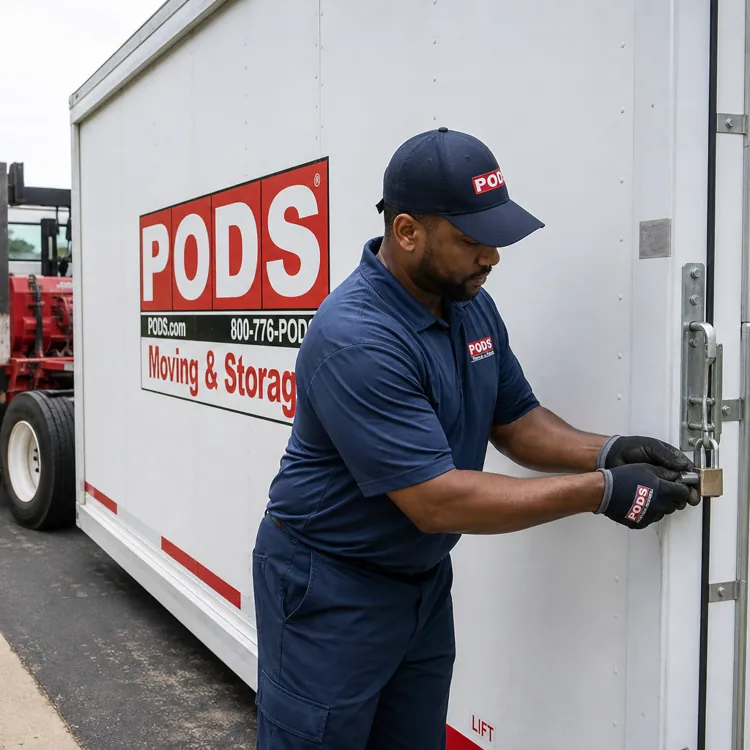
Pods vs. moving truck basics
Moving pods and rental trucks both let you pack and load your own belongings, but the day-to-day process looks different. A pod gives you more time to load and leaves the hauling to the company. A rental truck puts the schedule, driving and return deadline in your hands.
How moving pods work
With a moving pod, you choose a container size and the delivery date, and then load it at your own pace. Once you finish, the company picks up the container and transports it to your home or a storage facility.
This can give you more time to pack than a one-day truck rental, but it also requires a place to put the container. Before booking, check driveway space, HOA rules, apartment policies and local permit requirements.
How moving trucks work
With a rental truck, you reserve the vehicle, pick it up, load it, drive it, unload it and return it by a deadline. You also manage fuel, parking, tolls, route planning and any add-ons, such as dollies or moving blankets.
Truck rentals can work well when you want to move in one push. They require more hands-on coordination, though, especially for long-distance moves or routes through busy city streets.
Who handles driving and transport
The main operational difference between using a pod or a rental truck is who moves your belongings after loading. With a pod, the moving container company transports the container. With a rental truck, you or someone you hire drives the truck.
| Option | Common sizes | Loading | Driving or transport | Basic workflow |
|---|---|---|---|---|
| Moving pod | About 7 to 16 feet | You or hired movers | Container company | Schedule delivery, load the container, schedule pickup, then have it moved or stored |
| Rental truck | About 10 to 26 feet | You or hired movers | You or someone you hire | Pick up the truck, load it, drive it, unload it, refuel it and return it |
Pods vs. moving truck costs
Pods cost more upfront than truck rentals, but the cheaper sticker price on a truck can shrink once you add fuel, mileage, insurance, equipment and overnight travel. For both options, the cost depends on distance, home size, dates and how much help you hire.
Local move costs
For local moves, pods often cost about $299 to $499, though larger containers, storage time and multiple deliveries can raise the total. Rental trucks often advertise daily base rates around $20 to $150, but that rate doesn’t include every cost.
A truck can still cost less for a short move if you can load, drive, unload and return it in one day. But compare the full receipt, not the headline rate.
Long-distance move costs
Long-distance pod moves often run about $1,500 to $6,500, depending on the container size, mileage, storage time and delivery fees. The company handles the hauling, so you don’t need to budget for gas in a large truck.
With a rental truck, distance can jack up your total cost. Many moving trucks get about 8 to 10 miles per gallon, so a 1,500-mile move could take roughly 150 to 188 gallons of fuel. Add hotels, meals, tolls, insurance and extra mileage fees, and a cheap rental can turn into an expensive one quickly.
» LEARN: How much does a moving truck cost?
Which option has more predictable pricing?
Pods often have more predictable pricing because the quote usually bundles transportation around your route and container needs. You may still pay more for storage, permits, extra containers, rescheduling or delivery changes.
Truck rentals give you more control, but the final cost can vary more. Fuel prices, mileage charges, weather delays, lodging and return timing all affect what you actually spend.
Your anticipated costs include:
| Cost factor | Pods | Moving truck |
|---|---|---|
| Base rate | Often about $299 to $499 for local moves and $1,500 to $6,500 for long-distance moves | Often about $20 to $150 per day before mileage, fuel and add-ons |
| Mileage | Usually built into the quoted transport cost | May come with mileage fees, especially for local rentals |
| Fuel | The company handles transport fuel | You pay for fuel, often at about 8 to 10 mpg |
| Insurance | Coverage options may cost extra | Damage waivers and coverage options may cost extra |
| Labor | You load it yourself unless you hire movers | You load it yourself unless you hire movers |
| Storage | Often available as part of the container service | Usually separate unless you rent storage elsewhere |
| Permits | May apply if the container sits on a street or public space | May apply for street parking in some cities |
| Taxes and fees | Delivery, pickup, storage, taxes and administrative fees may apply | Taxes, environmental fees, mileage fees, late fees and equipment rentals may apply |
» EXPLORE: Moving container discounts guide
Pods vs. moving truck logistics
Logistics can make or break your choice before price even enters the picture. A pod needs space to sit for several days (or even weeks). A truck may only need same-day parking, but you still have to account for height, ramps, stairs and long carries.
Apartment and condo parking issues
Pod rentals are often offered by the month and have space and access requirements for where they are placed. For example, PODS says its equipment needs a 12-by-40-foot area plus 15 feet of overhead clearance. Given that, renting a pod requires more planning for those living in apartments, condos or dense neighborhoods. Some buildings ban portable moving containers, limit how long they can stay or require written approval from management.
A moving truck can be easier if your building has a loading zone or service entrance. But if the truck can’t park close, you may pay more in labor because movers have to carry boxes farther.
Permits and placement rules
A pod may need a permit if it sits on a street, alley or public right of way. Rules vary by city: Atlanta requires permits for dumpsters and PODS in the public right of way, while Montclair, California, says portable storage units must stay in a residential driveway and can’t sit in streets or alleys.
Trucks can also run into parking rules, especially in cities, apartment complexes and HOA communities. Before booking either option, ask where the pod or truck can go, how long it can stay and whether you need a permit, reservation or manager approval.
Pickup and delivery scheduling
Pod delivery and pickup require advance scheduling. The container company needs room to place the unit, and delivery dates depend on availability.
Truck rentals can offer more same-day control, but the clock starts when you pick up the truck. If loading runs long, bad weather slows you down or the elevator gets tied up, you may face late fees or need to extend the rental.
Access limits and long carries
Pods sit at ground level, which can make loading easier if you have heavy furniture. Trucks sit higher off the ground and may require a ramp. For example, U-Haul lists a 35-inch deck height for its 20-foot truck and a 33-inch deck height for its 15-foot truck.
Run through these logistics before you book.
- Parking space: Confirm whether you have room for a pod or truck.
- Permits: Check city rules if anything will sit on public property.
- HOA or building rules: Ask about container bans, move hours and loading zones.
- Delivery windows: Book pod delivery and pickup early, especially around weekends.
- Loading time: Pods give you more time; trucks put you on a tighter rental clock.
- Elevator use: Reserve freight elevators where required.
- Long carries: Measure the distance from parking to your door.
- Overhead clearance: Watch for trees, wires, carports and garage overhangs.
Best choice by move type
The best choice for your move depends on how far you’re moving, how much stuff you have and how much time you need to load. A truck may win on price for a quick local move. A pod may make more sense when distance, storage or timing adds pressure.
| Scenario | Better option | Why |
|---|---|---|
| Local move | Moving truck | Often cheaper for moves under 100 miles if you can finish in one day. |
| Long-distance move | Moving pod | The company handles transport, so you avoid driving a loaded truck. |
| Tight timeline | Moving truck | You can pick up, load, drive and return it without waiting on delivery windows. |
| Need storage | Moving pod | Many container moves include storage time or let you store between homes. |
| Small load | Either | A small truck or small container can work, so compare the full quote. |
| Large home | Moving truck | Trucks often go up to 26 feet, which may fit more than one container. |
| No parking space. | Moving truck | Apartments, condos, HOAs or city streets may block pod placement. |
| Need car towing | Moving truck | Many truck companies over towing equipment for a personal vehicle. |
When a moving truck is better
A rental truck can be the better pick for a local move, especially under 100 miles, when you can load, drive and unload the same day. It also helps if you have no place to keep a container for several days.
Trucks can also work better for larger households because rental trucks often go up to 26 feet. If you’re moving a packed three-bedroom house, one larger truck may beat coordinating multiple containers.
» FIND OUT: What size moving truck do you need?
When a pod is better
A pod can make more sense for long-distance moves because you don’t have to drive the loaded container yourself. It can also help when your dates don’t line up, such as when you have to leave one home before the next one is ready.
Pods usually give you more time to load and unload than a truck rental period. That extra time can help if you’re packing after work, have young kids or are sorting through what to keep as you go.
FAQ
What are the disadvantages of pods?
Some of the disadvantages of renting a pod are that you need enough space to place the container and you may need to file for specific permits or permissions for where it’s placed. Delivery windows, HOA restrictions and apartment policies can also make pods harder to use.
Are pods cheaper than moving trucks?
Pods can cost more than rental trucks upfront, but may end up being cheaper than renting a moving truck when you factor in fuel, mileage, insurance, hotels, food and equipment rentals.
How long can you keep a pod at your house?
Many pod rentals start with a monthly rental period, but local rules may limit how long the container can stay at your home. Check with your city, HOA, landlord or building manager before scheduling delivery.
How much do pods cost to move 1,000 miles?
For a 1,000-mile move, expect pod pricing to land in the long-distance range, often about $1,500 to $6,500. Your quote depends on container size, distance, dates, storage time and delivery fees.
Article sources
ConsumerAffairs writers primarily rely on government data, industry experts and original research from other reputable publications to inform their work. Specific sources for this article include:
- 1-800-PACK-RAT, "Portable Storage Containers & Mobile Units." Accessed May 11, 2026.
- U-Pack, "ReloCube Size." Accessed May 11, 2026.
- Zippy Shell, "Portable Moving Containers." Accessed May 11, 2026.
- U-Haul, "U-Haul Moving Truck Sizes." Accessed May 11, 2026.
- Penske, "Moving Truck Sizes and Features." Accessed May 11, 2026.
- PODS, "How Much Does It Cost to Move With PODS?" Accessed May 11, 2026.
- U-Haul, "20ft Moving Truck Rental." Accessed May 11, 2026.
- Budget Truck Rental, "FAQ." Accessed May 11, 2026.
- PODS, "Portable Container Delivery Checklist & Requirements." Accessed May 11, 2026.
- PODS, "Scheduling and Delivery." Accessed May 11, 2026.
- Atlanta Department of Transportation, "Dumpster/Pod Replacement Permits." Accessed May 11, 2026.
- City of Montclair, "Where Am I Allowed to Put a Rented Portable Storage Unit/Moving Container?" Accessed May 11, 2026.
- U-Haul, "15ft Moving Truck Rental." Accessed May 11, 2026.
- PODS, "Portable Container Sizes." Accessed May 11, 2026.
- U-Haul, "Auto Transport Rental." Accessed May 11, 2026.
- PODS, "How PODS Works." Accessed May 11, 2026.
- PODS, "Frequently Asked Questions." Accessed May 11, 2026.
- PODS, "Containers and Storage." Accessed May 11, 2026.
- PODS, "Personalized Storage Units That Fit Your Needs." Accessed May 11, 2026.