


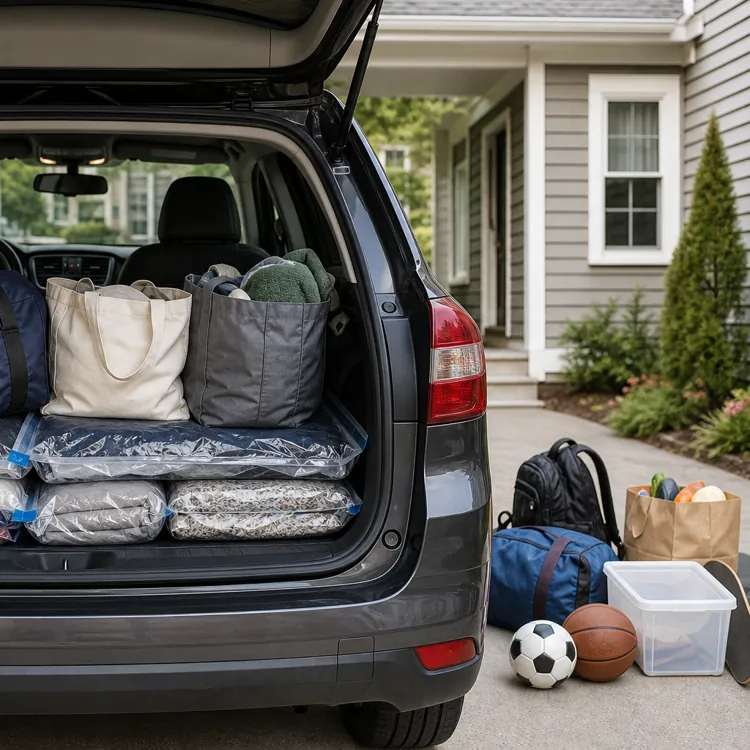
Steps to pack a car for moving
Follow these steps to make the most of your space without sacrificing safety:
1. Sort what goes in the car
“Before anything goes into the car, decide what needs to travel with you,” said Michelle Urban, founder of The Organized House, a Portland, Oregon-based home organizing company.
She recommended sorting items into three groups: what the movers will take, what you’ll need before the movers arrive and what you’ll want during the drive. This prevents overcrowding and keeps the load in your personal vehicle manageable.
2. Know what goes in the car versus the truck
“Anything irreplaceable or needed in the first 24 hours should stay with you,” Urban advised. Most movers won’t transport medications, jewelry, laptops, liquids, plants or hazardous materials such as paint — so those are coming with you regardless. To avoid identity theft or loss, you should carry essential documents, including birth certificates, financial records and passports, in your personal vehicle as well.
3. Prepare the car interior
Clear out the car before you start loading. “A lot of cars are already half full with sports gear, grocery bags and random everyday items,” said Urban. “Starting with a clean, empty trunk gives you far more usable space.”
4. Load heavy items first
Start by loading the heaviest items on the trunk floor, pushed up against the seat backs. This keeps the car stable when you brake hard or take a sharp turn. Spread items across both sides of the vehicle so the weight is balanced as much as possible; piling everything on one side throws off the car's handling.
5. Use soft bags instead of rigid boxes
Soft bags including duffels, totes and vacuum-sealed bags compress into corners and footwells that rigid cardboard boxes or plastic bins can’t reach. “If bringing clothes and linens, use vacuum storage bags to condense them,” suggested Marshall Aikman, co-founder and president of Amazing Moves Moving and Storage in Denver, Colorado. “You can also use reusable tote bags to pack small items.”
6. Secure loads and do a final check for visibility
Tuck loose items snugly together so nothing shifts on the road. Urban cautioned against stacking items high enough to block the rear window; even if everything technically fits, the lost visibility isn’t a worthwhile tradeoff. Before you begin your drive, confirm that the load sits below the seat line, all mirrors are clear and anything you might need during the trip is within reach.
Car packing safety and weight limits
For anyone handling a DIY move, loading a car involves more than just fitting everything in. Knowing your vehicle’s limits and loading it properly go a long way toward a safe drive.
Check the payload and tire pressure
Aikman recommended referring to your vehicle owner’s manual for guidance on the load capacity and any consequences of exceeding it. Many drivers skip this step, but going over your car’s limit puts measurable strain on brakes, steering and tires. It can also reduce fuel efficiency during a long drive.
Urban flagged tire pressure as another pre-departure check worth making. “A heavily loaded car may require slightly higher tire pressure to support the additional weight,” she said. Most gas stations have air pumps available, and some tire retailers check and fill tires for free.
Distribute weight evenly
Spread heavy items evenly across the trunk or cargo area rather than concentrating them on one side. Loading all heavy items on one side can make the vehicle handle unpredictably. SUVs and taller vehicles are especially susceptible, as top-heavy loading affects braking distance and steering responsiveness.
Keep driver areas clear
The driver’s footwells, pedals and steering areas must stay clear. “I’ve seen people tuck bags under the driver’s seat or around pedals to save space, which is a serious safety risk,” Urban warned. Sightlines are just as critical; nothing should obstruct the rearview mirror or rear window.
Secure items to prevent projectiles
Loose items can become hazardous during a sudden stop or an accident. “Use straps, seatbelts or other forms of security to make sure items are tightly locked,” Aikman advised. Urban added that even small objects can become projectiles.
Packing essentials for arrival day
Once you’ve crossed off the items on your moving checklist and the big day has arrived, make sure these items stay with you rather than on the truck:
Documents
- Passports and identification cards
- Birth certificates and Social Security cards
- Moving contracts and insurance information
- Financial and medical records
Valuables
- Jewelry and heirlooms
- Laptops, phones and chargers
- Cameras and small electronics
First-night essentials
- Toiletries and medications
- Change of clothes and pajamas for each family member
- Bedding
Comfort and emergency items
- Snacks and water
- Some books or other forms of entertainment
- Emergency roadside kit
- Pet food, leash and favorite toys
Tip: For bigger households, Aikman recommended preparing one bag per person to keep everyone’s essentials organized and easy to grab. Keep medications, toiletries and pet supplies at the top of each bag so they’re the first things you can reach when you arrive at your new home.
Rooftop carriers and extra storage options
External storage options such as rooftop cargo carriers, hitch-mounted carriers and trunk organizers provide additional space beyond what the car’s interior offers. They work best for bulky, lightweight items such as bedding, pillows and coats that don’t fit in the car after you load the essentials.
If you’re shopping for a rooftop carrier, look for one with a hard shell, waterproof construction and a locking mechanism to protect items from the weather and theft. A hitch-mounted carrier is a practical alternative for vehicles without a roof rack.
Here’s how the most common external storage options compare:
| Option | Capacity range | Best for | Key drawbacks | Security features |
|---|---|---|---|---|
| Rooftop box | 10 to 20+ cubic feet | Bulky, lightweight items | Reduces fuel economy | Lockable hard shell |
| Rooftop bag | 8 to 22+ cubic feet | Soft items, movers on a budget | Not weatherproof, less secure | Zipper only |
| Hitch cargo carrier | 9 to 14 cubic feet | Vehicles with no roof rack | Adds vehicle length, open exposure | Varies by model |
| Trunk organizer | 1 to 3 cubic feet | Small loose items | Limited capacity | None |
| Vacuum storage bag | 1 to 8 cubic feet | Clothing and bedding | Requires a vacuum, can puncture | None |
Did you know? Rooftop carriers can reduce fuel economy by up to 25%, according to the United States Department of Energy. They also raise the vehicle’s center of gravity, which can affect handling, particularly in SUVs and taller vehicles. Remove them once you’re done moving.
FAQ
Should I use boxes or bags when packing a car?
You should use bags when packing a car; they mold into corners and spaces that rigid boxes can’t fill. Reserve small boxes for fragile items or to create a stable stacking base.
What items must stay with me instead of going with movers?
Items that must stay with you include important documents (e.g., passports, birth certificates, financial and medical records), valuables (jewelry and small heirlooms), medications and small electronics. Most movers won’t transport hazardous materials, plants or perishables, so those should also stay with you.
How do I maximize space in a small car for moving?
To maximize space in a small car, fold the back seats flat, pack heavy items low in the trunk and use soft bags to fill awkward corners and footwells. Consider vacuum-sealing bags to compress bulky bedding and clothing.
Can I pack items on top of my car for a move?
Yes, you can pack items on top of your car with a proper roof rack or cargo carrier. Keep loads under your roof’s carrying capacity as listed in your vehicle owner’s manual and secure everything in a waterproof hard-shell or soft carrier rather than stacking loosely.
Article sources
ConsumerAffairs writers primarily rely on government data, industry experts and original research from other reputable publications to inform their work. Specific sources for this article include:
- North American Van Lines, Inc., “How to Pack Your Car When Moving.” Accessed March 14, 2026.
- Square Cow Movers, “Car Packing Tips from the Moving Pros.” Accessed March 14, 2026.
- United States Department of Transportation, “Check the Box: Is it Hazmat?” Accessed March 14, 2026.
- Real Pro Auto Service, “The Best Way to Drive With a Full Load Without Overloading.” Accessed March 14, 2026.
- Motorist Assurance Program, “The Best Way to Drive With a Full Load Without Overloading.” Accessed March 14, 2026.
- Moving Proz, “Tips To Avoid Overloading Your Car During A Move.” Accessed March 14, 2026.
- UTires, “What Should Tire Pressure Be: The Ultimate Motorists Guide.” Accessed March 14, 2026.
- The Travelers Indemnity Company, “How to Pack a Car Safely.” Accessed March 14, 2026.
- The Engine Block, “Packing With Weight Distribution In Mind.” Accessed March 14, 2026.
- Knob Hill Towing, “Impact of Poor Weight Distribution on Vehicle Safety.” Accessed March 14, 2026.
- National Auto Collision Centers, “The Dangers of Loose Items in Your Car During an Accident.” Accessed March 14, 2026.
- Buckle Up MN, “Projectiles.” Accessed March 14, 2026.
- Einstein Moving Company, “What To Pack For Your First Night After A Move.” Accessed March 14, 2026.
- Central Systems, “What Should Go In Your First Night Moving Essentials Box?” Accessed March 14, 2026.
- Moishe’s Moving and Storage, “Moving Day Checklist: Build Your Ultimate Emergency Kit.” Accessed March 14, 2026.
- Penske Truck Rental, “Your Moving Day Essentials Checklist.” Accessed March 14, 2026.
- Extra Space Storage, “Essential Moving Supplies Checklist.” Accessed March 14, 2026.
- United Van Lines, “Pack First Night Moving Boxes.” Accessed March 14, 2026.
- GOBI Racks, “Choosing the Best Car Top Cargo Carrier for Extra Storage.” Accessed March 14, 2026.
- Thule Group, “Will a roof box fit my car?” Accessed March 14, 2026.
- GOBI Racks, “How to Maximize Your Roof Carrier for Extra Storage and Convenience.” Accessed March 14, 2026.
- Let’s Go Aero, “Hitch Carriers vs. Rooftop Carriers: A Fuel Efficiency Perspective.” Accessed March 14, 2026.
- United States Department of Energy, “Driving More Efficiently.” Accessed March 14, 2026.
- ReRack, “How do hitch mounted cargo boxes stack up against rooftop cargo boxes?” Accessed March 14, 2026.
- Acorn Mini Storage, “How to Pack Your Vehicle for a Move.” Accessed March 14, 2026.
- United Van Lines, “United’s Restricted Items.” Accessed March 14, 2026.
- Allied Van Lines, Inc., “Don’t Pack These: 11 Essentials You Need on Moving Day.” Accessed March 14, 2026.
- Mayflower, “Moving Companies’ Restricted Items.” Accessed March 14, 2026.