

Home security system tax deductible basics
For most homeowners, a home security system isn’t tax deductible. If your system protects your family, your furniture, your laptop and the rest of ordinary home life, the Internal Revenue Service (IRS) treats that cost as a personal expense.
Tax law separates personal expenses from business expenses, and a monitored alarm bill doesn’t turn into a write-off just because it can be responsible or expensive.
There are a few narrow exceptions. If you run a qualifying business from home or you own rental property, part or all of the cost may fall into a deductible category.
Personal residence vs. business use
Think about the reason the security system exists. Is it there to guard your home as a place to live, or does it protect income-producing activity?
If the answer is personal living, you are in a personal-expense territory. If the system protects a qualifying home office or a rental house, the tax picture changes.
Is your home security system tax deductible?
| Type of property | Deductible? |
|---|---|
| Personal residence | Not usually |
| Qualifying home office | Sometimes partly deductible |
| Rental property | Often deductible as a rental expense |
When a deduction may apply
A deduction may be appropriate in two situations:
- You have a qualifying home office. If you’re self-employed and meet the home office rules, you may deduct the business-use share of certain household costs. That can include part of a security system expense when the system helps protect the business portion of the home.
- You own rental property. If the system serves a property you rent to tenants, the cost is often treated as a rental business expense.
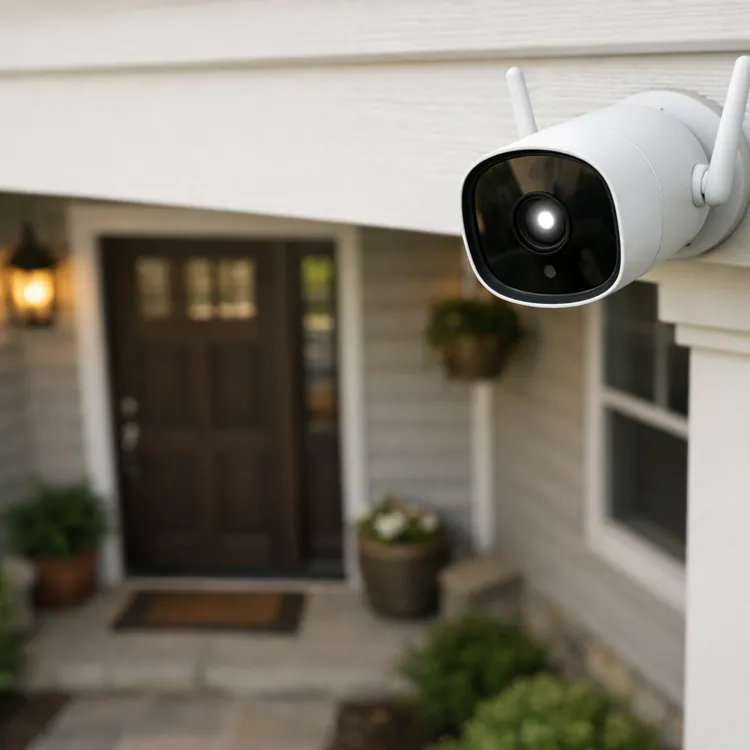
These exceptions are narrow for a reason. Tax treatment depends on use, not your good intentions. A camera over the front porch of your primary residence is one thing, but a system installed in a duplex you rent out is another.
Even when your system isn’t deductible, it still may pay off in other ways:
- Insurance discounts: Some insurers offer premium discounts for monitored systems or fire protection features.
- Home value appeal: Security features may help your property look more attractive to buyers.
- Loss prevention: A working system may reduce theft, vandalism or property damage.
Home office security system deduction rules
If you work from home, you can’t write off your whole alarm bill just because you answer emails from the kitchen table. The IRS looks at how you use the space, whether that use is consistent and whether the security cost ties back to the business part of the home.
Before you count any part of a home security system as a home office expense, run through these eligibility checks:
- Regular use: You use a specific part of your home for business on an ongoing basis, not once in a while.
- Exclusive use: That area serves business only, unless you qualify for the daycare exception.
- Principal place of business: Your home office is your main place of business, or it’s where you handle administrative or management work because you have no other fixed location for those tasks.
- Client or patient meetings: You meet clients, customers or patients there in the normal course of business.
- Detached structure: A garage, studio or other separate structure may qualify if you use it regularly for business.
- Daycare exception: If you run a qualifying daycare from home, the IRS doesn’t require exclusive use in the same way it does for most other businesses.
- Documentation: You keep records showing business use, related expenses and what part of the home the system protects.
Exclusive and regular use test
This is where many home office claims fall apart. The IRS says you must use a specific area of your home only for your trade or business. The space doesn’t need to be walled off with a permanent partition, but it does need to be separately identifiable.
A spare bedroom used only as your office can qualify. A den where you work by day and your family watches movies at night usually can’t. In fact, in Publication 587, the IRS gives that exact example: once personal use enters the picture, the exclusive-use test usually fails.
Regular use matters, too. The IRS specifies incidental or occasional business use is not enough. You need a pattern that looks like a real working arrangement, not a once-in-a-while setup when the house is noisy.
Principal place of business test
Your home office can qualify even if you also work elsewhere. The IRS says the home generally must be your principal place of business, but you can still meet that test if you handle administrative or management work there and have no other fixed location for those duties. Billing, bookkeeping, ordering supplies, setting appointments and writing reports all count as administrative or management tasks.
A plumber, sales representative or medical professional may spend much of the week on the road or at client sites, yet still qualify if the home office is where the paperwork, scheduling and records live.
If you physically meet patients, clients or customers in your home in the normal course of business, and that use is substantial and integral to the business, the space may qualify even if it’s not your principal place of business. A room used for occasional calls or casual drop-ins don’t count.
Detached structures also have their own qualifications. A studio over the garage, a backyard workshop or a barn can qualify if you use it exclusively and regularly for business. It doesn’t have to be your principal place of business to pass that separate-structure rule.
Daycare special rules
Daycare providers get a break that most other taxpayers do not. The IRS specifies exclusive use isn’t required when you use part of the home on a regular basis to provide daycare.
That doesn’t mean the whole house becomes deductible. The calculation changes because the IRS looks at both space and time. If a basement playroom serves daycare during business hours and family use after hours, the deductible share shrinks to match the hours the area is actually used for the business. There are specific formulas the IRS uses in Publication 587 to determine deductibility.
Business-only coverage considerations
The IRS includes security system costs among home office expenses, but that doesn't mean you may deduct the full household bill every time. Home office expenses are sorted into direct and indirect categories. Direct expenses benefit only the business part of the home and are generally deductible in full, subject to limits. Indirect expenses keep up and run the entire home and are deductible only by the business-use percentage.
So if your office has its own camera, sensor or alarm equipment that protects only that workspace, that cost may fit the direct-expense bucket. If your monitoring plan covers the whole house, it’s more likely an indirect expense, which means only the business-share may be deductible.
You should keep canceled checks, receipts and other proof of expenses paid. Your records should also show which part of the home you use for business and that the use meets the IRS tests. For a security system claim, that can mean invoices, contracts, floor plans, equipment lists and anything else that shows what areas the system protects.
Rental property security system tax deduction
Security system costs for rental property often qualify as deductible rental expenses because they tie to protecting income-producing real estate. That treatment usually applies when a landlord owns a house, condo or apartment used only by tenants. The rules change once the owner also lives in the property, because personal use affects how the expense is divided.
The price of security system installation also deserves attention, since landlords may pay an upfront installation bill, a monthly monitoring fee and later service costs. Those charges don’t always receive the same tax treatment. Some fall under current rental expenses, while others may need to be handled differently based on the work performed.
Landlords vs. owner-occupied rentals
A pure rental property usually gets simpler tax treatment. When tenants use the property and the owner doesn’t, security costs tied to operating and protecting that rental generally stay on the rental side of the return.
Owner-occupied rentals require more care. A duplex where the owner lives in one unit and rents the other doesn’t receive the same treatment as a house leased full time to tenants. If one alarm system covers the whole building, only the rental share of the expense usually belongs with rental deductions. The same monthly monitoring plan may be fully deductible for a stand-alone rental home, yet only partly deductible for a property where the landlord lives on-site.
What costs usually qualify
Several security-related costs may qualify when they connect to rental activity:
- Monitoring fees: These often fit with ordinary rental operating expenses because the IRS allows ordinary and necessary expenses for managing, conserving or maintaining rental property.
- Maintenance and repairs: Service calls, sensor replacement and wiring fixes may qualify when they keep an existing system operating. Repairs are treated separately from improvements.
- Installation charges: These need more care. Some costs may be treated as current rental expenses, while costs tied to improvements may need to be recovered through depreciation.
- Equipment for the rental: Cameras, alarms or access controls bought for the rental may fall under current expenses or improvements depending on what was purchased and whether the work adds value or extends the property’s life.
Where deductions are reported
Most landlords report rental income and expenses on Schedule E (Form 1040). That is the form commonly used for residential rental activity, including the ordinary costs of operating and maintaining the property.
The label used for the expense may vary. Some owners place monitoring with other operating costs, while repair work tied to an existing system may sit with repairs or maintenance. Good records help, since invoices and contracts show what was installed, what was serviced and which part of the property the cost relates to.
The reporting rules also change when a property goes beyond ordinary renting and includes substantial services for tenants. For a standard landlord with a rental house or apartment, though, security expenses usually remain on Schedule E.
How to claim the deduction
Claiming the costs of a security-system deduction starts with four jobs: measure the business-use share of your home, sort recurring costs from one-time costs, decide whether any part must be depreciated and put the deduction on the right form.
- Measure the business area: Use a reasonable method, usually square footage or room count if the rooms are about the same size.
- Figure the business-use percentage: Divide the office area by the total area of the home, or divide business rooms by total rooms.
- Separate recurring costs from one-time costs: Monitoring and maintenance usually belong in one category. Equipment and installation may belong in another.
- Choose a deduction method: The simplified method uses a flat rate. The actual-expense method uses real costs and records.
- Check whether depreciation applies: One-time system costs may need to be recovered over time instead of deducted all at once.
- Use the right form: Self-employed taxpayers using actual expenses generally calculate the deduction on Form 8829 and report it on Schedule C.
Calculate business use percentage
The business use percentage controls how much of an indirect home expense you may deduct. For most taxpayers, that means comparing the size of the office space with the size of the whole home.
Two common methods work:
- Square footage: Divide office square footage by total home square footage.
- Room count: Divide business rooms by total rooms, but only when the rooms are about the same size.
The square-footage method usually gives the best result. Room count can work for smaller homes with similar-sized rooms, though it’s more difficult when one room is tiny and another takes up half the floor.
Deduct monitoring and maintenance fees
Ongoing monitoring fees and routine security system service costs usually fit the current-expense side of the deduction. If the system covers the whole home, you generally deduct only the business-use share.
That same rule usually applies to repair and upkeep costs tied to the existing system. A service call to fix wiring or replace a faulty sensor doesn’t get treated the same way as installing a new system from scratch.
Depreciate installation and equipment
Equipment and installation often need more care. A new system may have to be recovered over time instead of deducted in full the year you bought it. That is where many taxpayers trip up. Monthly monitoring belongs in one bucket. A one-time install with equipment, wiring and hardware may belong in another.
If you use the simplified home-office method, you also give up the actual-expense route for that year, which affects how much detail goes into the deduction.
Choose the correct tax forms
For self-employed taxpayers using the actual-expense method, the home-office deduction is generally figured on Form 8829 and carried to Schedule C. Taxpayers using the simplified method skip Form 8829 and use the flat-rate calculation instead.
Be sure to keep invoices, contracts, payment records and notes showing what part of the home the system protects. If you’re sorting out whether a cost belongs in current expenses or depreciation, a tax professional can save you a headache later.
FAQ
Can I claim a home security system on taxes?
Usually not for a personal residence. The IRS treats personal, living and family expenses as nondeductible, though part of the cost may qualify if you have a deductible home office or a rental property.
Is a home security system tax deductible for remote employees?
In most cases, no. The home office deduction is generally for self-employed taxpayers and certain other limited situations, not employees who work remotely for an employer.
What percentage of my security system can I deduct for a home office?
Usually only the business-use share. The IRS says indirect home expenses are allocated based on the percentage of your home used for business, measured by square footage or, in some cases, room count.
Are security cameras tax deductible for rental properties?
They often can be, if they are tied to operating, managing or protecting rental property. The exact treatment depends on whether the cost is a current rental expense or part of an improvement that must be recovered over time.
Article sources
ConsumerAffairs writers primarily rely on government data, industry experts and original research from other reputable publications to inform their work. Specific sources for this article include:
- Internal Revenue Service, "Topic no. 509, Business use of home." Accessed April 23, 2026.
- Internal Revenue Service, "Publication 334 (2025), Tax Guide for Small Business." Accessed April 23, 2026.
- Department of the Treasury, Internal Revenue Service, "Tax Guide for Small Business (For Individuals Who Use Schedule C)." Accessed April 23, 2026.
- Department of the Treasury, Internal Revenue Service, "Publication 527, Residential Rental Property (Including Rental of Vacation Homes)." Accessed April 23, 2026.
- Internal Revenue Service, "Topic no. 414, Rental income and expenses." Accessed April 23, 2026.
- National Association of Insurance Commissioners, "Tips for Saving on your Homeowners Insurance." Accessed April 23, 2026.
- National Association of Insurance Commissioners, "How Can Insurance Help Protect Your Financial Future?" Accessed April 23, 2026.
- Department of the Treasury, Internal Revenue Service, "Publication 587, Business Use of Your Home (Including Use by Daycare Providers)." Accessed April 23, 2026.
- Internal Revenue Service, "How small business owners can deduct their home office from their taxes." Accessed April 23, 2026.
- Internal Revenue Service, "Simplified option for home office deduction." Accessed April 23, 2026.