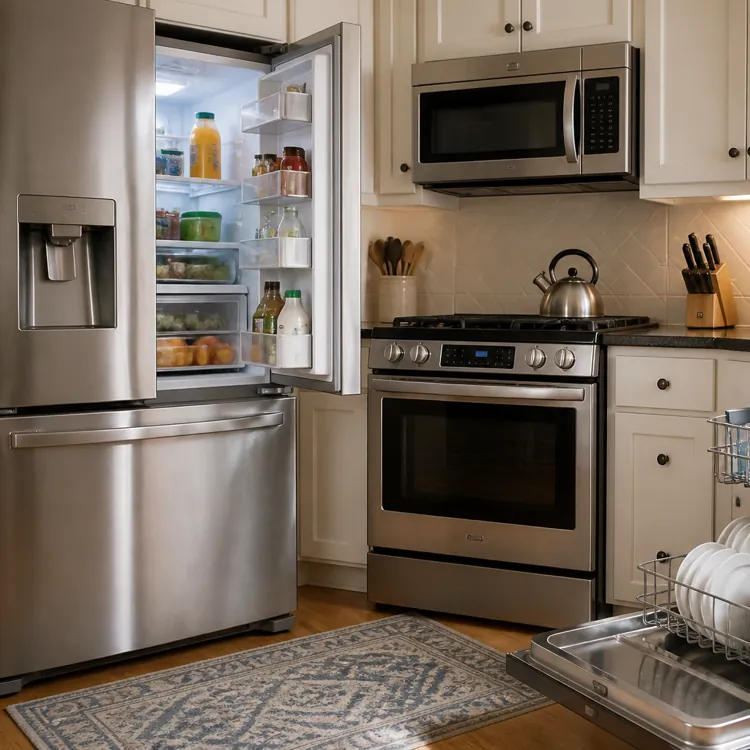



How much does it cost to repair a fridge?
The cost to repair a refrigerator can vary greatly, ranging anywhere from as little as $40 for a low-end repair to as much as $1,000 for high-end repairs. However, most homeowners pay $350 on average to repair a fridge. While the range is large, the cost really depends on the repair needed and the type of fridge you have.
Beyond fridge repair, labor costs can average between $45 and $120, and a one-time service call fee can be as much as $150 to $200. The overall cost will really come down to the type of repair needed and the severity of the issue.
Ask your repair company for a quote including a list of any fees and costs they charge. Some repair companies may have an out-of-pocket minimum for any call. Others may also charge a diagnostic fee to investigate the issue and determine the necessary fix. These are fees charged on top of labor and parts costs, and commonly cost around $60 to $100 or more, making them important to consider when planning for your total cost.
How to ballpark your fridge repair estimate
Before you call a repair company for a quote, you can estimate your repair cost. This quick math will give you a better sense of the price to expect so you can make sure it's worth it to you to repair your fridge.
Consider three factors when estimating your repair costs: the age and brand of your fridge, what's wrong with it and your local labor rate. To start, review the average range for common problems below, then consider the age, make and model of your fridge. Lastly, add in the local labor rates for your area, as some areas may have higher labor rates than others. Don't forget to factor in those diagnostic fees and service call costs that some repair companies may charge as well.
Keep in mind that calls for emergency service or after-hours appointments may come with extra fees, too. Companies may add a surcharge for same-day calls. Ask about any additional charges you may incur for an emergency service visit before you schedule it. For certain fridge repairs, it may be worth the after-hours surcharge in order to keep all your food fresh. Weigh the pros and cons before deciding.
Types of fridge repairs and costs
Refrigerators are fairly complex, with many moving parts. In addition to the severity of the issue, repair costs will depend on the capacity, technology and model of your system. The control board is typically one of the most expensive repairs for a refrigerator, and one that could easily put your total costs over $1,000 when you add in labor and any other fees.
| Component needing repair | Average cost range |
|---|---|
| Coils | $100 to $450 |
| Compressor | $200 to $650 |
| Control board | $500 to $800 |
| Door dent | $50 to $75 |
| Door seal | $100 to $350 |
| Drip pan | $150 to $400 |
| Ice maker | $200 to $350 |
| Refrigerant leak | $100 to $440 |
| Thermostat | $100 to $300 |
Coils
Coils, located at the bottom of your fridge, are what keep it cold. Sometimes they decrease in efficiency if they get dirty from lack of maintenance. Before you call in a professional, try to clean them. If that doesn’t help, you’re looking at $100 to $450 for a repair.
Compressor
Fridges use compressors, which need proper ventilation. Mark Morris, a master plumber and HVAC technician, says you may just not have enough ventilation around your fridge in some cases, which can affect its cooling efficiency and lifespan. “Most manufacturers recommend leaving at least 1 inch of space at the top and back of the fridge for air circulation,” he said.
If you have enough ventilation, but your compressor is still not operating at peak efficiency, your repair could cost between $200 and $650.
The control board is one of the most expensive fridge repairs.
Control board
The control board is the brain of your entire system, and the repair cost reflects its importance. You could pay anywhere from $500 to $800 for a repair or replacement, depending on how high-tech your fridge is and what types of features it comes with. The part alone costs at least $300, not including the labor.
If your fridge just randomly stops working one day without many symptoms or warnings, it’s probably your control board.
Door dent
Removing a door dent costs between $50 and $75 on average. If there are multiple dents or the dent is extra large, you may have to replace the door completely. This could cost upwards of $300 plus labor, depending on the make, model and material.
Door seal
If your fridge is too warm, check the seal first. This is often one of the first parts of a fridge to wear out from use and is a relatively easy fix. You’ll usually notice if it’s the seal based on how it feels when you open and shut the door. Replacing the seal costs $100 to $350 on average.
Drip pan
Repairing a drip pan costs between $150 and $400. Usually, the cost depends on how easy it is to reach the drip pan. It’s located at the bottom of your fridge under the coils and is designed to catch any drips that come from the evaporation process. In some cases, it’s harder to get to, which will increase labor costs.
Ice maker
Repairing an ice maker can cost anywhere from $200 to $350. But considering that a new ice maker could cost you as low as $75, it may be more affordable to go that route instead.
Refrigerant leak
If the refrigerant leaks, your repair could cost between $100 and $440. Refrigerant is the liquid your fridge uses to help move heat out of the system. If your fridge indicates low levels, there’s a leak somewhere. You’ll never need to add refrigerant to your fridge.
The ideal temperature to set your fridge should be between 35 degrees and 38 degrees Fahrenheit.
Thermostat
It’s easy to see why a broken thermostat could play a role in a fridge that won’t stay cold. At $100 to $300 on average, it’s not the most expensive repair, but it’s also not the cheapest. The repair cost will depend on the complexity of your fridge and where your thermostat is located.
Defrost motor
A malfunctioning defrost motor can lead to frost buildup, causing cooling issues in your refrigerator. Repair costs typically range from $100 to $440, depending on the model and labor rates in your area.
» COMPARE: Best refrigerator brands
Other refrigerator repair cost factors
Several variables can influence the total cost to repair a refrigerator beyond the type of issue itself. Labor rates, parts availability and even your location can make a noticeable difference in the final bill.
Brand and model
Premium refrigerator brands like Sub-Zero, Viking and Thermador tend to have higher repair costs because of specialized parts and limited authorized service networks. These luxury brands are pricier upfront, and OEM parts for repairs also come with a higher parts cost price tag.
More common brands like Whirlpool, GE or Frigidaire are typically less expensive to repair since parts are easier to find and technicians are more familiar with their systems. Repair costs for high-end models and luxury brands can be 25% to 50% higher than standard units.
Refrigerator size
Larger or more complex models, such as French door or built-in refrigerators, often cost more to repair than top-freezer or side-by-side models. Bigger units may require extra labor or more expensive components, like dual evaporators or advanced cooling systems, and parts may be harder to access on a built-in fridge.
The cost to repair a mini fridge is similar to a regular fridge, between $45 and $120 per hour, plus parts. Expect a lower final cost if it’s a small fix, like a broken latch or hinge. For more complex or less obvious issues, repair costs could reach $450. In many cases, it’s more practical to replace a mini fridge rather than repair it.
Geographic location
Where you live also affects refrigerator repair costs. Labor rates are typically higher in urban or high-cost areas, while rural homeowners might face additional service fees for travel. Regional energy codes and the cost of living can influence pricing as well. Homeowners in large metro areas can expect to pay roughly 10% to 20% more for appliance repairs compared with national averages.
Should you repair or replace your fridge?
In most cases, it’s cheaper to repair a fridge than replace it. Repairs cost between $300 and $500 on average, compared with the average cost of a new fridge, which is about $1,500. Even the most expensive repair, a new control board, is almost half the average cost of a new fridge.
The average lifespan of a fridge is 12 years, according to the U.S. Department of Energy.
However, if you have an older fridge or a cheaper model, it may not be worth your time or money. A ConsumerAffairs reviewer from Texas wrote:
“The technician told me … ‘Unfortunately, with the age of your refrigerator, it's not economically feasible to fix it.’ The channel that the air comes from the freezer to the refrigerator was clogged and he said that with one this age, it is the insulation that breaks down in it over time.”
The 50% rule
A good rule of thumb when deciding whether to repair or replace your refrigerator is the 50% rule. If the repair costs more than 50% of the price of a new fridge or your appliance is more than halfway through its expected lifespan, replacement usually makes more financial sense.
For example, if a new refrigerator costs around $1,500 and your repair estimate is $800, it’s likely more cost-effective to invest in a new unit. Similarly, if your fridge is over 6 years old and showing multiple issues, replacing it could save you money on future repairs and energy bills, especially if you upgrade to an ENERGY STAR-certified model.
Warranty impact on refrigerator repair costs
Before paying for a repair, look into your refrigerator’s warranty, as it can significantly reduce out-of-pocket expenses — especially if it's new.
Manufacturer warranties: These typically cover defects in parts such as compressors, control boards, and sealed systems. Labor or service call fees are sometimes excluded, so it’s important to read the fine print.
Extended warranties or protection plans: These may provide additional coverage for labor, in-home service or replacement parts beyond the standard manufacturer period. Keep in mind these plans often have deductibles, limits or exclusions for certain types of damage.
Always check your warranty documentation before scheduling a repair. Contact the manufacturer or warranty provider first if your fridge is still covered, since attempting an out-of-pocket repair could sometimes void your protection.
Signs you need a fridge repair
If your fridge starts making weird noises or any of these other signs, it’s probably time to call in a repair tech.
Loud noises
Banging, whistling or running too often are all signs that something’s wrong with your refrigerator. If these noises start randomly or continue for a few days, don’t wait to call for a repair. The culprit could be the condenser fan, compressor or ice maker.
Leaks
Refrigerators leak in two places: the coolant and the water line. Because refrigerant is an odorless gas, you won’t be able to “see” a leak and will instead notice that your fridge isn’t staying cool. But if you see visible water pooling at the bottom of your fridge or on the floor outside your appliance, there could be an issue with your water line or ice maker. If that’s the case, turn off the water to your fridge while you wait for a repair to avoid any more costly damage.
Not cooling
The biggest sign of an issue with your fridge is that it’s not staying cold enough. But this is also a pretty broad symptom that could mean anything from a loose seal to a bad compressor. If it’s simply not maintaining the right temperature, a technician will have to test a few parts and run some diagnostics to figure out what’s actually the root cause of the problem.
Excess condensation or frost
Some condensation is normal in a fridge as you open and shut the door. But if you notice an uptick in condensation or frost starting to form on the fridge walls — especially if accompanied by a musty smell — you may have issues with the door seal or thermostat.
Overheating
If your refrigerator feels hot to the touch, like on the side or back of the fridge, your coils may be working extra hard to keep up. If you notice this, it may be a sign it’s time to get refrigerator maintenance. But if you regularly maintain your fridge, like by cleaning the coils and vents, call in a pro to diagnose the issue.
Can I repair my fridge myself?
Being able to repair a fridge yourself depends on the type and severity of the problem. Some minor issues, like replacing a door gasket, can be solved with some basic tools and instructions. However, major issues, such as repairing a compressor or a thermostat, should be left to a professional who has the skills, tools and parts to fix them safely and correctly.
This is especially true if your fridge is under warranty, either by the manufacturer or a home warranty policy. Repairing it yourself could void either one.
“You should hire a professional to help repair your fridge if you don’t have access to the right tools, you’re dealing with electrical or gas components, or you’re under warranty or insurance that requires professional service,” says master plumber Morris.
FAQ
How long does it take to repair a refrigerator?
It could take anywhere from 30 minutes to a couple of hours to repair a refrigerator. If the issue is immediately evident and parts are readily available, a repair tech could be in and out in less than an hour.
However, if they have to spend time diagnosing the issue and locating the right parts, you could be looking at a few hours or even a few days before your fridge is back in working condition.
How long do refrigerators last?
Refrigerators last 12 years on average, although a properly maintained fridge can last upward of 20 years. The best thing you can do to extend the lifetime of your fridge is to clean the coils, seal and inside regularly. And if you do notice an issue, remedy it as soon as possible, before it can cause further damage.
What can I do to prevent my fridge from needing a repair?
The best way to keep a refrigerator running properly is to clean the condenser coils — coils that help keep refrigerators cool — on a regular basis. It is generally recommended that they be cleaned once to twice a year.
Other ways to maintain your fridge include clearing freezer vents (which can get clogged with ice) and emptying the drip pan every three months. Additionally, cleaning the space between where the fridge closes (also known as the door gasket) and adjusting the fridge thermostat are effective ways to help avoid needing fridge repairs.
Do home warranties cover refrigerators?
Some companies include refrigerators as a standard part of coverage while others don’t — meaning you’ll have to choose it as an add-on. In general, most components and parts, along with the hardware and water leaks, should be covered. But you may find exclusions for beverage dispensers and the door.
Make sure to read your contract fully to see if your fridge is covered. And if you have more than one fridge, like a garage fridge or a mini fridge, don’t expect that to be included, either.
Bottom line
It’s nearly impossible to live today without a refrigerator. And when something is wrong with it, it can be pretty frustrating for most homeowners. Luckily, repair costs are relatively affordable compared to the price of buying an entirely new fridge, averaging just $350. If you have a manufacturer’s or home warranty plan, you may be eligible for coverage for some or all of the repair.
Article sources
ConsumerAffairs writers primarily rely on government data, industry experts and original research from other reputable publications to inform their work. Specific sources for this article include:
HomeAdvisor, “What Does Refrigerator Repair Cost?” Accessed Sept. 30, 2026.
HomeAdvisor, “How Much Does a Refrigerator Cost to Install?” Accessed Sept. 30, 2026.