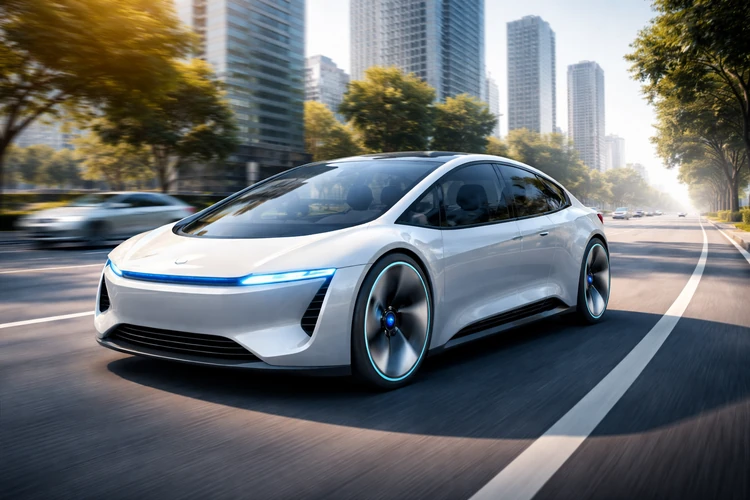

Uber plans to deploy up to 50,000 fully autonomous vehicles through a new partnership with Rivian.
The first robotaxis are expected to hit select cities as early as 2028.
The move signals a big shift toward driverless rides — but widespread adoption will take time.
If the idea of hopping into a car with no driver sounds like something out of a sci-fi movie, it may soon feel a lot more normal.
Uber has announced a major partnership with electric vehicle maker Rivian to roll out a large fleet of fully autonomous “robotaxis” — and it could reshape the future of ride-hailing.
Uber plans to invest up to $1.25 billion into Rivian as part of the partnership, with the goal of deploying tens of thousands of driverless vehicles on its platform in the coming years.
“We couldn’t be more excited about this partnership with Uber — it will help accelerate our path to level 4 autonomy to create one of the safest and most convenient autonomous platforms in the world,” RJ Scaringe, Founder and CEO of Rivian, said in a news release.
“The scale of Rivian's growing data flywheel coupled with RAP1, our state of the art in-house inference platform, and our multi-modal perception platform make us incredibly excited for the rapid advancement of Rivian autonomy over the next couple of years.”
What the Uber–Rivian deal includes
At the center of the partnership is Rivian’s upcoming R2 SUV, which will be redesigned to operate without a human driver. Uber (or its partners) will initially purchase about 10,000 of these autonomous vehicles, with the option to scale up to as many as 50,000 by 2031.
The rollout won’t happen overnight. The first robotaxis are expected to launch in cities like San Francisco and Miami starting in 2028, with plans to expand to as many as 25 cities across the U.S., Canada, and Europe over time.
These vehicles will run exclusively on Uber’s platform, meaning riders could be matched with a driverless car the same way they currently get paired with a driver.
This move is part of Uber’s broader strategy: instead of building its own self-driving tech, the company is partnering with multiple automakers and tech firms to create a network of robotaxis.
“We’re big believers in Rivian’s approach — designing the vehicle, compute platform, and software stack together, while maintaining end-to-end control of scaled manufacturing and supply in the U.S,” Dara Khosrowshahi, CEO of Uber said in the release.
“That vertical integration, combined with data from their growing consumer vehicle base and experience managing the complexities of commercial fleets, gives us conviction to set these ambitious but achievable targets.”
What it means for riders
In the near term, expect robotaxis to roll out slowly, with safety testing, regulations, and limited availability shaping how quickly they expand. You may even get the option in the app to choose between a human driver and a self-driving vehicle, similar to how Uber has tested robotaxis in select markets already.
The bottom line: driverless rides are coming, but they’ll arrive gradually. For now, this partnership is less about your next Uber ride — and more about laying the groundwork for a future where getting around might not require a driver at all.