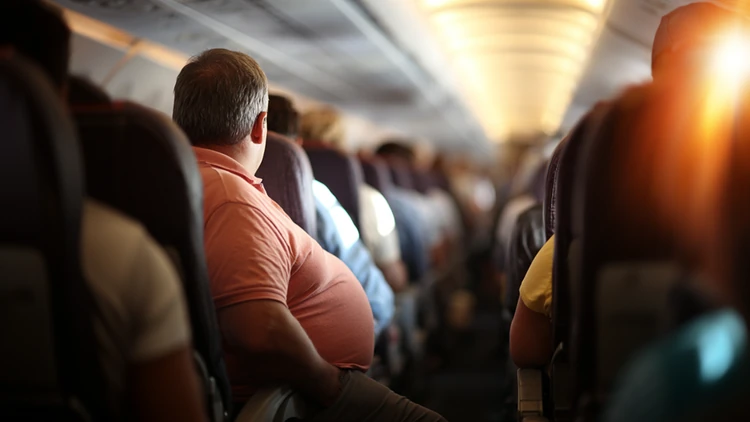

Lighter passengers, lighter planes: A 10% drop in average passenger weight could cut total aircraft weight about 2%, trimming fuel use roughly 1.5% per flight.
Savings scale quickly: For major carriers like American Airlines, Delta Air Lines, Southwest Airlines, and United Airlines, that could mean about $580 million a year in fuel savings.
Fares likely won’t fall: Ticket prices usually follow demand and competition, so lower fuel costs may lift profits more than cut prices.
A surprising side effect of America’s weight-loss boom could show up in the skies and not just on bathroom scales.
According to an analysis from Jefferies Research Services, widespread use of GLP-1 weight-loss medications like Ozempic and Wegovy could eventually lower airline fuel costs by making passengers lighter on average.
Airlines have long obsessed over shaving ounces, from lighter seats to thinner paper manuals. The one thing they can’t control? Passenger weight.
That’s where these medications come in.
The math behind the savings
Jefferies modeled the impact on a Boeing 737 MAX 8, a common narrow-body jet used on domestic routes.
If the average passenger weight dropped by 10%, that total weight on the plane could fall by as much as 2%. That smaller load could translate to roughly 1.5% in fuel savings per flight.
Scaled across the industry, that adds up pretty fast. Jefferies estimates the four largest U.S. carriers — American Airlines, Delta Air Lines, Southwest Airlines, and United Airlines — could save about $580 million a year on fuel if average passenger weight fell meaningfully.
Together, those airlines are expected to spend nearly $39 billion on jet fuel this year.
Will travelers see cheaper tickets?
That sure would be nice, but it probably won’t work that way.
Airlines historically do not lower airfare based on cost savings alone. They tend to base it more on travel demand (or lack thereof) along with what competing airlines are doing.
So in the end, lower fuel usage may improve airlines’ profits, but it won’t necessarily make air travel cheaper.
Still, over time, lower operating costs can:
- Help airlines keep fares from rising as fast.
- Improve route profitability, potentially adding more flight options.
- Boost airline earnings, which can stabilize the industry during downturns.
The bigger picture
This projection hinges on the assumption that GLP-1 drugs become widely used and lead to sustained weight loss across a large share of the population.
But it shows how deeply connected health trends and everyday consumer costs can be. A medical breakthrough aimed at waistlines could ripple into airfare pricing, airline profits, and even how carriers plan routes and fleets.