
Secret Service agents found 35 skimmers during a three-day New York City sweep in June, estimating they prevented $36.5 million in potential fraud.
The devices can be installed in seconds, closely imitate legitimate terminals, and transmit stolen card data wirelessly.
Skimming persists partly because most benefit cards still rely on vulnerable magnetic stripes instead of fraud-resistant chips.
The U.S. Secret Service is intensifying a nationwide campaign against payment-card skimming, conducting coordinated sweeps of stores, ATMs, and fuel pumps as increasingly discreet devices threaten consumers and recipients of government benefits.
In one of its largest recent operations, 14 teams inspected 3,935 payment terminals at 1,010 businesses across New York City from June 23 through June 25. Agents and local authorities removed 35 illegal skimmers — 15 in Brooklyn, 10 in Queens, nine in the Bronx, and one in Manhattan — preventing an estimated $36.5 million in potential losses, according to the Secret Service’s account of the operation.
The sweep, conducted with the New York Police Department, the city Department of Investigation, and the Agriculture Department’s inspector general, was the fourth major skimming operation in the city. Together, those efforts have uncovered 133 devices and prevented an estimated $139 million in losses.
The New York crackdown follows a broad expansion of the Secret Service’s anti-skimming work. During 2025, the agency led 22 outreach operations, examined roughly 60,000 terminals at more than 9,000 businesses and removed 411 devices. It estimated the interventions prevented more than $428 million in fraud. Agents have continued conducting operations in cities including Dallas, Houston, and communities in Northern California this year.
A device that hides in plain sight
A skimmer captures information from a card’s magnetic strip. Criminals may combine it with a false keypad or miniature camera that records a customer’s PIN, then encode the stolen information onto another card and use it to withdraw cash or make purchases.
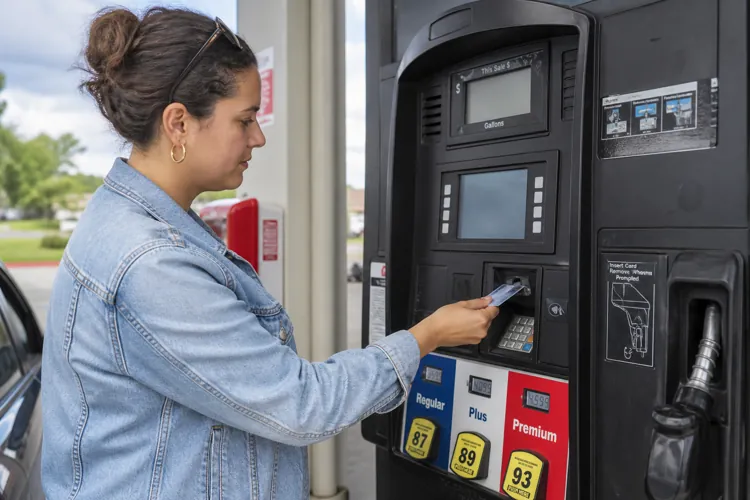
Some skimmers are installed inside fuel pumps, where customers cannot see them. Others are molded overlays that fit so precisely over a point-of-sale terminal that they can pass a casual inspection.
The devices also require remarkably little time to deploy. Criminals can attach one in seconds, sometimes while an accomplice distracts a cashier. Once installed, a skimmer may store account information for later collection or transmit it wirelessly in real time, according to the FBI’s skimming guidance.
That combination — speed, concealment, and remote data collection — creates a difficult enforcement problem. Removing a device stops one stream of theft, but it does not necessarily identify the installer or the broader criminal organization. Nor does it prevent another inexpensive overlay from being placed on the same terminal later.
What to do
Consumers can sharply reduce their risk with a few habits:
Tap instead of swiping. Contactless cards and mobile wallets are generally safest. Otherwise, use the chip rather than the magnetic strip.
Inspect the terminal. Look for loose, crooked, unusually thick, or mismatched parts. Gently pull on the card slot and keypad; don’t use the machine if anything moves or looks altered.
Cover the keypad. Shield your hand while entering a PIN to defeat hidden cameras.
Choose safer machines. Prefer bank-owned indoor ATMs and fuel pumps visible to store employees. At gas stations, consider paying inside.
Use credit instead of debit. Credit cards usually provide stronger fraud protections and don’t expose money directly from your checking account.
Enable instant transaction alerts. Review bank and benefit accounts frequently so fraudulent activity is caught quickly.
Lock cards between uses. Many banking and EBT apps let users temporarily freeze cards or block out-of-state and online transactions.
Protect EBT benefits. Change the PIN regularly — particularly before monthly benefits arrive — and avoid easy combinations such as 1234.
Never disclose a PIN by phone, text or email. Banks and benefit agencies will not contact you to request it.
If you detect an unauthorized transaction, immediately lock the card, contact the issuer, change the PIN, and request a replacement. Report suspected skimming to the store or ATM operator and the FBI’s Internet Crime Complaint Center.