
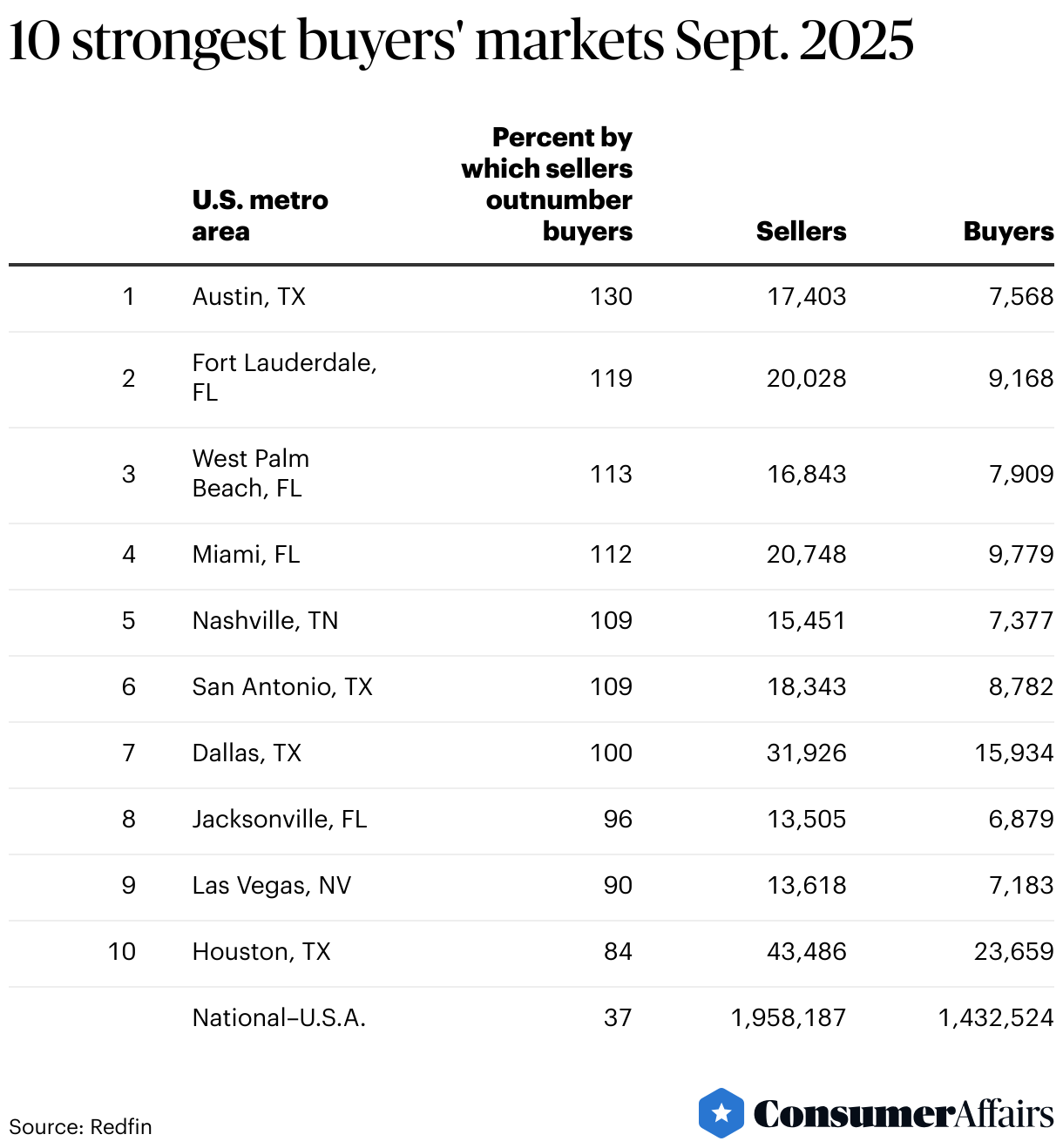
Austin tops the list of the strongest buyer’s markets, with 130% more home sellers than buyers in September, according to Redfin.
Florida metros dominate the list, with Fort Lauderdale, West Palm Beach, and Miami all ranking in the top five.
Nationwide, sellers outnumbered buyers by 36.7%, giving home shoppers more negotiating power than at nearly any point in the past decade.
Remember when a house in Austin or Miami could go on the market and sell in a day, usually for more than the list price? Those days are over, according to a new new housing report from real estate brokerage Redfin.
According to the report, Austin has become the nation’s most favorable market for homebuyers, with 130% more sellers than buyers in September. The oversupply of homes means buyers in Austin, and in many Sun Belt metros, are finding themselves with rare bargaining power.
Following Austin are Fort Lauderdale, West Palm Beach, and Miami in Florida, along with Nashville rounding out the top five. In total, eight of the ten strongest buyer’s markets are in Texas or Florida, two states that have seen a construction boom in recent years.
Nationally, sellers outnumbered buyers by 36.7%, nearly matching the record gap of 36.9% recorded in June 2025. The imbalance means that homes are staying on the market longer and sellers are increasingly willing to negotiate on price and closing costs.
According to Redfin, these are the housing markets that have changed the most to favor buyers:
The Austin market
Austin’s shift reflects a combination of soaring housing supply and falling rent prices, which have pushed many would-be buyers to rent instead.
“Rents have gone down so much in Austin that a lot of people are opting to rent instead of buy,” said Andrew Vallejo, a Redfin Premier agent in Austin. “If a $500,000 home costs about $4,000 a month to own, but you can rent it for $2,500, the math just doesn’t add up for many buyers.”
Some sellers are finding the new reality sobering. Vallejo recalled a homeowner who bought a property for $420,000 in 2022 but would be lucky to sell for $250,000 today. “It’s a tough conversation,” he said, “but the good news is that lower prices are finally opening doors for first-time buyers.”
Nationwide, the number of active home sellers had been rising, until recently. Now, some homeowners are pulling their listings rather than accept reduced prices in a sluggish market.
In Miami, for instance, the gap between sellers and buyers has narrowed from 165% a year ago to 112% this September, as some frustrated sellers withdraw their listings and rent out properties instead.
“Miami’s housing market is at a standstill,” said Ozzie Linares, a Redfin agent. “Many sellers just don’t want to face the reality that their homes aren’t worth what they were two years ago.”
Where sellers still have the upper hand
While most of the nation favors buyers, five major metro areas remain seller’s markets, primarily in the Northeast and Midwest. Newark, N.J., leads with roughly 42% fewer sellers than buyers, followed by Nassau County, N.Y.; Montgomery County, Pa.; New Brunswick, N.J.; and Cleveland, Ohio.
These markets tend to have limited housing inventory and slower new construction, keeping demand high despite rising borrowing costs.
Compared to a year ago, Austin and Denver have experienced the largest swings toward buyer-friendly conditions. Austin’s buyer-seller gap widened by 49 percentage points year over year, while Denver’s grew by 46 points.
On the flip side, Miami and Kansas City are among the metros moving back toward balance, though most still lean toward buyers.