
Shop backwards: Check clearance before browsing the rest of the store. You could find a marked-down version of something similar — or even identical — to what's selling for full price up front.
Know your colors: Red stickers indicate markdowns, while yellow tags are generally used for final-clearance merchandise during major clearance cycles.
Don't blindly wait for a sale: HomeGoods' inventory changes constantly, so waiting for another markdown can mean the chair, lamp, or rug you really want disappears.
HomeGoods is a dangerous place to walk into and say, "I'm just looking."
A $12 candle becomes a $39 lamp, which becomes a $129 chair you had absolutely no intention of buying.
That's partly because HomeGoods doesn't operate like a traditional retailer. Its buyers scoop-up merchandise when manufacturers overproduce or other retailers overbuy. Stores receive new merchandise several times a week, often hundreds of items at a time, and managers may not know what's arriving until the truck shows up.
I've spent years shopping HomeGoods and researching how the chain works, including talking with employees and frequent shoppers about how they find bargains without getting sucked into the treasure hunt.
Here are six strategies that can change the way you shop.
1. Ask when your HomeGoods gets deliveries
Forget the internet advice claiming Tuesday or Wednesday is universally the best day to shop at HomeGoods. There isn't one magic day.
HomeGoods says stores receive new merchandise several times a week. In my own research, I found the more useful strategy is simply asking employees when their particular store typically receives deliveries and when that merchandise usually reaches the sales floor.
That's particularly useful if you're hunting for furniture because employees told me larger pieces tend to get put out quickly.
Ask an employee, "What days do you usually get your biggest deliveries?" Then try shopping shortly after your store typically restocks.
2. Shop backwards

Most shoppers walk into HomeGoods and immediately start browsing whatever is displayed up front.
Try doing the opposite. Head to clearance aisles first, then work your way back toward the front of the store.
One shopper I talked to found a marble cutting board for $12 in clearance, while the same cutting board was priced at $24.99 elsewhere in the store.
Clearance merchandise can also get buried on lower shelves and back-wall endcaps, so don't just scan what's at eye level.
Give clearance a five-minute sweep before doing the rest of your shopping. That way you'll know what's already discounted before considering the full-price stuff.
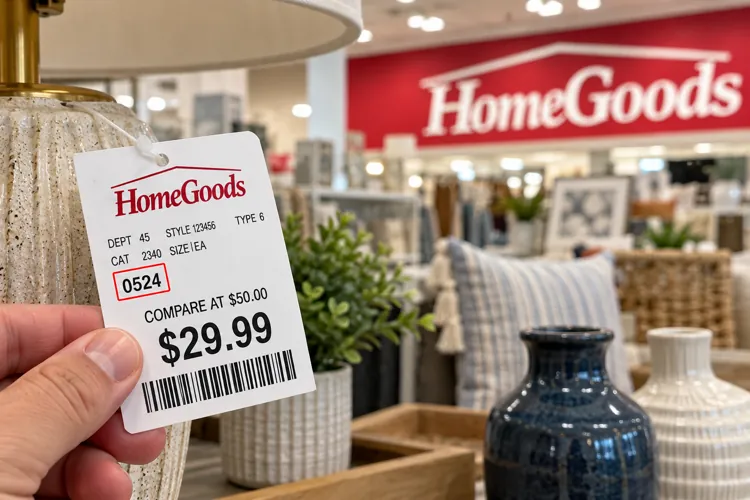
Pro tip: Decode the four-digit date code. HomeGoods employees have told me that the four-digit number underneath the category on the price tag indicates the month and year the merchandise arrived. For example, 0524 would mean May 2024. That can give you a clue about how long something has been sitting in the store.
3. Learn what the red and yellow price tags mean

Here's one HomeGoods clearance trick that's actually useful: A red sticker indicates an item has been marked down, and you may see multiple markdown stickers on merchandise that has gone through more than one price reduction.
Then there's the elusive yellow tag. Yellow tags represent the final clearance markdown and usually appear during major clearance cycles around January and again during the summer, according to deal trackers and employees.
But don't fall for the social-media hype that a "yellow tag sale" means everything in HomeGoods suddenly gets deeply discounted. That’s just not how it works.
The smart move: Think red = clearance and yellow = probably the final markdown. If you really want something with a yellow sticker, waiting for another price cut probably isn't much of a strategy.
Don’t rely on viral posts claiming you can decode the price tags at HomeGoods to determine exactly when its next markdown is coming. While employees have consistently described the four-digit code as the month and year an item arrived, claims online that other tag codes can predict exactly when the next markdown will happen are much shakier.
4. Don't wait for a markdown on something you really love
This sounds contradictory after telling you to hunt for clearance deals first, but it's one of the most important HomeGoods shopping rules.
Waiting only works if the merchandise sticks around, and a lot of the good deals simply don’t.
Employees have told me that stores don't keep replenishment inventory sitting in the back, and because individual locations receive thousands of constantly-changing items, they have no way of tracking down how much of a certain product they have in-stock. That means the one chair you're considering may really be the only one of its kind in the entire building.
It’s fine to gamble on another markdown when it's something you'd be perfectly willing to lose. But if it's unique, hard to replace, and already a good value, waiting another few weeks could cost you the item rather than save you money.
5. Find the flaw — then ask about it
Before buying furniture, lamps, mirrors, or other décor, inspect them from every angle. Look for scratches, chips, dents, missing hardware, and other damage.
If you find something, don't automatically put it back. Instead, show an employee the specific defect and politely ask whether the item qualifies for an additional markdown.
What you shouldn't do is rely on online claims that a damaged item automatically gets you 10% off, 20% off, or some other specific discount. HomeGoods doesn't publish a guaranteed damage-discount schedule.
Rather than asking, "Can you give me a discount?" try something like: "I noticed this chip on the corner. Does this qualify for a damage markdown?"
Pro tip: Ask for a “markdown lookup.” If an item looks like it's been sitting around forever but still has its original price, politely ask an employee whether they can do a markdown lookup. HomeGoods employees on Reddit say items can occasionally miss a markdown if they're in the wrong area when markdowns are done or are returned afterward.
6. Google Lens it before assuming it's a bargain
This might be my favorite HomeGoods trick because it takes about 30 seconds.
Let’s say you find a lamp, mirror, or cookware item and are wondering if the price is a “real” deal. Here’s what you do: photograph it and run the image through Google Lens or another reverse-image search.
It can quickly identify the item and show prices from other sellers, so you'll know if that $79.99 HomeGoods price is actually a bargain.
One shopper I interviewed found a lamp at HomeGoods for $59 and discovered the same lamp selling at a boutique for $180 using this hack.
But the trick works the other way, too. She considered an $80 mirror until an image search turned up a similar version online for $42. She left the HomeGoods mirror behind.
The smart move is to not let the "Compare At" price make the decision for you. A 30-second image search can tell you whether you've actually found a steal.