

Average clutch replacement cost ranges
Costs to replace a clutch sometimes fall below or exceed the average range, but averages can generally give you an idea of what to expect. Auto repair and replacement costs vary based on the make, model and year of the vehicle, as well as labor fees and the parts themselves.
Average clutch replacement costs by vehicle type
The parts used and labor required to replace a clutch vary by category of vehicle, making vehicle type the most significant factor in replacement costs. See the table below for average clutch replacement costs by vehicle category, based on data from RepairPal and other sources.
| Type of vehicle | Average cost to replace clutch |
|---|---|
| Economy and compact cars | $600 to $1,000 |
| Midsize sedans and family vehicles | $600 to $1,200 |
| Pickup trucks and SUVs | $700 to $1,500* |
| European luxury vehicles | $1,000 to $3,000 |
| Exotic vehicles and supercars | $3,000+ |
Clutch replacement cost breakdown
There are three main cost components for replacing the clutch on any vehicle: replacement parts used, labor fees and additional work required. We break down what goes into those costs in the following sections.
Clutch replacement parts
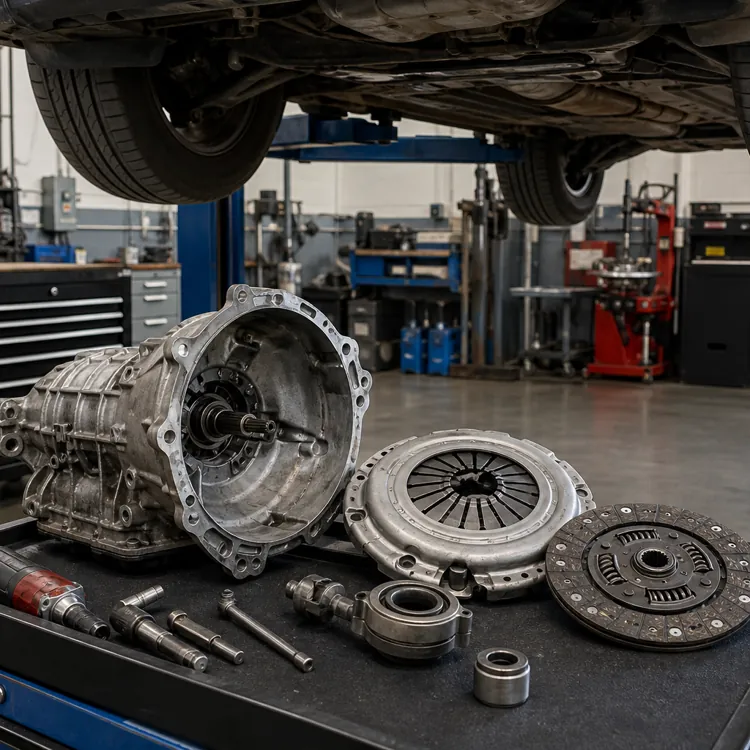
A clutch isn’t a single part. The three main components in a clutch assembly are the clutch disc, pressure plate and release bearing. These parts typically come packaged in a clutch replacement kit. Other smaller components related to the clutch assembly include:
- Clutch flywheel
- Pilot bearing
- Seals and gaskets
- Clutch fork (on older model vehicles)
Buying a clutch kit vs. individual parts
You can choose to buy a pre-compiled clutch kit to replace your transmission or buy parts individually. Purchasing a replacement kit ensures that the components fit and work together properly. But if you don’t need to replace every component in your clutch, buying only the part or parts that need replacing in your clutch assembly could save you money.
Labor to replace clutch
Some clutch replacement jobs are more involved (and therefore more costly) than others. Factors that affect labor costs include:
- Complexity: The less complicated the clutch configuration is, the less time is needed to replace it. More common, less expensive vehicles tend to have simpler clutch assemblies than performance or luxury vehicles.
- Powertrain configuration: Disassembling and reassembling the clutch system in four-wheel or all-wheel drive vehicles often requires more steps. This means these vehicles need a longer time in the shop for replacement service.
- Country of origin: European cars are engineered differently than domestic- or Asian-manufactured vehicles, requiring more specialized labor to replace the clutch. In the U.S., there are also fewer mechanics trained to work on European brands, so these vehicles tend to have the most expensive car repairs.
Additional work needed to replace a clutch
The clutch assembly may not be all that needs replacing or repairing to complete the fix. Any additional parts or labor required will add to your total cost. Other work that may need to be done for a full clutch replacement includes:
- Resurfacing or replacing the flywheel
- Replacing seals and gaskets
- Draining and replacing transmission fluid
- Replacing bearings and/or bushings
Clutch replacement cost by transmission type
Your vehicle’s transmission type is also a major factor in the cost of replacing your clutch. Similar to other cost factors, the difference comes down to the complexity of the repair work and the cost of parts that need to be replaced.
Traditional manual clutches are the least expensive to replace, and dual-clutch transmissions can be the most expensive. See the table below for average cost ranges to replace different types of clutches and why costs vary.
| Type of transmission | Average cost to replace | Reason for cost difference |
|---|---|---|
| Manual clutch | $500 to $2,500 | Simplest and most common type of clutch |
| Dual-clutch transmission | $1,500 to $8,000 | Houses two clutch assemblies in one unit, requires complex mechanical system to operate |
| Automated manual clutch | $1,200 to $5,000 | Similar in assembly to manual clutch, but uses an electro-hydraulic actuator rather than a simple pedal to change gears |
It’s worth noting that the cost of clutch replacement is covered under many factory and extended warranties. A vehicle’s transmission is often included among covered components, even in lower-tier powertrain warranties.
Clutch replacement cost: DIY vs. shop
Labor fees can account for half or more of the total cost to replace a clutch. This means doing the repair work yourself instead of taking it to a shop can save you a significant amount of money. Going the DIY route to replace your clutch can save you $500 to $1,500, but it’s not recommended for the majority of car owners for a few key reasons.
Downsides to DIY clutch replacement
Replacing a clutch on your own is possible if you have the skills, tools, time and space needed to do it properly. But you should be aware of a few risks and considerations before attempting to replace your vehicle’s clutch yourself.
Cost of tools
Some vehicle repairs don’t require more than a set of wrenches and an all-purpose jack or set of wheel ramps, but you’ll need a few specialty tools to replace a clutch. These tools can be expensive and may only have a few specific uses.
| Purpose | Cost | |
|---|---|---|
| Standard car jack | Lifts and holds the body of the vehicle safely off of the ground | $80 to $200 |
| Socket wrench set | Used to remove and reattach nuts and bolts in the assembly | $40 to $150 |
| Socket extensions | Allows user to reach deep-seated nuts and bolts and those mounted in tight spaces | $15 to $50 |
| Torque wrench | Used to tighten flywheel and other components to manufacturer-required torque specifications | $40 to $150 |
| Breaker bar | Used to get additional leverage needed to loosen rusted, worn or otherwise stubborn bolts for removal | $20 to $60 |
| Pry bars | Allows user to remove transmission assembly without damaging surrounding components or casing | $20 to $60 |
| Screwdrivers | Used to remove and reattach screws on housings and mounting sites | $15 to $50 |
| Trim tools | Allows user to "pop" trim clips and other attachments without damaging surfaces | $10 to $30 |
| Transmission jack | Safely supports the transmission assembly while removing or reinstalling it | $100 to $300 |
| Transmission jack adapter | Sits between transmission assembly and jack to safely and securely support the assembly | $30 to $80 |
| Engine support bar | Used when working on front-wheel drive vehicles to support the engine when it tilts, allowing the transmission to be removed or reinserted | $50 to $150 |
Unless you have most or all of these tools available to you already, buying the items you need will significantly reduce your DIY savings.
Required skills
Replacing a clutch, especially in a vehicle with a traditional manual transmission, isn’t the most complex car repair job, but it’s not one for absolute beginners, either. If you don’t know what you’re doing, you could improperly install your new clutch, damage your vehicle or get stuck in the middle of the replacement and have to get a non-driveable vehicle to the shop, where you’ll end up paying for repairs anyway.
Ideally, you’d have some experience working with transmissions if you go the DIY route for replacing your vehicle’s clutch. At the very least, you should have some experience working on mechanical components in vehicles before attempting the job.
Risks to your vehicle
The clutch in your car or truck is an essential component that’s constantly in use, meaning an improper installation could have serious consequences. Risks include:
- Safety risks: A poorly-installed clutch can result in brake failure, loss of driving control or the transmission dropping out while the vehicle is in operation, putting the vehicle — and any occupants — in jeopardy.
- Drivetrain damage: Improper transmission installation can damage other drivetrain components, such as the flywheel, input shaft, clutch disk or casing.
- Hydraulic system issues: If hydraulic cylinders are moved out of place or damaged, this may cause hydraulic fluid leaks that can degrade performance and further damage clutch components.
- Electronic and sensor problems: Vehicles with sensors and other electronic components in the clutch assemblies often need to be calibrated to function properly. Failure to calibrate these components could result in performance problems or loss of function.
- Long-term wear issues: Even if your DIY clutch replacement is fully functional, slight misalignments of parts or miscalibrations can cause the new transmission and surrounding components to wear out unevenly and much more quickly, requiring you to spend money for another replacement.
Time needed
It’s easy to look at the hourly cost of repair work and not consider how much your own time is worth. If doing DIY clutch replacement work takes you away from things that would otherwise be earning you money, be sure to calculate that as a cost to you. While less quantifiable, you should also consider what you’d be missing out on while working on your vehicle. This may include keeping up with chores and tasks, getting adequate rest from work or getting quality time with family and friends.
Space considerations
An often-overlooked part of DIY car repairs is the space required to work on a vehicle. You’ll need at least twice as much space as the size of your vehicle to be able to effectively work and maneuver around it. That space should be off of public streets and safely away from traffic. If the repair site is located away from your home, consider the logistics of getting your vehicle and all the tools you need to the site.
Warranty coverage
As one of the most fundamental parts of a vehicle, the clutch is often covered under warranties. The factory warranty from your manufacturer likely covers the transmission assembly. You may choose to cover the clutch and related components with an extended warranty once your manufacturer’s warranty runs out. In some cases, the cost of an extended car warranty may be less than the cost of replacing the clutch on its own, making it worth considering additional coverage as a cost-saving tool.
» MORE: What voids a car warranty?
FAQ
Is it worth replacing the clutch on a car?
Replacing the clutch on a car is not only worth it, but it’s important to do so as soon as you start noticing problems. Driving around on a bad clutch can further damage your vehicle and put you and your passengers in serious danger.
What are the symptoms of a bad clutch?
Symptoms of a bad clutch include difficulty shifting gears, gears slipping, grinding or squealing noises from the transmission assembly and excessive vibration in the clutch pedal. Other telltale signs of clutch failure include leaking transmission fluids, a burning scent or other abnormal smells and lack of clutch pedal resistance.
Does clutch replacement include the flywheel?
Clutch replacement services don’t always include replacing the flywheel. If the flywheel is in good condition, it does not require servicing when you replace the clutch. In some cases, you may need to resurface the flywheel to restore full functionality but not replace it.
Are clutches covered under warranty?
Whether your vehicle’s clutch is covered under warranty depends on the warranty. The clutch is almost certainly covered under the manufacturer’s bumper-to-bumper factory warranty and is often part of the longer powertrain coverage. Many extended car warranty plans, including basic powertrain warranties, also cover the vehicle’s transmission.
Article sources
ConsumerAffairs writers primarily rely on government data, industry experts and original research from other reputable publications to inform their work. Specific sources for this article include:
- RepairPal, "Clutch Replacement Cost Estimate." Accessed April 1, 2026.
- United States Department of Defense, "Chapter 10 Automotive Clutches, Transmissions, and Transaxles." Accessed April 1, 2026.
- Federal Trade Commission, "Auto Repair Basics." Accessed April 1, 2026.