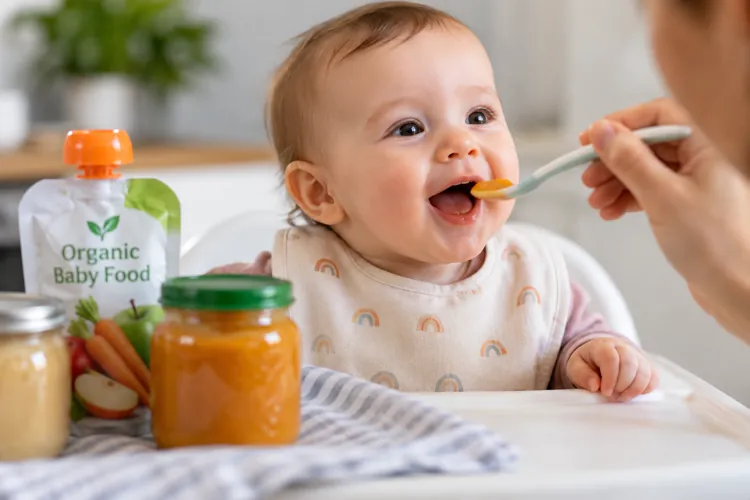

Consumer Reports found microplastics in all 15 baby food purees it tested, including products sold in plastic pouches and glass jars.
The amount varied dramatically, from about 17,000 particles per serving to more than 814,000.
Parents don't need to eliminate packaged baby food, and they can help reduce exposure by having variety in options, avoiding heating food in plastic, and using non-plastic storage containers.
Parents worried about what's hiding in packaged baby food have another contaminant to think about.
Consumer Reports tested 48 baby foods from 11 brands for contaminants including heavy metals, phthalates, and bisphenols. For the first time, it also tested a subset of the products for microplastics.
The results were eye-opening.
Specifically, researchers tested 15 purees and one juice for microplastic particles. Microplastics were detected in every puree. The juice was the only product where they weren't detected.
But the amount varied significantly from one product to another.
Walmart's Parent's Choice Stage 1 Carrot baby food had the highest level, averaging 814,589 microplastic particles per serving.
Gerber Organic Plant Protein Banana Berry and Veggie Smash Puree with Oats had 728,294 particles per serving, while Beech-Nut's Turkey, Butternut Squash, Corn, and Spinach pouch had 680,295.
At the other end of the spectrum, Serenity Kids Organic Savory Veggies pouch contained just 17,177 particles per serving.
What parents can do right now
The findings sound alarming, but Consumer Reports isn't telling parents to stop buying baby food. Instead, focus on reducing unnecessary exposure.
Here are some tips to start implementing today:
Mix things up. Don't rely heavily on one brand, product, or type of packaged baby food. A varied diet can reduce the chance that one source of a contaminant becomes a large part of your child's diet.
Don't heat baby food in plastic. Transfer it to a glass or ceramic container before warming it.
Use less plastic for storage. When practical, store food in glass or stainless-steel containers.
Don't assume organic means microplastic-free. Consumer Reports found microplastics in both organic and conventional products.
And don't panic if your child's favorite food appears on the list. Scientists still don't know what level of microplastic exposure from food poses a health risk, and there are currently no federal limits for microplastics in food.
Glass jars aren't necessarily the answer
It might seem logical that switching from plastic pouches to glass jars would solve the problem.
Consumer Reports' testing suggests it's not that simple.
Microplastics were also detected in baby food packaged in glass. Beech-Nut's Chicken & Chicken Broth, for example, averaged 330,079 particles per jar.
Consumer Reports said plastic-lined lids could potentially contribute particles, but contamination can also occur during food production from machinery, tools, clothing, and other materials that come in contact with the food.
Researchers didn't test the plastic composition of the packaging, so they couldn't determine exactly where the particles originated.
There's actually some good news
The broader Consumer Reports investigation also found significant improvement in another area that has worried parents for years: heavy metals.
Of the 48 baby foods tested, 96% had levels of lead, cadmium, mercury, and inorganic arsenic below Consumer Reports' levels of concern.
Researchers found no consistent difference in heavy-metal contamination between organic and conventional baby foods.
Some products were exceptions. Consumer Reports recommended limiting consumption of Gerber Rice Cereal because of inorganic arsenic and Target's Good & Gather Banana, Peach & Apricot puree because of arsenic levels.
The bottom line for parents isn't to eliminate packaged baby food altogether. But instead, try to vary what your child eats and reduce unnecessary contact with plastic when it’s practical.
When it comes to contaminants, variety may be one of the simplest protections parents have.