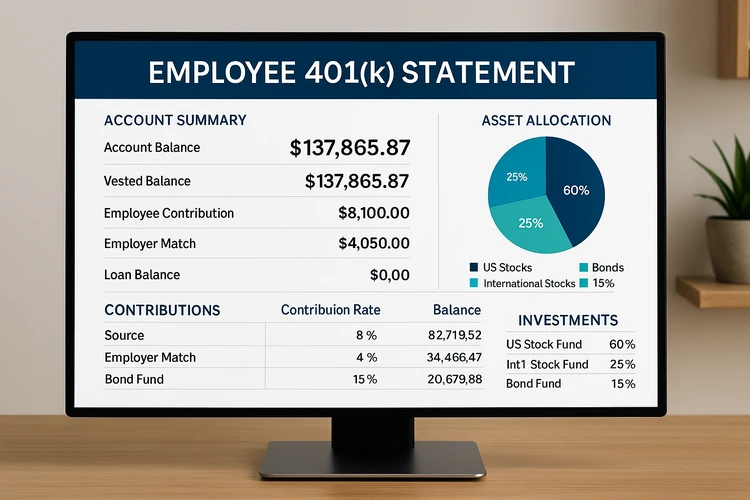

IRS raises 401(k) contribution limit to $24,500 for 2026
IRA contribution caps and catch-up limits rise under SECURE 2.0 adjustments
Income phase-out ranges for IRAs, Roth IRAs, and Saver’s Credit also increase
The Internal Revenue Service has announced a new round of cost-of-living adjustments that will raise contribution limits for retirement savers in 2026. The changes, affecting 401(k)s, IRAs, SIMPLE plans and eligibility thresholds for several tax-advantaged programs, are detailed in Notice 2025-67.
The move gives workers and retirees more room to save as inflation continues to shape long-term financial planning.
Higher limits for 401(k), 403(b), and other workplace plans
Employees who participate in 401(k), 403(b), governmental 457 plans, or the federal Thrift Savings Plan will be able to contribute up to $24,500 in 2026, up from $23,500 in 2025.
Catch-up limits are also increasing. Workers age 50 and older may contribute an additional $8,000—bringing their total possible annual contribution to $32,500. A separate, higher catch-up category created under the SECURE 2.0 Act for workers ages 60 to 63 remains at $11,250 for 2026.
IRA contributions and catch-up limits rise
The annual IRA contribution limit will increase to $7,500, up from $7,000. The IRA catch-up contribution for savers age 50 and over—now subject to an annual cost-of-living adjustment—rises to $1,100.
Eligibility to deduct traditional IRA contributions also shifts upward. In 2026:
Single filers covered by a workplace plan can take a deduction with incomes up to $81,000–$91,000.
Married couples filing jointly, where the contributor is covered by a workplace plan, face a phase-out range of $129,000–$149,000.
IRA contributors not covered by a workplace plan but married to someone who is will see a phase-out range of $242,000–$252,000.
Married individuals filing separately see no change, with the long-standing $0–$10,000 phase-out range unaffected by COLA rules.
Roth IRA eligibility and Saver’s Credit thresholds expand
Roth IRA income limits will climb in 2026:
Singles and heads of household: eligibility phases out between $153,000–$168,000.
Married couples filing jointly: the phase-out range increases to $242,000–$252,000.
Married filing separately: unchanged at $0–$10,000.
The Saver’s Credit, aimed at low- and moderate-income workers, also expands:
Up to $80,500 for joint filers
Up to $60,375 for heads of household
Up to $40,250 for single filers and married individuals filing separately
For 2026, individuals contributing to SIMPLE retirement accounts may save up to $17,000, an increase from $16,500. Higher limits created for certain eligible SIMPLE plans rise to $18,100.
Catch-up contributions for SIMPLE savers age 50 and older increase to $4,000, though certain eligible plans retain a separate $3,850 limit. The enhanced catch-up option for ages 60–63 remains steady at $5,250.