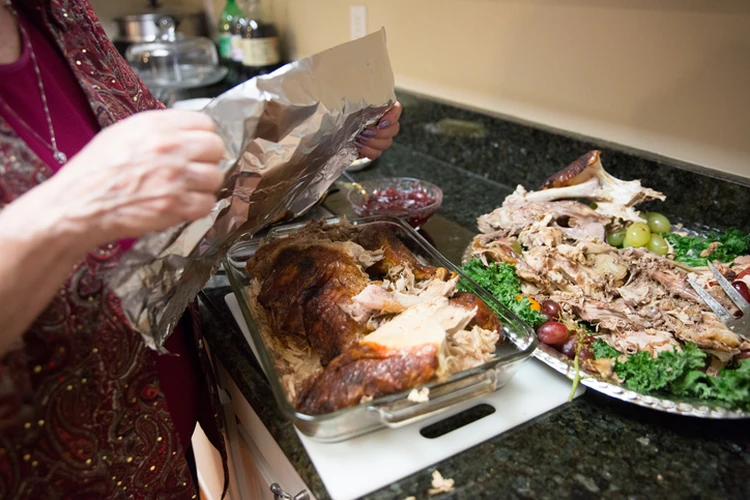
While the price of Thanksgiving dinner has been top of mind for many consumers this year, what about preserving all of those leftover meal items to last as long as possible?
Food safety experts are sharing their best tips on how to ensure that your family and friends are only eating foods that are fresh and safe this holiday season.
Pay attention to meat
With turkey being the star of the show for Thanksgiving dinner, it’s important to make sure that the meat is safe and cooked at the right temperature. Experts from the U.S. Department of Agriculture (USDA) encourage consumers to have a meat thermometer ready for Thanksgiving.
Turkey should be cooked to 165 degrees Fahrenheit in three key places: the thickest part of the breast, the innermost part of the thigh, and the innermost part of the wing. Checking each part of the turkey with a meat thermometer will ensure that the meat is cooked thoroughly and not overdone.
This also goes for leftovers; be sure all food that is reheated is done so to the proper temperature.
“It’s important to keep food out of the danger zone, which is the temperature between 41 and 135 degrees,” said Alexis Hamilton, a postdoctoral associate and incoming assistant professor of food processing microbiology at Virginia Tech. “It’s important that foods pass through this range as quickly as possible. Basically, keep hot foods hot and cold foods cold.”
When it comes to preparing the turkey, experts from USDA also recommend not to wash it, and only to thaw it in the refrigerator. Washing raw meat can increase the risk of bacteria, while defrosting in the refrigerator allows the meat to thaw all the way through at a consistent rate.
Storing food
When it comes to storing food, there are several key factors to keep in mind. For starters, all hot food should be left to cool before being transferred to the refrigerator or freezer.
On the other hand, leftovers can’t last forever, and it’s important to know when food has gone bad. The U.S. Food and Drug Administration (FDA) has a chart that consumers can keep handy that details how long certain foods can last either in the refrigerator or in the freezer. However, should those foods go bad, consumers should look for: a weird taste, an odd texture, a bad smell, or mold.
If you’re really unsure whether or not something is spoiled or safe to eat, the USDA has a FoodKeeper app that’s available for both iPhone and Android. In the app, consumers can learn about how to safely handle and store over 650 food items, and get specific storage timelines for individual foods.
To prevent food from spoiling – and maximize your time with your Thanksgiving leftovers – the general rule of thumb is that most foods will last three to four days when properly sealed and stored in the refrigerator. That is unless they’re all eaten before then!
This rule stands for cooked meats, fish, macaroni and cheese, or casseroles. However, storing food in the freezer can extend the lifespan by months. Thanksgiving dinner can last through the new year if properly stored in an air-tight container or wrapped in tin foil, plastic wrap, or freezer paper.
“One trick I like to use is to put meals onto plates and place the amount for a few days in the fridge and put the rest in the freezer, where the foods will safely keep for a few months,” said Hamilton. “If you like Thanksgiving foods the best after a few weeks, I would suggest that you freeze the meal on Thanksgiving Day and defrost it when you want to eat it.”