
2021 Home Product Recalls and Safety Alerts

Article Image

Biden asks Congress to extend federal eviction ban

President Biden is calling on Congress to extend the federal halt on evictions due to the threat of the COVID-19 Delta variant. The eviction moratorium is set to expire Saturday, but White House officials say Biden has asked Congress to extend the order “without delay.” 

"Given the recent spread of the Delta variant, including among those Americans both most likely to face evictions and lacking vaccinations, President Biden would have strongly supported a decision by the CDC to further extend this eviction moratorium to protect renters at this moment of heightened vulnerability. Unfortunately, the Supreme Court has made clear that this option is no longer available," White House press secretary Jen Psaki said in a statement on Thursday.

"In light of the Supreme Court's ruling, the President calls on Congress to extend the eviction moratorium to protect such vulnerable renters and their families without delay.”. 

Congressional action needed

The federal eviction ban was put in place last September by the Centers for Disease Control and Prevention (CDC) as a way to help Americans who had fallen behind on their rent during the pandemic. The eviction freeze has been extended several times since then. 

Last month, the Supreme Court allowed the eviction moratorium to remain in place until July 31. Lawmakers said no further extensions would be approved without congressional action. Since then, however, concern about the highly contagious Delta variant has risen. Housing advocates have said that ending the eviction ban is likely to lead to a huge spike in homelessness, which would only worsen the spread of the virus. 

“The confluence of the surging delta variant with 6.5 million families behind on rent and at risk of eviction when the moratorium expires demands immediate action,” said Diane Yentel, executive director of the National Low Income Housing Coalition. “The public health necessity of extended protections for renters is obvious. If federal court cases made a broad extension impossible, the Biden administration should implement all possible alternatives, including a more limited moratorium on federally backed properties.”

Psaki said Biden has asked the departments of Housing and Urban Development, Agriculture, and Veterans Affairs to extend their respective eviction bans through the end of September. As Saturday approaches, states and localities are being urged to "urgently accelerate" their efforts to get emergency rental assistance funds to those in need.
Article Image

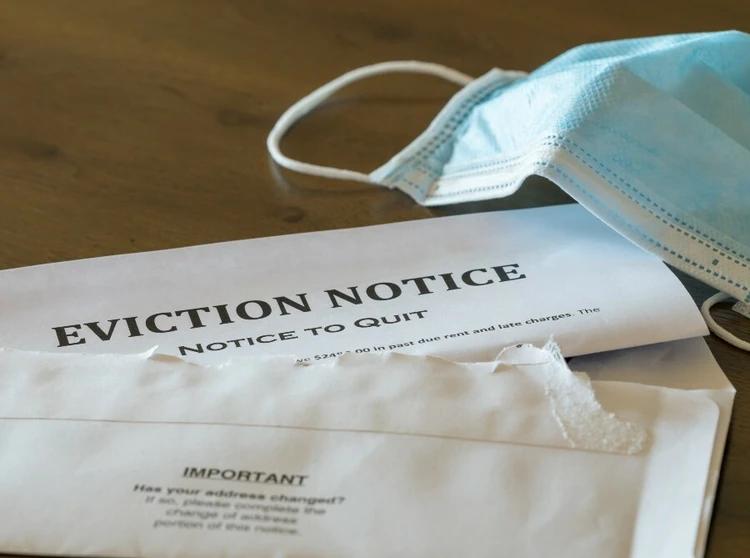
Federal judge overturns CDC eviction ban six weeks before its expiration

A federal judge has overturned the moratorium on evictions put in place by health officials during the pandemic. 

D.C. District Judge Dabney Friedrich issued a 20-page ruling on Wednesday that stated, in part, that the Centers for Disease Control and Prevention (CDC) overstepped its authority with the temporary eviction ban. 

"The question for the Court is a narrow one: Does the Public Health Service Act grant the CDC the legal authority to impose a nationwide eviction moratorium? It does not," Friedrich wrote. 

The nationwide halt on evictions was enacted last September and extended twice this year under President Biden -- first until April, and then through June. Health officials said allowing renters to remain in their homes would keep millions of cash-strapped Americans from being displaced and prevent the COVID-19 pandemic from worsening again.

DOJ reviewing the decision

At her daily news briefing, White House press secretary Jen Psaki told reporters that the Department of Justice "is reviewing" the decision and would offer further comments on it later in the day.  

"We also recognize of course the importance of the eviction moratorium for Americans who have fallen behind on rent during the pandemic. A recent study estimates that there were 1.5 million fewer evictions filed during 2020 than would be expected due to the eviction moratorium so it clearly has had a huge benefit," Psaki said.

In her ruling, Dabney said the coronavirus pandemic has “triggered difficult policy decisions that have had enormous real-world consequences.” 

“The nationwide eviction moratorium is one such decision," Friedrich wrote. "It is the role of the political branches, and not the courts, to assess the merits of policy measures designed to combat the spread of disease, even during a global pandemic."

Diane Yentel, CEO of the National Low Income Housing Coalition, told CNBC that it remains unclear whether lifting the ban will affect the entire country. 

“Several court rulings have attempted to strike down the moratorium, but all had limited application,” she said. “While this ruling is written more starkly than previous ones, it likely has equally limited application, impacting only the plaintiffs who brought the case.”

Article Image

CPSC issues urgent warning about adult bed rails

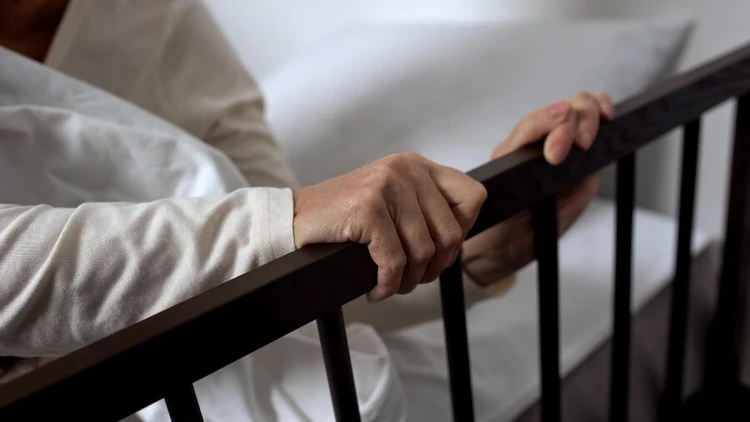
Federal safety officials are warning families with elderly family members that the bed rails designed to keep the bed occupant safe could pose a threat to their life.

The U.S. Consumer Product Safety Commission (CPSC) said consumers should immediately stop using three models of adult portable bed rails manufactured by Bed Handles, Inc. The agency said the railings leave too much space between the mattress and railing and can pose a risk of someone becoming trapped and suffocating.

The models in question are:

  • AJ1

  • BA10W

  • BA11W

Ordinarily, there would be a recall for these products but the CPSC said that’s not possible because Bed Handles, Inc. is no longer in business. So it is advising consumers to immediately stop using the bed rails and dispose of them.

CPSC said it evaluated the bed rails and discovered that it is easy for a person to become trapped between the bed rail and mattress, or within the portions of the bed rail itself, leading to asphyxia.  

If you purchased one of these bed rails, you probably got it by ordering it online at Walmart.com, MedontheGo.com, soymedical.com, bpimedicalsupply.com, sonomasurgical.com, or other online retailers and paid around $80 to $100.  

Authorities say the bed rails have also been found for sale on secondary sites, such as eBay. The model number can be found on a white label located on the bottom of the handle.

The rails lack retention straps

The CPSC is concerned that a significant number of the bed rails may still be in use. It announced a recall of a previous version in both 2014 and 2015. The agency warned that the rails, made between 1994 and 2007, were sold without retention straps.  

According to reports to the agency, four people died after becoming trapped in the bed rail. All four victims were elderly or disabled individuals.  

Since 2007, the bed rails have been sold with retention straps, but CPSC has found that the straps do not adequately protect consumers.

CPSC urges consumers to stop using these bed rails and report any related incidents to the agency at www.SaferProducts.gov.

Article Image

Consumer agency says consumers should stop using the Peloton Tread+ treadmill

The Consumer Product Safety Commission (CPSC) has issued an urgent warning to owners of the Peloton Tread+ treadmill after it said one child was killed in an accident and several others were injured.

The agency said it acted after an investigation, reporting that its staff believes the Peloton Tread+ poses “serious risks to children for abrasions, fractures, and death.”

The warnings drew strong pushback from the company, which said the treadmill is safe when safety rules are followed. Peloton said it reported to the CPSC in March when it learned of a child’s death caused by the machine. 

“On March 18, 2021, Peloton's co-founder and CEO John Foley sent an urgent reminder directly to Tread+ members to follow the critical warnings and safety instructions that accompany the Tread+, which state that children, pets, and objects should be kept clear of the Tread+ at all times,” the company said in a statement. “Members were also reminded to remove the safety key and store it out of the reach of children when an adult is not using the Tread+.”

‘Inaccurate and misleading’

Peloton said information in the CPSC press release about the incidents is “inaccurate and misleading” and said its efforts to aid in the investigation of the incidents were rejected.

The CPSC said its investigation turned up at least 39 reports of children, and one pet, being injured while the machine was in operation. It released a video showing one incident in which a child was injured. (Warning: Video content may be disturbing to some viewers.)

“In light of multiple reports of children becoming entrapped, pinned, and pulled under the rear roller of the product, CPSC urges consumers with children at home to stop using the product immediately,” the agency said.

The CPSC believes that at least one incident occurred while a parent was running on the treadmill, suggesting that the hazard cannot be avoided simply by locking the device when not in use. Reports of a pet and objects being sucked beneath the Tread+ also suggest possible harm to the user if the user loses balance.

All treadmills can be dangerous

Injuries caused by any kind of treadmill are not uncommon. The CPSC has reported that 24,000 Americans were treated for treadmill injuries at hospitals in 2014. However, that statistic includes patients treated for injuries from overuse, such as pulled muscles and tendons.

Deaths from treadmill accidents are said to be somewhat rare. In 2015, SurveyMonkey CEO Dave Goldberg died of a head injury after falling while using a treadmill at a resort.

According to Sadler, a sports and recreation insurance provider, the treadmill is among the riskiest of all workout equipment because it has a motor that propels it.

The CPSC says consumers who decide to keep using the Peloton+ treadmill should keep it in a locked room. They are also advised to keep all objects, including exercise balls and other equipment, away from the machine. When not in use, the agency says it should be unplugged.

Article Image

States with stricter gun laws have fewer issues with youth gun violence, study finds

The strictness of gun laws varies from state to state. Recently, experts have found that in areas where these laws have tighter restrictions, the outcomes are better for both school safety and teens’ mental health.

Now, a new study conducted by researchers from Rutgers University has found that stricter gun laws also contribute to fewer overall instances of gun violence among young people. 

“We understood the role of individual characteristics in youth gun carrying, but we often ignored the broader environmental context surrounding youth gun carrying behavior, such as whether gun laws are in place in a state to discourage access to guns,” said researcher Paul Boxer. “Our study helped prove clarity to these associations.” 

Young people are safer

To better understand how gun laws can impact youth gun violence, the researchers looked at each state’s gun laws and compared them to related instances of violence -- particularly among young people -- between 2005 and 2017. 

The researchers learned that regulations around guns were a big indicator of whether or not young people were carrying weapons and whether gun violence occurred. The study showed that regions with more laws prohibiting carrying weapons were less likely to experience youth gun violence, while states with more lenient laws had more young people carrying weapons and more instances of gun violence. 

The findings highlight two states in particular that show these disparities: New York and Louisiana. In 2013, New York had more than 60 laws in place that prohibited weapon carrying; in turn, the rate of gun violence among young people that year was at just three percent. Conversely, Louisiana had 13 gun laws in place in 2017; that year, they experienced the highest rate of gun violence across the entire country, at nearly 13 percent. 

Moving forward, the researchers hope that legislators realize just how important these findings are. State’s gun laws can have a ripple effect on consumers’ safety in public places, and reducing gun violence should be the top priority. 

“Though more work is needed, the current findings point to the potential of gun laws to lower youth gun carrying behavior, which all sides of the gun-law debate can agree is unwanted and dangerous,” said researcher John Gunn.