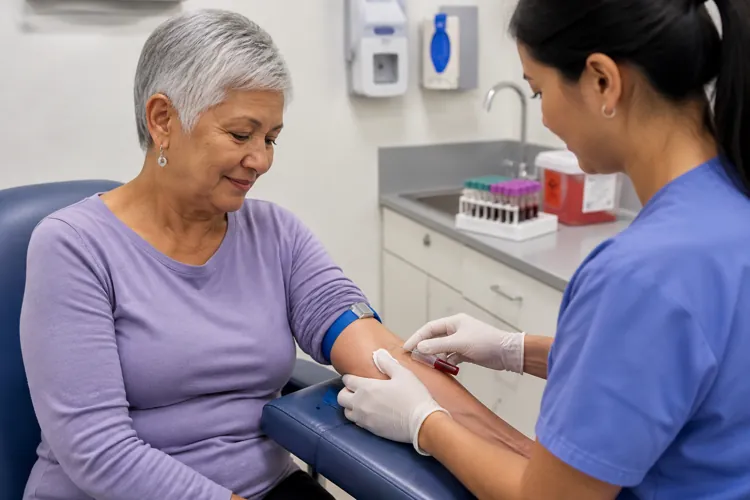

Roche’s new blood test can help doctors assess whether amyloid pathology linked to Alzheimer’s disease is likely present.
The test is intended for people 55 and older who have signs, symptoms, or concerns about cognitive decline.
Because it can be used in both primary and specialty care, the test could make the evaluation process more accessible for some patients.
Getting answers about changes in memory or thinking can involve a number of steps, particularly when doctors are trying to determine whether Alzheimer’s disease may be involved.
Now, the U.S. Food and Drug Administration (FDA) has cleared a new blood test from Roche that could give doctors another tool for that process.
The Elecsys pTau217 blood test is designed to help assess amyloid pathology associated with Alzheimer’s disease. Roche says it is the first and only FDA-cleared single-biomarker blood test that can support both ruling in and ruling out amyloid pathology in primary and specialty care settings.
"FDA clearance of Elecsys pTau217 marks an important milestone in Alzheimer's disease diagnosis and underscores Roche's continued leadership in advancing innovative solutions that can help patients get answers sooner," Dan Malarek, President and CEO of Roche Diagnostics North America, said in a news release.
"As the first and only FDA-cleared, single-biomarker blood test supporting both rule-in and rule-out assessment of amyloid pathology, Elecsys pTau217 has the potential to transform how Alzheimer's is assessed across primary and specialty care. This kind of innovation can help bring diagnostic evaluation closer to patients and give clinicians greater confidence in determining the right step in their care.”
How the test works
The test measures phosphorylated tau 217, or pTau217, in a blood sample. Rather than producing a simple yes-or-no diagnosis, the test provides positive, intermediate, or negative results indicating the likelihood of amyloid pathology.
Those results aren't meant to stand alone. Doctors are expected to consider them alongside a patient's clinical information and other relevant findings when determining the next steps in an Alzheimer's evaluation.
The test is intended for people aged 55 and older who have signs, symptoms, or complaints of cognitive decline. It can be run using Roche's existing cobas laboratory instruments, with more than 4,500 of those instruments already in use across the U.S., according to the company.
What this means for consumers
For patients experiencing cognitive changes, one potential advantage is that the test offers a minimally invasive option that can be incorporated into existing medical and laboratory workflows.
Roche notes that traditional methods of assessing amyloid pathology, including PET imaging and cerebrospinal fluid testing, can be costly, invasive, and difficult to access outside specialty centers. The new blood test may help doctors determine which patients should receive additional testing or be considered for a specialist referral.
That doesn't mean a blood test will replace every other part of an Alzheimer's evaluation. Instead, it gives doctors another way to gather information — and potentially helps some patients move through the diagnostic process with fewer barriers.
"For decades, clinicians have faced significant challenges in accurately diagnosing Alzheimer's disease in its early stages," Jared R. Brosch, M.D., Neurologist, Indiana University Health, said in the release.
"Advances in blood-based biomarkers have the potential to transform the diagnostic pathway by expanding access to evaluation for Alzheimer's across a variety of care settings. As these tools become available, clinicians may be able to evaluate more patients earlier in the disease course, improving diagnostic confidence and helping patients and their families make more informed decisions at a critical time."