
2025 Gas Prices and Trends

Article Image

Christmas Day gas prices expected to dip to a multi-year low

  • National average gasoline price expected to be $2.79 per gallon on Christmas Day

  • Drivers projected to save about $521 million nationwide during Christmas week compared with last year

  • Prices remain below last Christmas and among the lowest holiday levels since 2020


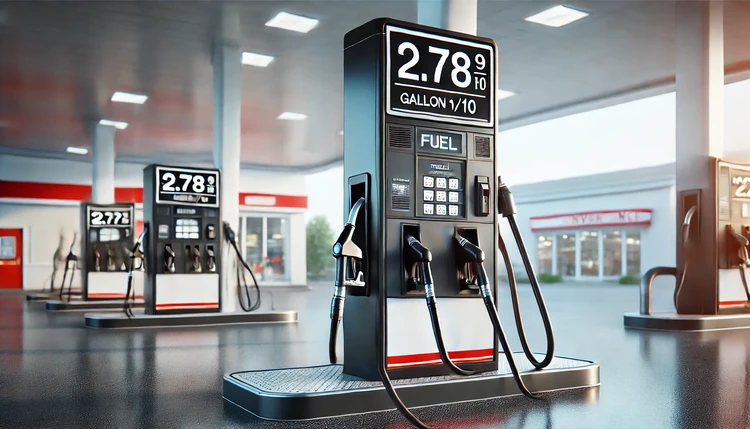
While the cost of celebrating Christmas remains high, holiday travelers may find an unexpected bit of cheer at the gas pump this Christmas, with prices continuing a multi-year trend of seasonal relief. GasBuddy forecasts the national average price of gasoline will land near $2.79 per gallon on Christmas Day, down from about $3.00 a year ago.

That decline adds up. GasBuddy estimates motorists will collectively save roughly $521 million during the Christmas travel week compared with last year, offering some financial breathing room as millions of Americans hit the road to visit family and friends.

The favorable outlook reflects a combination of supply and demand dynamics that have eased pressure on prices heading into the holidays. Refinery maintenance that typically tightens supply earlier in the fall has largely wrapped up, allowing gasoline inventories to rebuild. At the same time, OPEC’s increased oil production through much of 2025 has pushed crude oil prices to multi-year lows in the weeks leading up to Christmas.

Less demand helps

Seasonal demand also plays a role. While holiday travel remains heavy, winter gasoline consumption is significantly lower than during the summer driving season, helping keep prices in check. That natural demand slowdown has allowed prices to settle near what are often the lowest levels of the year.

“Christmas is often when gas prices settle near the lowest levels of the year, and 2025 is no exception,” said Patrick De Haan, head of petroleum analysis at GasBuddy. 

“Refinery maintenance has wrapped up, supplies are rising, and winter demand is much lower than in summer — all of which help keep a lid on prices. Provided there are no surprises, holiday travelers should see pump prices that come in a bit lower than last Christmas.”

De Haan cautioned that unexpected refinery disruptions or international tensions could still introduce short-term volatility, but said the broader backdrop is far more favorable than in the years immediately following the pandemic, when reopening demand sent prices sharply higher. 

He also noted early indicators are encouraging as GasBuddy prepares to release its 2026 Fuel Outlook in January, with signs that lower prices could extend into next year.

Holiday tips

For drivers heading out this holiday season, GasBuddy recommends a few simple strategies to maximize savings:

  • Compare prices before filling up, as nearby stations can differ by 10 to 25 cents per gallon, and even more on longer trips.

  • Plan around state lines, where tax differences can create price swings of 20 to more than 80 cents per gallon.

  • Use loyalty programs and fuel-saving apps to stack discounts.

  • Drive efficiently, maintaining steady speeds and using cruise control, which can boost fuel economy by up to 15% on long drives.

Taken together, this year’s Christmas gas price outlook offers a modest but meaningful gift for holiday travelers — one that could make the journey home a little easier on the wallet.

Article Image

7-Eleven hit with record $4.5 million penalty for antitrust violations — what it means for gas prices

  • 7-Eleven paid a record $4.5 million fine for secretly acquiring a gas station without FTC approval

  • The company violated a 2018 consent order designed to prevent fuel price manipulation in local markets

  • This enforcement action signals stronger merger oversight that could protect consumers from higher gas prices


If you've noticed gas prices varying wildly between stations in your neighborhood, corporate consolidation might be to blame. When big chains gobble up independent stations without proper oversight, it can reduce competition and drive up prices at the pump.

What happened with 7-Eleven

On December 8, 2025, the Federal Trade Commission announced that 7-Eleven will pay a record-breaking $4.5 million penalty for violating antitrust rules. This marks the largest civil penalty ever collected for a prior-notice violation in FTC history.

The violation stems from 7-Eleven's secret acquisition of a fuel outlet in St. Petersburg, Florida, in December 2018. The company was required under a 2018 consent order to notify the FTC before acquiring competing gas stations in 76 specific markets.

Instead, 7-Eleven bought the station without telling anyone. The company didn't inform the FTC about the acquisition until March 2022 — more than three years later.

The bigger picture on gas station consolidation

This case originated from 7-Eleven's massive $3.3 billion acquisition of 1,100 Sunoco fuel outlets in 2018. The FTC found this mega-merger would harm competition and raise fuel prices for consumers in 76 local markets.

The consent order was designed to prevent exactly what happened in St. Petersburg — stealth acquisitions that reduce competition without regulatory review.

How to protect yourself from gas price manipulation

  1. Use gas price apps like GasBuddy or Waze to find the cheapest stations in your area and avoid price-gouging locations

  2. Report suspected price fixing to the FTC at reportfraud.ftc.gov if you notice identical pricing across competing stations

  3. Support independent gas stations when possible, as they often offer more competitive pricing than large chains

  4. Consider fuel rewards programs that aren't tied to a single chain to maintain flexibility in where you shop

  5. Monitor local news for proposed gas station mergers in your area and submit comments to the FTC if you're concerned about reduced competition

What this enforcement means going forward

The FTC is signaling a tougher stance on merger violations under new leadership. Daniel Guarnera, Director of the FTC's Bureau of Competition, stated that "merger remedies that protect competition are once again on the table."

This aggressive enforcement could prevent future stealth acquisitions that harm consumers. 7-Eleven was also required to sell the St. Petersburg station and commit to additional approval requirements for future purchases.

The bottom line: This record penalty shows regulators are serious about preventing gas station consolidation that drives up prices. While you can't control corporate mergers, you can vote with your wallet by choosing competitive stations and staying informed about proposed acquisitions in your area. The FTC's renewed enforcement efforts could mean more stable gas prices and better competition at the pump.

Article Image

Drivers spending near record-low share of income on gasoline

  • In 2025, drivers are expected to spend less than 2% of disposable income on gas — the smallest share in two decades.

  • The average price of regular gasoline is $3.12 per gallon, down compared to last week, last month, and last year, with most states seeing decreases except parts of the West Coast facing infrastructure-related increases.

  • Prices range from as low as $2.68 in Mississippi to as high as $4.64 in California and Washington, though the median U.S. price is $2.95 per gallon, with many common prices under $3.


While restaurant bills can put a dent in your wallet, paying for the gasoline to get you to the restaurant won’t. A report by the Energy Information Administration found that drivers are expected to spend the smallest share of their disposable income on gasoline this year than at any time in the past two decades.

The agency’s report said less than 2% of people's personal disposable income will be spent on gasoline in 2025, down from an average of 2.4% over the previous decade. Excluding 2020, when the pandemic made gas incredibly cheap, that’s the lowest percentage since 2025.

According to GasBuddy data, the national average price of gasoline is down 3.6 cents in just the last week and stands at $3.12 per gallon.

That’s 1.8 cents lower than a month ago and is 2.8 cents per gallon lower than a year ago. The national average price of diesel has decreased 2.6 cents in the last week and stands at $3.658 per gallon.

The West Coast is still expensive

“While gas prices fell in more states than they rose last week, the West Coast continues to face challenges, with Oregon and Washington seeing some of the largest increases due to regional infrastructure issues,” Patrick De Haan, head of petroleum analysis at GasBuddy, said in the company’s blog. 

“The good news is that the transition to cheaper winter gasoline begins across most of the nation, and with improvements underway in the West Coast market, I expect that average gas prices will continue to decline in the weeks ahead in most states — assuming hurricane season remains quiet.”

Drivers have benefited in two ways. First, gas prices have remained stable for months, making it easier to budget for fuel. Second, adjusted for inflation, gas prices are about the same as they were five decades ago.

In 1970, the national average retail price of regular gasoline in the United States was about $0.36 per gallon. To put that in perspective, adjusted for inflation, that’s roughly $2.80–$3.00 per gallon in today’s dollars.

Below $3 a gallon

According to GasBuddy, the most common U.S. gas price encountered by motorists is $2.99 per gallon, unchanged from last week, followed by $2.89, $2.79, $3.09, and $2.69, rounding out the top five most common prices.

The median U.S. gas price is $2.95 per gallon, down 4 cents from last week and about 17 cents lower than the national average.

The top 10% of stations in the country average $4.45 per gallon, while the bottom 10% average $2.58 per gallon.

The states with the lowest average prices: Mississippi ($2.68), Oklahoma ($2.73), and Arkansas ($2.75).

The states with the highest average prices: California ($4.64), Washington ($4.64), and Hawaii ($4.45).

Article Image

Gas prices to fall due to tariffs, feds say

Key takeaways:

  • Changes in trade policy, namely tariffs, and oil production are expected to lower gas prices.

  • Gas prices are expected to come down to around $3.10 a gallon in 2025 and 2026 from $3.30 a gallon in 2024.

  • Still, there is uncertainty about how oil markets could react in the coming months if trade policy continues to change.

One benefit from tariffs could be seen at the pump.

Recent developments in global trade policy and oil production are expected to lower demand growth for U.S.-exported petroleum through 2026, sending gas prices down, according to the latest short-term outlook from the Energy Information Administration.

The EIA said it expects gas prices to be around $3.10 a gallon in 2025 and 2026, down from $3.30 a gallon in 2024.

"If the forecast holds, this price would be the lowest inflation-adjusted summer average gasoline price since 2020," the EIA said.

President Trump's announcements of tariffs sent the price of brent crude down 12% to $68 a barrel on April 2, the EIA said.

Inflation also declined in March for the first time in five years, largely because of lower gas prices, according to the Consumer Price Index.

But there is other uncertainty about the future of trade policy and how that will affect gas prices, the EIA said.

For instance, existing sanctions on Russia, Iran, and Venezuela, which could change, are also affecting oil prices, the EIA said.

Propane prices are also expected to lower due to tariffs weakening demand demand from China, which is a major importer of U.S. propane, the EIA said.

The EIA said it expects propane prices to fall to 50 cents a gallon in 2026 from 80 cents a gallon in 2025.

"Some propane previously exported to China will likely find new destinations." the EIA said.

Article Image

At least 23 states have average gas prices under $3 a gallon

Oil refineries in the U.S. get most of their crude oil from Canada, and after the U.S. slapped a 10% tariff on Canadian oil, industry experts predict gasoline prices would rise. So far, that hasn’t happened. Gasoline prices are falling, with the lowest March gas prices since before the pandemic.

AAA reports the national average price of regular gas is $3.08 a gallon, down two cents in the last week and six cents lower than a month ago. Last year at this time, a gallon of gas averaged 31 cents a gallon more.

So, what’s going on? For starters, the world price of crude oil is falling, thanks to growing supplies from Saudi Arabia. Oil futures markets have been weak lately over growing concerns about the global economy.

In the U.S., 23 states have average prices of regular gas below $3 a gallon. Mississippi has the lowest gas prices in the nation with an average of $2.64 a gallon. California has the most expensive gas in the nation, averaging $4.64 a gallon.

Bucking the seasonal trend

Normally, gasoline prices begin to rise at this time of year. Refineries reduce output so they can perform seasonal maintenance. In another few weeks they will switch over to producing summer grades of fuel, which are more expensive.

Even though motorists may be enjoying lower gas prices now, the lower prices may be a sign of economic trouble ahead. 

“Concerns about the direction of the economy could have a major influence on fuel prices in the months ahead, especially with the high level of uncertainty surrounding tariffs,” Patrick DeHaan, GasBuddy’s head of Petroleum Analysis wrote on the company’s blog.

“Additionally, OPEC+ announced last week that it would gradually begin restoring oil production after nearly two years of cuts, adding further downward pressure on oil prices. As a result, the typical seasonal rise in gas prices has yet to materialize, and if and when it does, it may be considerably smaller than expected.”