


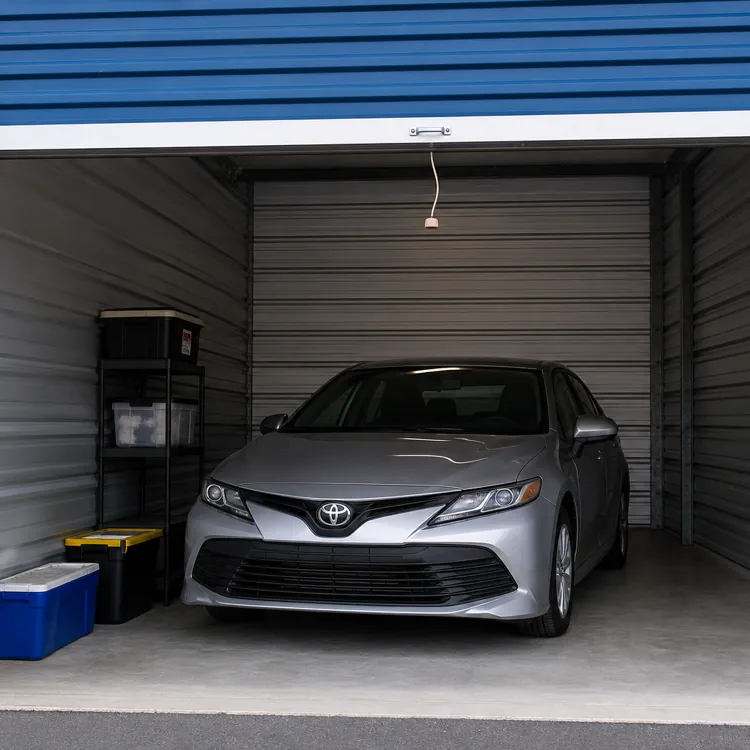
Can you store a car in a storage unit?
Many self-storage facilities offer car storage, but it’s not universal. Whether a location accepts vehicles often comes down to its layout, local fire codes and insurance requirements. Properties not specifically designed for vehicle access may lack the space or safety infrastructure to accommodate them.
When car storage is allowed
“Legally, vehicles must have current registration and insurance while in storage,” said Robby Piper, principal at The Storage Center, a self-storage company headquartered in Baton Rouge, Louisiana. Cars must also be operational and leak-free, according to Dave Collins, general manager at Sparefoot, an online marketplace for booking self-storage units headquartered in Austin, Texas.
You’ll typically need to show the following to secure a car storage:
- Current vehicle registration
- Valid license plates
- Proof of insurance
- Vehicle title or proof of ownership
- Driver’s license or state identification
Vehicles commonly accepted
Each facility sets its own rules on which vehicles it will take. “Standard cars, small SUVs and some trucks are commonly accepted if the space fits,” said David Hurless, director of Stor-It, a self-storage operator with vehicle storage at select locations in the United States. “Facilities may restrict oversized trucks, commercial vehicles, boats on trailers or anything with hazardous materials.”
Common restrictions and prohibitions
Rules around what you can do inside a storage unit are strict across most facilities. Mechanical work, fluid changes and anything involving fumes, leaks or sparks are almost universally off-limits. Fuel policies vary, too. Some operators limit tank levels while others require a full tank. “Check with your storage facility instead of assuming every property handles it the same way,” Hurless advised.
Before renting, get answers to these questions:
- Must the car be operable and leak-free on arrival?
- Are mechanical work and repairs prohibited inside the unit?
- Is there a fuel level requirement?
- Are there any tire condition or inflation standards to meet?
- Are vehicles on blocks permitted?
Storage unit size for a car
To pick the ideal storage unit size, you must account for length, width, door height and aisle clearance.
Measure your car first
Before booking a unit, measure your vehicle bumper-to-bumper and side-to-side with mirrors extended. Include height too, accounting for any roof racks or antennas. “Add extra space around each measurement to enable you to open the door, exit the vehicle and avoid damaging the walls of the unit,” Collins advised.
10x20 vs. 10x25 units
A 10x20 storage unit is the most common starting point. It works for most sedans, crossovers and smaller SUVs and has roughly the footprint of a one-car garage. A 10x25 unit offers more room and better suits pickup trucks, cargo vans and small boats. For large trucks or full-size sport utility vehicles (SUVs), a 10x30 unit is the better fit.
Here’s a breakdown of unit sizes and what they usually accommodate:
| Unit size | Typical fit | Best for |
|---|---|---|
| 5x10 | Motorcycles, all-terrain vehicles (ATVs) | Single small vehicles |
| 10x15 | Compact cars | Tight budget, smaller vehicles |
| 10x20 | Sedans, crossovers, small SUVs | Most standard vehicles |
| 10x25 | Pickup trucks, cargo vans, small boats | Larger vehicles or extra storage |
| 10x30 | Large trucks and SUVs | Oversized vehicles |
Floor dimensions get most of the attention, but door height and aisle clearance can be the deciding factors for whether a vehicle actually fits. Most facilities offer 8-foot doors, though some go up to 10 feet or higher.
“On paper, a unit may look long enough. But if the door opening is too low, that vehicle is simply not going to fit,” said Hurless. Collins pointed out that the drive aisle angle matters, too. A tight turn into the unit can be just as problematic as a low door. When in doubt, both experts recommend sizing up to avoid a difficult move-in.
»MORE: Are storage units worth it?
Car storage types: Indoor vs. outdoor
Vehicle storage comes in three main forms, each offering a different level of protection and cost.
Indoor storage
Indoor drive-up units offer the most comprehensive protection. The vehicle sits behind a locked door, shielded from sun, rain, hail and wind-blown debris.
“For collector vehicles, climate control is crucial because materials and finishes deteriorate more rapidly when subjected to extreme temperature fluctuations,” Collins pointed out. Indoor, climate-controlled storage is the top choice for classic cars, luxury vehicles and anything you want to preserve long-term.
Covered parking
Covered parking shields the vehicle from direct sunlight, rain and hail but doesn’t offer full enclosure. Piper noted that covered units also tend to have easier access since there are no tight turns or roll-up doors to navigate. It’s a practical option for seasonal storage or when full indoor protection isn’t necessary.
Outdoor parking
Outdoor parking is the most affordable option. It works best for short-term needs or larger vehicles like trucks and recreational vehicles, particularly when the priority is extra space rather than long-term protection. For extended storage, the lack of enclosure and basic security may not be sufficient.
Here’s how the three storage types compare:
| Storage type | Weather protection | Security | Cost | Best for |
|---|---|---|---|---|
| Indoor unit | Maximum | Highest | Highest | Classic and luxury vehicles |
| Covered parking | Partial | Moderate | Mid-range | Seasonal storage |
| Outdoor parking | Minimal | Basic | Lowest | Short-term needs |
For collector vehicles, climate control is crucial because materials and finishes deteriorate more rapidly when subjected to extreme temperature fluctuations.”
Prepare your car for storage
How much prep your car needs depends on how long it’s staying. Short-term storage requires basic maintenance, while long-term storage demands a more thorough approach to protect the vehicle’s mechanical systems, interior and finish.
Short-term storage (under three months)
For stays under three months, the prep is straightforward. Give the car a thorough clean inside and out, remove any food or trash to deter pests and top off oil, coolant, brake fluid and washer fluid. “Check for leaks and ensure the battery and fluids are in good condition before closing the door and walking away,” said Collins. The goal is to leave the car in the condition you’d want to find it in.
Long-term storage (three months or more)
“The largest number of problems associated with long-term storage relate to neglect, not mileage,” Collins noted. “These include stale fuel, dead batteries, flat tires, moisture and pest activity.” A little work before move-in prevents a lot of problems on the way out.
Follow these steps before putting your car in long-term storage:
- Wash and dry the exterior to prevent paint damage.
- Vacuum the interior and remove all food and trash.
- Top off or change oil and fluids.
- Fill the gas tank (a full tank leaves less room for moisture to form).
- Add fuel stabilizer, then run the engine for five to 10 minutes so it works through the system.
- Unhook the battery or plug in a battery maintainer to avoid a dead battery on pickup day.
- Fill tires a few PSI above the recommended level — they’ll deflate on their own over time.
- Use a breathable car cover rather than a plastic one, which traps moisture.
- Plug exhaust pipes and air intakes to keep rodents from nesting inside.
- Check your facility’s fuel and maintenance policies before move-in day.
- Leave pest deterrents inside the unit as an added precaution.
- Take photos of the vehicle before storing it to document its condition.
- If possible, plan to start and drive the car for at least half an hour every two weeks to keep fluids circulating and the battery charged.
»FIND OUT: What is climate-controlled storage?
FAQ
How much does it cost to store your car in a storage unit?
Storing a car in a storage unit costs $70 to $300 per month. Indoor units average $150 to $270, while outdoor spots run cheaper. Prices differ by location, unit type and whether there’s climate control.
How long can a car be in storage?
A car can stay in storage for months or even years with the right prep. Short-term stays of three months or less require minimal effort, but anything beyond six months calls for extra steps to protect against stale fuel, dead batteries and flat tires.
Can you work on a car in a storage unit?
No, most facilities don’t allow you to work on a car in a storage unit. They typically prohibit repairs, oil changes and anything involving fumes or sparks due to fire hazards and safety codes.
What size storage unit does a car need?
Most cars fit in a 10x20 unit, which is about the size of a one-car garage. Compact cars may fit in a 10x15, while larger trucks and SUVs typically need a 10x25 unit or 10x30 unit.
Article sources
ConsumerAffairs writers primarily rely on government data, industry experts and original research from other reputable publications to inform their work. Specific sources for this article include:
- A+ Storage, "How to Properly Store Your Car in a Storage Unit." Accessed March 21, 2026.
- Extra Space Storage, "Can You Store a Car in a Storage Unit?" Accessed March 21, 2026.
- Harwich Self Storage, "Why Cars or Motorcycles Are Not Allowed in Self Storage Units." Accessed March 21, 2026.
- Right Move Storage, "How To Prepare Your Car or Boat for Long-Term Storage." Accessed March 21, 2026.
- Storage Post, "How to Store Your Car in a Self-Storage Unit." Accessed March 21, 2026.
- Barclay Self Storage, "Tips and Rules for Car Storage." Accessed March 21, 2026.
- Storage Star, "Car Storage Units." Accessed March 21, 2026.
- Public Storage, "Car Storage Up to 20' FAQ." Accessed March 21, 2026.
- RecNation Storage, "What Can and Can’t You Store in a Self Storage Unit? Complete List and Safety Guidelines." Accessed March 21, 2026.
- Informa Markets, a trading division of Informa PLC, "Legal Considerations of Storing Boats, RVs and Other Vehicles: A Self-Storage Operator's Guide for Avoiding Pitfalls." Accessed March 21, 2026.
- Low Cost Storage, "Vehicle Storage Facts." Accessed March 21, 2026.
- Informa Markets, a trading division of Informa PLC, "Important Risk-Management Considerations for Offering Vehicle Storage at Your Self-Storage Facility." Accessed March 21, 2026.
- Guardian Storage, "How to Store a Car in a Storage Unit." Accessed March 21, 2026.
- Storage Rentals of America, "How to Prepare A Car for Long Term Storage." Accessed March 21, 2026.
- Extra Space Storage, "How to Choose Between a 10x20 vs. 10x25 vs. 10x30 Storage Unit." Accessed March 21, 2026.
- Herrmann's Storage - A Minify Facility, "The Ultimate Guide to Choosing Large Storage Units in Hampshire, IL." Accessed March 21, 2026.
- Storage Star, "What Fits in a 5x10 Storage Unit? Size Guide and Tips." Accessed March 21, 2026.
- Minify Self Storage, "What Size Unit Fits Your Car?" Accessed March 21, 2026.
- Low Cost Storage Options, "Vehicle Storage Size Needed." Accessed March 21, 2026.
- SpareFoot, "How to Pick the Right Size Storage Unit for Your Car." Accessed March 21, 2026.
- Janus International Group, "6 Frequently Asked Questions About Self Storage Roll Up Doors." Accessed March 21, 2026.
- Primos Garage Doors, "Unlock Extra Storage Space With the Right Garage Door Height: Here's How." Accessed March 21, 2026.
- SecureSpace, "Vehicle Storage 101: Indoor vs Outdoor vs Covered." Accessed March 21, 2026.
- The Storage Advantage, "Indoor vs. Outdoor Parking: Which Is Best for Your Vehicle?" Accessed March 21, 2026.
- RecNation Storage, "What is Vehicle Storage? Types, Costs, and Benefits Explained." Accessed March 21, 2026.
- SmartStop Self Storage, "Storing Your Car? Learn How to Choose the Right Storage Unit." Accessed March 21, 2026.
- Storage Post, "The Pros and Cons of Indoor vs. Outdoor Vehicle Storage." Accessed March 21, 2026.
- Outrig Vehicle Storage, "How to Choose a Car Storage Facility (and Why Outrig Makes It Easy)." Accessed March 21, 2026.
- The Storage Mall, "Choosing the Right Type of Storage for Your Car." Accessed March 21, 2026.
- Kelley Blue Book, "How to Store a Car Long-Term: Everything You Need To Know." Accessed March 21, 2026.
- SpareFoot, "How to Store a Car Long Term: 12 Effective Tips for Long Term Car Storage." Accessed March 21, 2026.
- Fort Worth Car Storage, "The 30-Day, 90-Day, and 6-Month Car Storage Checklist." Accessed March 21, 2026.
- SmartStop Self Storage, "How to Prepare Your Car for Storage." Accessed March 21, 2026.
- Low Cost Storage, "Vehicle Storage Preparation." Accessed March 21, 2026.
- Extra Space Storage Inc., "How Often Should You Start A Car in Storage?." Accessed March 21, 2026.
- Extra Space Storage, "Your Guide to Vehicle Storage Rates." Accessed March 21, 2026.
- Derrel's Mini Storage, "Can You Use a Self Storage Unit as a Workshop?" Accessed March 21, 2026.
- StoreEase Self Storage, "Can You Work on a Car in a Storage Unit? What You Should Know." Accessed March 21, 2026.
- Superior Storage, "What Size Storage Unit Do You Need for a Car?" Accessed March 21, 2026.
- SecureSpace Self Storage, "What Size Storage Unit for a Car: 10×20 Guide." Accessed March 21, 2026.