

Assessing the home
A thorough home assessment helps to tailor your plan to the unique features of your residence and the needs of your child. By understanding the specifics of your home and your child's requirements, you can create a customized approach that fosters a safe and nurturing environment.
1. Conduct a thorough inspection
Before you start, take some time to inspect your home and identify potential hazards. Some key areas to focus on:
- Kitchen: The kitchen is a hotspot for potential hazards. Check for reachable sharp objects like knives, scissors and utensils, as well as cleaning supplies, chemicals and medications that should be stored out of your child's reach.
- Bathroom: Keep an eye out for accessible medications, cleaning agents and sharp objects like razors, and ensure that the bathtub and toilet lids have proper locks to prevent drowning.
- Electrical outlets and cords: Inspect all electrical outlets to see if they’re properly covered with safety plugs. Also, secure any cords and wires to avoid tripping hazards.
- Stairs and railings: To prevent falls, it’s essential to check that staircases have sturdy railings and to install safety gates at both the top and bottom of the stairs. Falls are the leading cause of nonfatal injury for children, with children 19 and under accounting for about 8,000 fall-related visits to hospital emergency rooms every day.
- Windows: Install window guards or safety stops to prevent accidental falls from open windows.
- Furniture and appliances: Assess the stability of your furniture and large appliances like bookshelves, televisions and ovens. Anchor them to the wall if necessary to prevent tipping.
2. Identify potential hazards and risks
Create a list of potential hazards you come across in each area of your home as you go. Keep an eye out for the following common hazards:
Choking hazards
Falling hazards
Electrical hazards
Chemicals and poisonous substances
Drowning hazards
If you have a pool, ensure it’s surrounded by a secure fence with a self-closing gate. Always supervise children around water, including bathtubs, and avoid leaving large buckets filled with water unattended.
Strangulation hazards
Burn and scald hazards
Sharp objects
3. Adapt depending on the developmental stage
It's essential to take into account your child’s current (and near-future) developmental stage. Children progress through various stages of physical and cognitive development, each presenting its own unique challenges.
Some age-specific considerations:
- Infants (0 to 12 months): At this stage, focus on eliminating choking hazards, keeping small objects out of reach and ensuring a safe sleep environment.
- Toddlers (1 to 3 years): As children become more mobile, secure furniture and use safety gates to prevent access to stairs and other more dangerous areas.
- Preschoolers (4 to 5 years): Educate young children about safety rules and encourage responsible behavior around potential hazards.
- School-age children (6-plus years): While children this age may be more aware, it's still important to maintain safety measures — and communicate openly — about potential risks.
Safety measures by room
Necessary childproofing steps vary by room type and location — take note of how safety issues differ between the kitchen, the living room and the bathroom, for instance.
Kitchen
The kitchen is a potentially hazardous area for young children due to a plethora of sharp objects, hot surfaces and toxic substances.
Implement these safety measures to childproof your kitchen effectively:
- Secure cabinets and drawers: Install childproof locks on cabinets and drawers that contain knives, sharp utensils, cleaning supplies and other dangerous items. These locks prevent your child from accessing harmful objects and minimize the risk of accidents.
- Use stove knob covers: Stove knob covers help keep children from turning on the stove or changing the settings. This is crucial for avoiding burns or gas leaks caused by accidental activation of the burners.
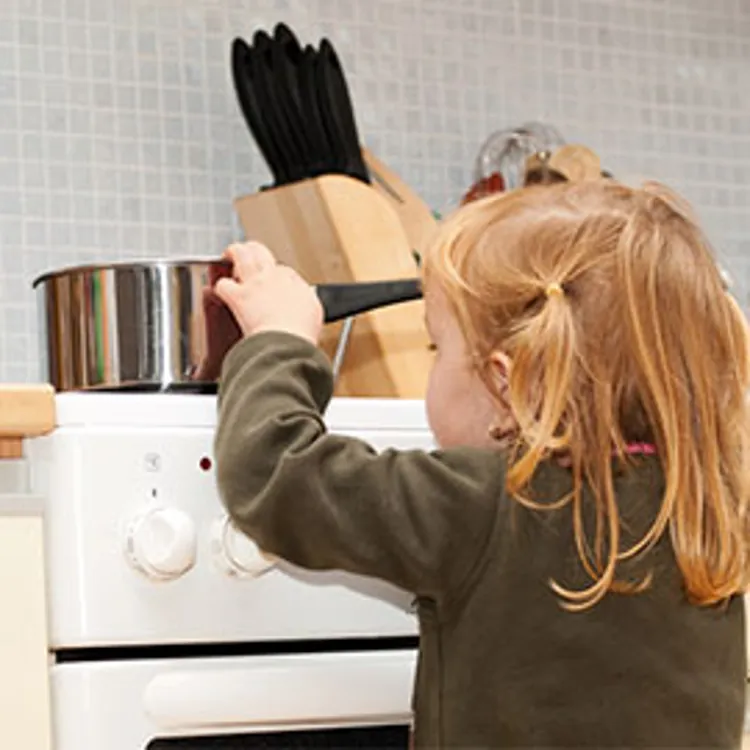
- Ensure appliance safety: Keep small appliances, such as toasters and blenders, unplugged and stored out of reach when not in use. When cooking, use back burners whenever possible and turn pot handles inward to prevent children from grabbing them.
Living room
It’s likely your family spends a significant amount of time in the living room, so it’s smart to make it a safe and comfortable place for both the children and the adults in your home.
Consider the following safety measures for your living room:
- Anchor heavy furniture, like bookshelves and TV stands, to the wall to prevent tip-over accidents. Mount flat-screen TVs securely on the wall or use anti-tip straps to keep them stable.
- Use safety plugs or outlet covers to block access to electrical outlets. These inexpensive yet effective devices prevent the risk of electrocution or injuries from inserting objects into outlets.
- Keep blinds and cords out of reach or use cord shorteners to prevent strangulation hazards. Also, secure cords from electronics and lamps to prevent tripping accidents.
- Use corner guards and edge bumpers to protect children from sharp edges and corners of furniture and countertops.
Bathroom
The bathroom presents several potential dangers, including drowning hazards and access to medications.
To childproof your bathroom:
Set your water heater to no more than 120 degrees Fahrenheit; this will protect your child in the event they turn on your hot water unsupervised.
- Use toilet locks to prevent children from opening toilet lids and falling in.
- Set your water heater to a safe temperature (typically 120 degrees Fahrenheit) to prevent scalding accidents when your child comes into contact with hot water.
- Store all medications, vitamins and toiletries (including shampoo, soap, razors and lotions) in locked cabinets or drawers, out of reach of children. Childproof latches can provide an extra layer of security to keep these items safely stored.
- Keep hair straighteners, curling irons and their cords out of reach and ensure they’re unplugged when not in use (this also saves energy). Storing them in a high cabinet or drawer can prevent accidental access by curious children.
Bedroom
The bedroom should be a safe haven for your child to rest and play. Especially if you have a very young child, protect them by using a baby monitor, securing furniture and practicing crib safety in their room.
- Use baby monitors and safety gates: Baby monitors help you keep an eye on your child while they sleep or play in their bedroom. Install safety gates at the entrance of the room and near stairs to prevent unsupervised access.
- Anchor dressers and bookcases: Secure dressers, bookcases and other tall furniture to the wall using brackets or anti-tip straps to prevent tipping accidents.
- Ensure a safe crib environment: Follow the latest safety guidelines for cribs, including using a firm mattress with a fitted sheet, avoiding soft bedding and toys and ensuring the crib bars are spaced correctly to prevent entrapment.
» COMPARE: Best mattresses for kids
Stairs and hallways
Stairs and hallways are particularly dangerous for those learning to crawl or walk. Consider placing safety gates at the top and bottom of any staircases and at the entrances to hallways to prevent falls and restrict access to potentially hazardous areas.
Also, ensure any banisters and railings are secure and spaced properly to prevent accidental falls or entrapment, and keep stairs free of clutter and tripping hazards — encourage family members to put away their belongings promptly.
General safety precautions
To create a safe environment for your children, implement the following practices and rules of thumb:
Practice window and balcony safety
Install window guards on all windows above the first floor to prevent accidental falls. Ensure the guards are sturdy and have quick-release mechanisms for emergency exits.
If you have a balcony, install childproof locks on the doors leading to it. Make sure the balcony railing is secure and that there are no gaps a child could slip through. Also, keep furniture away from windows and balcony railings to discourage children from climbing and leaning on them.
Get cordless blinds and curtains
Opt for cordless blinds or shades throughout your home, especially in areas accessible to children. Cordless designs eliminate the risk of entanglement. If you have blinds with cords, consider retrofitting them with cord cleats or tension devices. These devices secure the cords out of reach, minimizing the risk of accidents.
If corded blinds are unavoidable, ensure that the cords are as short as possible and secured tightly to prevent them from forming loops.
Install and maintain smoke and carbon monoxide detectors
Install smoke alarms on every level of your home, including inside and outside sleeping areas. Test them regularly and replace batteries at least once a year. Do the same with carbon monoxide detectors, especially if you have fuel-burning appliances.
Also, take the time to create a fire escape plan with your family and practice it together. Ensure everyone knows the fastest route out of the house and designate a meeting point outside.
» MORE: House fire safety tips
Secure cords and cables
Use cord organizers and cable management solutions to bundle and secure cords together. This not only reduces tripping hazards but also keeps devices out of your child's reach.
Use cable ties or cord covers to secure cords from TVs and other electronics so they don't dangle and tempt curious hands. To prevent children from tampering with electrical cords, use outlet covers and cord concealers to hide them from view.
Hide firearms and ammunition
Each day, eight children and teens aged 1 to 17 suffer from unintentional shootings due to incidents caused by improperly stored or misused guns, leading to injury or death. To prevent such tragedies, always store your firearms in a locked container, even if you have no children at home. This helps prevent unauthorized access and keeps the firearms out of the hands of potential intruders or thieves.
Also store your firearms and ammunition separately in different locked containers. This adds an extra layer of security and reduces the risk of accidents. Consider using trigger locks or cable locks to further immobilize your firearms — these devices prevent the gun from being fired, especially when transporting firearms.
FAQ
Is there a specific age at which childproofing is no longer necessary?
Childproofing is an ongoing process, but as children grow and become more responsible, some safety measures can be gradually relaxed. However, it's crucial to maintain general safety precautions and communicate openly about potential risks even as children grow older.
Are there any safety considerations for families with pets when childproofing the home?
Yes, families with pets should be mindful of pet food and water dishes, which should be kept out of reach of children to prevent potential choking hazards. Also ensure that your child’s pet interactions are supervised, especially if the pet is large or excitable.
How can I create a safe outdoor play area for my child?
To create a safe outdoor play area, install a secure fence around the play space to prevent children from wandering off. Use soft surfaces like rubber mulch or sand under play equipment to cushion falls, and avoid placing play equipment near hard surfaces like concrete or asphalt.
Article sources
- Stanford Medicine Children’s Health, “ Accident Statistics .” Accessed July 24, 2023.
- Centers for Disease Control and Prevention, “ Injuries Among Children and Teens .” Accessed July 24, 2023
- Brady, “ Key Statistics .” Accessed July 25, 2023.