


How an Illinois tax payment plan works
Even if you cannot pay your tax bill, the Illinois Department of Revenue (IDOR) urges you to file your back taxes via IL-1040, the state’s individual income tax return.
Pay as much as you can at filing, then make follow-up payments as you are able. Keep in mind that you’re subject to late payment penalties and interest until your total debt is resolved.
You may request a payment installment plan from the IDOR. Similar to IRS payment plans, this monthly payment plan consolidates all of your Illinois back taxes into a single monthly payment over an established period of time.
An Illinois tax payment plan covers several types of tax debt, including individual income tax, corporate income tax, sales tax and excise taxes.
Illinois tax filing and penalties
Illinois residents must file and pay their taxes each April.
In addition to your tax debt, you may also need to pay the following fees if you file your taxes late or incorrectly.
- Late-filing penalty
- Late-payment penalty for unpaid or underpaid taxes
- Bad check penalty
- Collection fee
- Frivolous return penalty for insufficient or incorrect returns
Penalties and interest accrue over time.
Illinois installment agreement eligibility requirements
Taxpayers experiencing financial hardship may qualify for an Illinois tax payment plan if they meet the following terms.
- All tax returns must be filed through the current date. The payment plan will combine all outstanding tax debts.
- The taxpayer must demonstrate the ability to meet monthly payment obligations.
- Business owners must be current on sales tax filings and employment tax payments.
Tax payment plans do not apply to the following situations.
- Non-IDOR taxes, including:
- Property tax
- Estate tax
- Franchise tax
- Insurance tax
- Local taxes
- Motor Fuel Use Tax (MFUT/IFTA)
- Federal tax
- License fees, surcharges or permits
- Tax liabilities limited to penalties and/or interest
- Taxpayers involved in criminal investigation or tax litigation, including bankruptcy proceedings (those undergoing an audit may still qualify)
- Liabilities that are not based on a tax, such as audit penalties or other penalties not related to tax
- Taxpayers with a prior history of not meeting tax obligations
- Taxpayers who previously defaulted on a tax payment plan
- Financial disclosures with missing or incomplete information
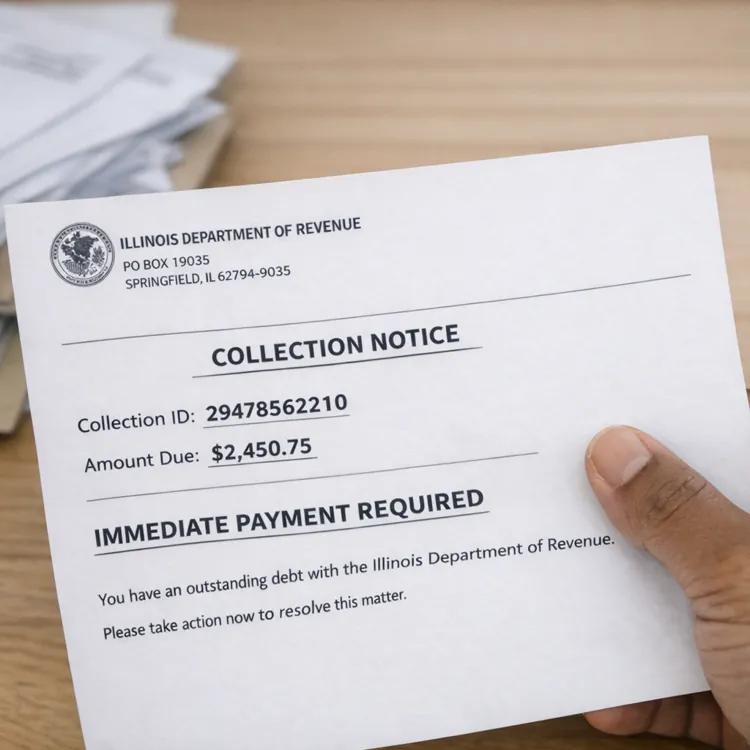
You cannot enroll in a payment plan for tax relief until your account goes to collections. When this happens, the IDOR should send you a collections notice with a Collection ID in the upper right corner. You can then proceed with an official request for a tax payment plan using your unique Collection ID.
Enrolling in a plan will stop further debt collection efforts, including wage garnishments, bank levies and tax liens.
Illinois tax payment plan application steps
If you meet eligibility requirements, you can apply for an Illinois tax payment plan.
You can apply by phone or mail, but for faster approval, you can submit your request online at MyTax Illinois using the following process.
- Log in to MyTax Illinois.
- Select Set up a Payment Installment Plan with IDOR.
- Provide the required information.
- After you submit your request, the IDOR will send a confirmation message.
How to Request an Illinois Tax Payment Plan
| Type of application | Where to apply |
|---|---|
| Online | |
Illinois Department of Revenue | |
| Phone | 1-800-732-8866 |
How to apply
The required forms and other documents you’ll submit when applying for a tax payment plan depend on the amount of debt you have, as well as whether you’re an individual or a business.
| Total tax debt | Required forms | Additional paperwork |
|---|---|---|
| Under $15,000 | Bank statements, recent tax returns, pay stubs and mortgage or rent statements | |
| Over $15,000 | Form CPP-1, Installment Payment Plan Request | Bank statements, recent tax returns, pay stubs, mortgage or rent statements, and detailed financial disclosures |
| $50,000+ | Form CPP-1, Installment Payment Plan Request | Bank records, financial statements and list of assets |
Processing times for requests vary. You may receive a decision within two to four weeks for online applications, while applications by mail can take four to six weeks. Decisions for more complex cases may take up to eight weeks.
Proposed payment plans
An Illinois tax payment plan may take one of several forms.
Installment agreement
An installment agreement is the most common option. This short-term solution typically lasts 12 to 24 months. Plans may extend to 36 months in some cases of extreme financial hardship, but the hardship must be proven.
The exact term and payment amount will depend on your individual financial status, and most plans require a direct debit from your checking or savings account.
If you owe less than $15,000, you may qualify for instant approval for an Illinois tax payment plan.
Payment extension
A payment extension is a solution for temporary financial hardships. In this case, the IDOR may offer a short-term payment extension lasting up to 120 days.
This is best if you expect to pay your total tax liability within a few months.
Business tax payment plan
IDOR also offers payment plans for businesses with outstanding tax debt.
Instead of focusing solely on financial statements, the IDOR will also consider factors such as business type and seasonal cash flow. Business owners may need to provide personal guarantees to enroll.
If you’re unable to meet the terms of the payment plan you receive from the IDOR, you may propose your own terms through your MyTax Illinois account. These terms must include realistic payment amounts that are appropriate for your income. The IDOR will review your offer and notify you if your terms are approved.
Illinois payment plan terms and costs
If you are approved for an Illinois tax payment plan, you’ll need to make monthly payments. These are typically fixed payments that are due on the same day each month, and the first payment is usually due within 30 days of your approval. Many payment plans require you to sign up for automatic withdrawals from your checking or savings account.
Remember that interest will continue to accrue during the payoff period, steadily adding to your debt. The IDOR will set the interest rate when it approves your payment plan.
Defaulting on a payment plan
If you default on your payment plan, the IDOR may terminate your plan for not paying your taxes. You may also deal with the following:
- Penalties. Penalties are suspended with timely payments, though they may apply if you fail to meet the terms of your payment plan.
- Lump sum payment. The IDOR may require you to pay your full balance in one lump sum.
- Collection efforts. You may be subject to additional collection efforts, including bank levies and wage garnishments.
Plan modification
If you’re unable to make your payments, you may be eligible for a plan modification from the IDOR. This could result in a lower payment amount, a payment date change, a temporary pause in payments or an extended payment plan.
To qualify, you must be experiencing a temporary hardship. This could be due to a reduction in income, such as the loss of a job or a reduction in hours, or to increased living costs, such as medical expenses.
If you think you need to make changes to your payment plan due to qualifying circumstances, make your request as soon as possible and submit supporting documentation.
FAQ
Does Illinois allow payment plans for taxes?
Yes, Illinois offers tax payment plans for taxpayers experiencing financial hardship who cannot afford to pay their tax debt in one lump sum.
How long does it take to get approved for an Illinois tax payment plan?
Online applications typically receive a response within two to four weeks, while mail-in applications take four to six weeks. More complicated cases may take up to eight weeks to receive approval.
Can Illinois file a tax lien if I'm on a payment plan?
Illinois will not file a tax lien while you are actively enrolled in a tax payment plan, unless you default on your payments.
What forms do I need to set up an Illinois payment plan?
To request an Illinois tax payment plan, you must file Form CPP-1, Installment Payment Plan Request. If you owe more than $15,000 in tax debt, you must also file Form EG-13-I, Financial and Other Information Statement for Individuals or Form EG-13-B, Financial and Other Information Statement for Businesses.
Article sources
ConsumerAffairs writers primarily rely on government data, industry experts and original research from other reputable publications to inform their work. Specific sources for this article include:
- Illinois Department of Revenue, "General Information." Accessed March 26, 2026.
- Illinois Department of Revenue, "2025 IL-1040 Individual Income Tax Return." Accessed March 26, 2026.
- Illinois Department of Revenue, "Make a Payment - Options for Individuals." Accessed March 26, 2026.
- Illinois Department of Revenue, "Payment Plan Information." Accessed March 26, 2026.
- The Tax School at the University of Illinois Urbana-Champaign, "Illinois Amnesty & Income Tax Law Changes: What You Need to Know." Accessed March 26, 2026.
- Get Tax Relief Now, "Understanding Illinois State Tax Payment Plan Options." Accessed March 26, 2026.
- Illinois Department of Revenue, "Mailing Addresses." Accessed March 26, 2026.